Guides
Dog Cross Stitch Pattern From a Photo: Coat by Coat
Make a custom dog cross stitch pattern from your photo: what smooth, long, curly, wiry, merle, black and white coats each need in colors, size and light.
By Antoine Duno
Updated September 23, 202612 min read
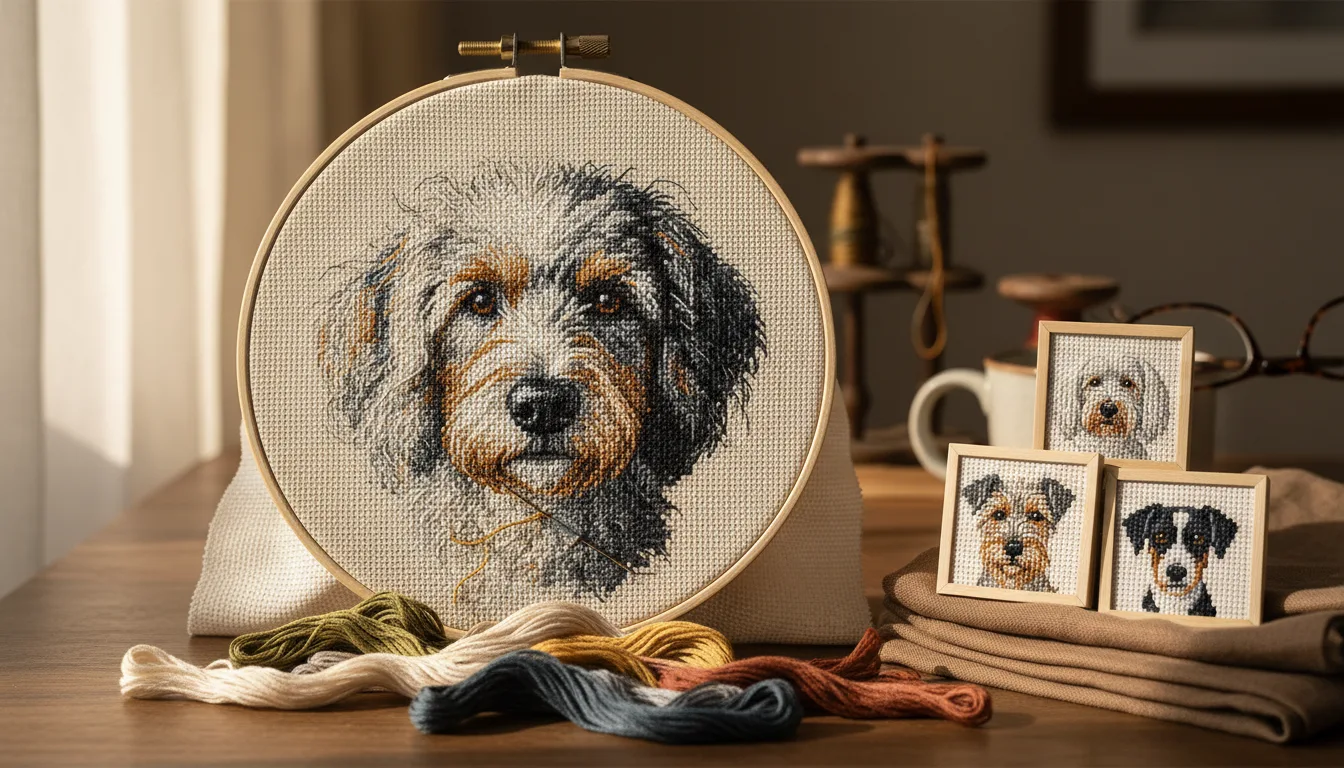
Every dog owner has a hundred photos on their phone, and nearly all of them are wrong for a chart: taken from above, in lamplight, with the dog's head turned away at the key moment. The good news is that a dog is one of the best subjects a photo pattern can have. Fur is texture, and texture is what a grid of stitches does well.
What changes the result most is the coat. A smooth-coated Labrador, a curly Poodle, a wire-haired terrier and a blue merle Collie ask for different things from the photo, the palette and the chart size. This guide goes coat by coat.
Coat by coat: what each one needs
The coat categories below follow how the American Kennel Club describes coat length, texture and pattern in its articles on coat genetics, double coats and merle. The chart advice is about what a stitched grid can and can't show. The color guidance is relative on purpose: the right count depends on your photo, so compare previews rather than trusting a number.
| Coat | Examples the AKC names | What the chart must show | Color budget | Photo priority |
|---|---|---|---|---|
| Short, smooth | Labrador Retriever | Skull and muzzle shape through light and shadow | Lower | Side light, or the head looks flat |
| Long or double | Irish Setter, Newfoundland, Border Collie | Outline against the background, flow of the coat | Higher | Brushed coat, plain contrasting backdrop |
| Curly | Poodle, Curly-Coated Retriever | Clumps of light and shadow, not individual hairs | Medium to higher | Soft light; harsh light turns curls to noise |
| Wire or furnished | Irish Wolfhound, Australian Terrier, Havanese | Eyebrows and beard without hiding the eyes | Medium | Eyes visible under the eyebrows |
| Merle | Australian Shepherd, Collie, Shetland Sheepdog | The dog's own patch layout, blue eyes if present | Higher | Even light so patches aren't confused with shadows |
| Black | Any breed | Shape inside a dark coat | Higher, in dark shades | Side light, brighter exposure |
| White or cream | Any breed | Modeling inside a pale coat | Higher, in pale shades | Avoid blown-out highlights |
Short, smooth coats
A smooth coat is the closest a dog gets to a flat subject. There's little texture to carry the portrait, so the likeness comes from the shape of the head: the brow, the cheek, the length of the muzzle. That shape only exists in the chart if the photo has light and shadow.
Take the photo near a window with the light coming from one side. Flash and overhead light flatten a smooth coat into a single tone, and no palette can put the shape back. With good side light, a smooth single-color coat usually needs fewer shades than any other type, which makes these dogs a good first portrait.
Long and double coats
The AKC describes a double coat as a harsh topcoat of long, coarse hairs over a soft, dense undercoat. In a photo, long and double coats hide the body's outline and flow in directions that the chart needs to follow.
Two things help. First, a background that contrasts with the coat, so the edge of the fur reads clearly: a golden dog against green grass or a gray wall, not against a beige sofa. Second, enough colors to describe the flow. Long coats have highlights along each lock and shadows between them, which is why they need more shades than smooth coats. When you stitch, working in small areas that follow the lie of the fur makes the texture more convincing than long rows straight across.
Curly coats
The AKC explains that one gene decides whether a coat is curly, wavy or straight, and names the Poodle and Curly-Coated Retriever as curly breeds. A chart can't draw individual curls at normal portrait sizes. What it can show is the pattern of light clumps and dark hollows that curls make.
Soft, even daylight is best. Hard sun on a curly coat creates hundreds of tiny bright points that become scattered single stitches. They're not wrong, but they read as noise rather than curls. A freshly groomed coat also photographs more clearly than an overgrown one.
Watch the eyes most closely. On a dark curly dog, the eyes can sink into the coat. Crop tighter if the preview loses them.
Wire coats and furnishings
The AKC uses "furnishings" for long hair on the face, including a long beard and eyebrows, often seen in wire-haired breeds. Furnishings are the likeness of a terrier or a Schnauzer-type face, and they're also the most common reason the eyes disappear.
Before the photo, brush the eyebrows so the eyes are visible, and get the camera slightly below eye level so you're looking up under the brow. In the preview, check that the beard hasn't merged with the chest into one block of color. A wire coat's harsh texture suits cross stitch well; a medium color count usually holds it.
Merle coats
Merle, in the AKC's description, is "irregular blotches of fur set on a lighter background of the same pigment", such as black on gray for blue merle or brown on tan for red merle. The AKC also notes that blue and partially blue eyes are often seen with merle.
That makes merle the coat where the chart has to be most faithful. Every merle dog's patch layout is unique, and the owner knows it by heart. Check the big patches around the eyes and ears against the photo, and check that a blue or partly blue eye stayed blue rather than turning gray. Merle needs more colors than a solid coat, because the chart is describing two color families at once.
Even light matters here. A strong shadow across a merle coat looks like one more patch in the chart.
Black coats
A black dog needs a different approach to the photograph and a key made of several near-blacks instead of one flat black. Stitching a black dog or cat without a silhouette covers both in full.
White and cream coats
The opposite problem: pale fur overexposes easily, and a blown-out white chest arrives in the chart as one flat color with no shape. Fabric color matters too, because white stitches on white Aida disappear. White dog or cat cross stitch goes into both.
Taking the photo
If your dog is with you, take a new photo for the chart. It saves more work than any setting.
- Daylight from a window, from one side. Turn the flash off.
- Get down to eye level. Photographing a dog from standing height gives a big nose and small eyes. Kneel or put the phone on the floor.
- Hold a treat just above the lens so the eyes come up toward the camera.
- Use burst mode and choose the frame with both eyes sharp.
- Fill the frame with the head and shoulders.
- Choose a plain background that contrasts with the coat.
For long-muzzled breeds, a slight three-quarter angle often shows the muzzle's length better than a straight-on shot, where it can foreshorten into a short snout. For flat-faced breeds, straight on usually works well.
The general rules, including what to do when you can't take a new photo, are in cross stitching a pet portrait from a photo.
Choosing the size
Finished size is stitches divided by fabric count; DMC defines count as the number of stitches you can make in an inch. DMC also recommends a clear border of at least 8 cm / 3 inches around the design, which adds 6 inches to each fabric dimension.
| Chart size | Total stitches | Finished on 14-count | Fabric to cut | Suits |
|---|---|---|---|---|
| 80 × 80 | 6,400 | 5.7 × 5.7 in | 11.7 × 11.7 in | A silhouette, a simple smooth-coated head |
| 100 × 125 | 12,500 | 7.1 × 8.9 in | 13.1 × 14.9 in | A head portrait with good light |
| 150 × 150 | 22,500 | 10.7 × 10.7 in | 16.7 × 16.7 in | Head and shoulders, most coat types |
| 150 × 200 | 30,000 | 10.7 × 14.3 in | 16.7 × 20.3 in | Long, curly or merle coats with room for detail |
The size test that matters more than any table: zoom into the preview and count how many stitches wide one eye is. If it's two or three, the eye will be a smudge. Crop tighter or raise the stitch count.
Coats that need more colors often need more stitches too. A merle pattern or a long, flowing coat needs space for its detail, while a smooth coat can often go smaller without losing the likeness. The same chart on 18-count fabric keeps all its detail in a smaller piece, because detail comes from the stitch count.
Eyes, nose and whiskers
Eyes. Look for the catchlight, the small bright reflection that makes the dog look alive. In the chart it may be one pale stitch, and the default Tidy up: Light erases a one-stitch highlight, so set it to Off if the catchlight is missing. Look also for the darker ring around the iris; if it has merged with the pupil into one dark circle, try a larger chart or more colors.
Nose. A dog's nose has a highlight too. A nose charted as one flat dark shape makes the whole portrait look older and duller.
Whiskers and fine lines. On many dogs the whiskers barely show in a photo, and a portrait can look better without them. If you add them, or outline an ear, DMC's backstitch guidance suggests a single strand for fine outlines, added after the cross stitches because backstitch can overlap stitched areas.
The collar. A collar, a tag or a favorite bandana is often what makes the portrait unmistakably theirs. Keep it if it's in the photo.
Setting the color count
Each color in the key costs at least one skein of DMC floss, which comes in 8.7 yard / 8 meter skeins, so extra shades have a cost. The method that works for any coat:
- Generate the same crop at two or three color counts.
- Look at the coat, not the background. Does the lowest count keep the shape of the head and the coat's main highlights?
- Check the markings. A white blaze, tan eyebrows or merle patches shouldn't vanish at the lower count.
- Look for banding in smooth areas, such as a short-coated flank. Visible stripes mean too few colors.
- Choose the lowest count that passes.
How many colors a photo pattern should use explains the trade-off between detail, scattered stitches and skeins in more depth.
Scattered single stitches in the coat are normal for a dog portrait. They are what make fur look soft. Worry about them only in places that should be flat, like the background.
Screen colors are approximate. DMC sells a printed shade card covering its full range of solid floss colors; if two coat shades in your key look almost the same, compare the real threads in daylight before you buy.
Backgrounds
Most dog portraits look best with little or no background. Leaving the background unstitched and choosing a fabric color that suits the coat saves hours and gives the dog a clean edge. A cream fabric behind a red or golden dog, or a pale blue-gray behind a black one, reads as a deliberate choice.
If there's a place that belongs to the dog, like the chair by the window or the end of the bed, keep a hint of it rather than the whole scene.
More than one dog, or another animal
Two dogs in one piece need roughly twice the width to keep the same detail, and the photo matters even more: both dogs in the same light and at a similar distance. Two pets in one cross stitch covers combining them. Horses follow many of the same coat rules at a larger scale; see a horse cross stitch pattern from a photo.
When you have the photo, upload it and look at the preview. Count the stitches across one eye before you change anything else.
Frequently asked questions
Can I turn a photo of my dog into a cross stitch pattern?
Yes. Use a daylight photo taken at your dog's eye level, crop it so the head fills most of the frame, and choose a chart size where each eye is several stitches across. Check the preview for the eyes, the nose highlight and the markings before you buy any floss.
How many colors does a dog cross stitch pattern need?
It depends more on the coat than on the breed's size. A smooth single-color coat needs relatively few shades, while a long, curly, merle or black coat needs more, concentrated in the coat's own color range. Generate two or three color counts and pick the lowest one that keeps the coat's shape.
What size should a dog portrait cross stitch be?
Big enough that each eye is several stitches wide. For a head-and-shoulders portrait, that usually means around 150 stitches on the longer side, which is about 10.7 inches on 14-count Aida. A simple silhouette or a small ornament can be much smaller because it doesn't depend on the eyes.
How do I stitch a merle dog's coat?
Treat the patches as the likeness. The AKC describes merle as irregular blotches on a lighter background of the same pigment, and no two dogs match, so check that the chart kept the big patches in the right places. Merle dogs often have blue or partly blue eyes, which the chart must keep too.
Should I add whiskers to a dog cross stitch?
Only if they help. On many dogs the whiskers barely show in the photo, and a straight backstitch line can look stiff. If you add them, DMC suggests a single strand for fine outlines and adding backstitch after the cross stitches are finished. Try the piece without them first.
Why does my dog look flat in the pattern?
Usually flat light or too few colors. Flash and overhead light remove the shadows that give a muzzle and skull their shape, and a tight palette merges mid-tones. Retake the photo in side light from a window if you can, then compare the preview at a higher color count.
Sources
- American Kennel Club — What genes decide a dog's coat length and type? (length, curl, furnishings, wire coats)
- American Kennel Club — What is a double-coated dog? (topcoat and undercoat)
- American Kennel Club — What makes the merle in dog coats? (patches, blue eyes)
- DMC — What fabric should I use? (count is the number of stitches per inch)
- DMC — How to prepare your fabric (border of at least 8 cm / 3 inches)
- DMC — Use back stitch to accentuate your cross stitch (single strand, add after cross stitches)
- DMC — Cotton Embroidery Floss (Mouliné Spécial): 8.7 yard / 8 meter skeins
- DMC — Embroidery shade card, printed version
Keep stitching
 Guides
Cross Stitching a Pet Portrait From a Photo
Choosing the photo, getting the eyes right, handling fur and backgrounds, sizing the chart, and how long a pet portrait cross stitch really takes.
Read · 13 min Technique
Stitching a Black Dog or Cat Without a Silhouette
Black fur defeats most converters. How to photograph a black pet, and how to build depth with several near-blacks instead of one flat black.
Read · 13 min Technique
How Many Colors Should a Photo Pattern Use?
How many colors for a cross stitch pattern? The trade-off between detail, confetti, skeins and time, with starting points by subject and finished size.
Read · 9 min Guides
Cat Cross Stitch Pattern From Your Own Photo
A custom cat cross stitch pattern from your photo: getting the eyes and pupils right, adding whiskers in backstitch, sizing the chart and picking colors.
Read · 11 min Guides
Cross Stitch Pattern Generators Compared: 2026 Prices
Pic2Pat, Stitchmate, Stitch Fiddle, StitchFromPhoto, Cross Stitched and more, compared on price and on what the PDF contains. Prices as of September 2026.
Read · 14 min Guides
Cross Stitch Gifts From Photos: Ideas and Start Dates
Photo cross stitch gift ideas by occasion, with the arithmetic to work out when to start: chart size, your stitching pace, hours a week and finishing time.
Read · 15 min