Guides
Two Pets in One Cross Stitch: Combining Photos
Two pets in one cross stitch: one photo or a composite, the chart width each face costs, layouts that save stitches, and when two panels work better.
By Antoine Duno
Updated October 27, 202610 min read
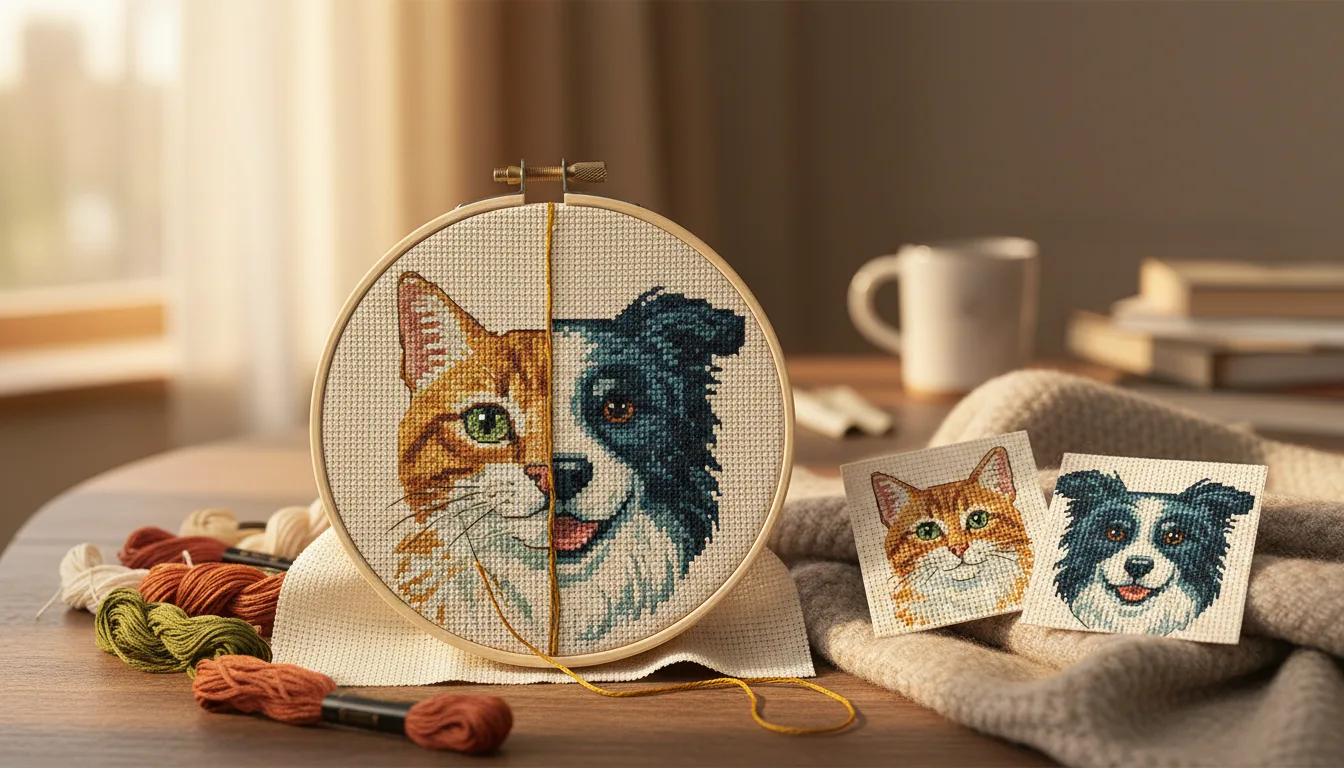
It is one of the most natural requests for a custom piece: both dogs on one piece, or the cat and the dog who tolerate each other. It's a lovely idea, and it's more work than it looks, because a chart doesn't get more detail just because it has more animals in it. Two faces share the stitches that one face would have had.
This guide works through that cost in numbers, compares a single photo of both pets with a composite built from two, and covers the layouts that keep the chart from doubling in size.
What a second pet costs in stitches
The likeness of a pet lives in its eyes, and an eye needs about 5 stitches across to keep a rim, iris, pupil and catchlight, with more room for shading as it grows. How big to make a photo pattern sets out that reasoning. What changes with two pets is how much of the width each eye gets.
Here is the arithmetic, with the assumption stated: in a head-and-shoulders crop of one pet, one eye is about 10% of the crop's width. Put two pets side by side at the same scale and each eye drops to about 5%.
| Stitches across each eye | One pet: chart width | Two pets side by side: chart width | Two-pet width on 14-count |
|---|---|---|---|
| 5 (the minimum) | 50 | 100 | 7.1 in |
| 8 | 80 | 160 | 11.4 in |
| 10 | 100 | 200 | 14.3 in |
| 12 | 120 | 240 | 17.1 in |
Your photos will have their own proportions, so measure: divide the width of the smaller pet's eye by the width of the whole crop, then multiply by the chart width you're considering. Our generator makes charts up to 250 stitches wide, which covers the table above; two long-bodied animals shown in full will run out of width sooner.
It doubles, it doesn't quadruple
Adding a pet beside the first one widens the chart but doesn't have to make it taller. So the stitches roughly double rather than growing with the square of the size:
| Chart | Total stitches if fully stitched | At 300 stitches/hour (arithmetic) |
|---|---|---|
| 100 × 125, one pet | 12,500 | ~42 hours |
| 200 × 125, two pets side by side | 25,000 | ~83 hours |
| 200 × 250, one pet at double size | 50,000 | ~167 hours |
The 300-an-hour figure is only an example. Time yourself over a 10 × 10 block of a detailed area and use your own rate. A bare, unstitched background takes a large share off every row of this table.
The fabric grows with the width too. DMC recommends a clear border of at least 8 cm / 3 inches all round a design you plan to frame, so a 200 × 125 chart on 14-count, about 14.3 × 8.9 inches, needs fabric of at least 20.3 × 14.9 inches. DMC defines the count as the number of stitches you can make in an inch, which is all the size arithmetic here uses.
One photo of both, or two photos combined?
| One photo of both pets | A composite of two photos | |
|---|---|---|
| Light direction | Already the same | Must be matched by choosing photos carefully |
| Color and warmth | Already the same | Often differs; needs correcting |
| Relative size | True to life | You decide, and it can look wrong |
| Sharpness | Often one pet is blurred or turned away | Each pet from its best frame |
| Editing needed | Cropping only | Cut-out, placing, color matching |
| Works when a pet has died | Only if a photo together exists | Yes |
A single photo is the easier route whenever one exists, because the hardest things to fake in a composite, the light and the color, are already consistent. The catch is that two animals rarely sit still and look good at the same moment.
Getting one good photo of both
- Same distance from the camera. A pet a step behind the other has a smaller face, and the smaller face sets the chart width. Line them up side by side, not one behind the other.
- Daylight from the side, no flash, camera at their eye level. Both animals should get the same light.
- Heads close together. The gap between two dogs is width you pay for in stitches and get nothing back.
- Burst mode, and patience. You need one frame where both pairs of eyes are open and sharp.
- A plain background in a tone that contrasts with both coats. A black dog and a white cat on a mid-grey blanket both keep their outlines.
Cross stitching a pet portrait from a photo covers the eye-level and catchlight details that matter for each animal.
Building a composite that stitches well
Our generator works from one photo per chart, so a composite has to be assembled first, in any photo editor that supports layers. Then upload the combined image as one photo.
Check these before you place anything:
- Light from the same side. Look at where the shadows fall on each face. If one pet is lit from the left and the other from the right, the chart will show it plainly.
- Don't fix the light by flipping. Mirroring a photo swaps the light, but it also swaps the markings. An owner knows which ear is the white one.
- Similar camera height. A dog photographed from above next to a cat photographed at eye level looks like two different pictures, because they are.
- Match the color. Put the two cut-outs side by side and adjust warmth and brightness until a white patch on one looks like a white patch on the other. Photos taken in different rooms usually disagree.
- Decide the scale on purpose. Measure something comparable, such as the width of each head, and set their relative size to what looks right for the two animals. A Chihuahua's head the same size as a Labrador's reads as wrong; a small gap in size can be flattering.
- Check the pixels. Each pet's cut-out still needs at least as many pixels across as the stitches it will fill. A small pet cropped out of a distant photo and enlarged will look soft next to a sharp one.
- Clean the edges. A cut-out with a halo of the old background stitches as a thin outline of the wrong color around the fur.
Layouts that save width
Side by side is the obvious layout and the most expensive. Three others use the width better.
Heads together, bodies apart. Two heads leaning in, cheek to cheek, with the shoulders diverging below. The faces share the middle of the chart and the gap disappears.
A slight overlap. One pet's shoulder in front of the other's. Keep both faces fully visible; an overlap that crosses an eye or a muzzle costs more likeness than it saves stitches.
Staggered heights. A big dog sitting, a small dog in front or a cat on a step above. Faces are placed partly in the height of the chart instead of all in its width, as with the two-row layout in family portrait cross stitch. Keep both at a similar distance from the camera so neither face shrinks.
When the animals are very different
Pets of very different sizes and head shapes are the hardest pairs.
- A dog and a cat: a cat's face is compact, a dog's muzzle long. Measure the eye of each; the smaller one sets the width.
- A large and a small dog: in a true-to-life photo the small dog's eyes are much smaller. Bring the small dog closer to the camera, or scale it up a little in a composite.
- A horse and a dog: a horse's head is long and its eye is a small part of it, so a horse needs more width for the same eye detail. Horse cross stitch from a photo covers that problem, and a head-only crop of the horse usually works better in a pair.
Coat colors matter too. A black dog beside a white cat needs a palette that holds both extremes at once, which means more colors than either portrait alone. Generate the pair at two color counts and check that neither coat has gone flat. Dog cross stitch patterns from a photo sets out color counts by coat type.
Two matching panels instead
When the only good photos of each pet were taken years apart, in different light, a composite fights you at every step. Two panels avoid it entirely:
- Each pet gets a whole chart. At 100 stitches wide, a head-and-shoulders crop gives each eye about 10 stitches with the assumption above, the same detail as a 200-stitch composite.
- The stitch total is similar. Two 100 × 125 panels are 25,000 stitches, the same as one 200 × 125 composite.
- No editing. Each panel is just a crop of that pet's best photo.
- You can stitch one at a time, and a finished first panel is a gift in itself if a deadline slips.
To make them look like a set, use the same crop shape, the same chart width, the same fabric and a similar color count, and frame them in matching frames or a double mat.
The cost is a second pattern. We charge per photo, so two panels from two photos are two $5.99 PDFs, or one month of the $7.99 pass if you're making several. A composite uploaded as one image is one PDF.
Checking the preview
Before you pay or buy floss, zoom into each animal separately:
- Count across the smaller pet's eye. Under about 5 stitches, widen the chart, crop tighter or overlap the pets.
- Find both catchlights. Each animal needs its own.
- Compare the coats. Has either coat gone flat or changed color?
- Look at the join. On a composite, is there a halo or a hard edge between the two animals?
- Step back. From across the room, do both look like themselves, and like they belong in the same picture?
When both pass, upload the photo you've settled on and try one width wider and one narrower before you decide.
Frequently asked questions
How wide should a cross stitch of two pets be?
About twice as wide as a single-pet chart if they sit side by side, because each face gets roughly half the width. As arithmetic, if a single head-and-shoulders portrait gives each eye 10 stitches at 100 stitches wide, two pets side by side need about 200 stitches for the same detail: 14.3 inches on 14-count.
Can I combine two separate photos into one pet portrait?
Yes, but you have to build the combined image in a photo editor first, and it only looks natural if the light comes from the same side, the colors match and the heads are at believable sizes. If the photos disagree on those, two matching panels usually look better than a composite.
Is it better to use one photo of both pets?
Usually. In one photo the light, color and scale already agree, which is the hardest part of a composite to fake. The pets should be at a similar distance from the camera, because the smaller face sets the chart size. If they never sit together, a careful composite or two panels is the alternative.
Does a two-pet cross stitch take twice as long?
Roughly, if they sit side by side at the same detail. Doubling the width while keeping the height doubles the stitches: as arithmetic, 100 by 125 is 12,500 stitches and 200 by 125 is 25,000. Leaving the background unstitched or overlapping the pets slightly reduces that.
Should I stitch two pets as separate panels instead?
Often, yes. Two panels of the same size give each pet a full chart width, need no photo editing, and can be stitched one at a time. The stitch total is similar to a side-by-side composite. Each panel comes from its own photo, so it is a separate pattern: two $5.99 PDFs, or the $7.99 monthly pass.
Sources
Keep stitching
 Guides
Cross Stitching a Pet Portrait From a Photo
Choosing the photo, getting the eyes right, handling fur and backgrounds, sizing the chart, and how long a pet portrait cross stitch really takes.
Read · 13 min Guides
Dog Cross Stitch Pattern From a Photo: Coat by Coat
Make a custom dog cross stitch pattern from your photo: what smooth, long, curly, wiry, merle, black and white coats each need in colors, size and light.
Read · 12 min Guides
Family Portrait Cross Stitch From One Photo
Why faces need far more stitches than pets, the chart width where a family's faces stop reading, and the photo, layout and color choices that keep them.
Read · 11 min Guides
Cross Stitch Skin Tones: Charting Faces From Photos
Why faces turn orange, grey, blotchy in photo cross stitch charts, how to fix the photo and palette, and how to check skin shades against real DMC thread.
Read · 12 min Technique
White Dog or Cat Cross Stitch: Keep the Detail
Why white pets come out as flat blobs in photo patterns, how to photograph white fur, which pale DMC shades carry it, and the white-on-white Aida trap.
Read · 13 min Guides
Cat Cross Stitch Pattern From Your Own Photo
A custom cat cross stitch pattern from your photo: getting the eyes and pupils right, adding whiskers in backstitch, sizing the chart and picking colors.
Read · 11 min