Guides
Photo Cross Stitch Pattern Size: Stitches vs Detail
How many stitches wide a photo pattern needs for eyes, faces and lettering to read, with the arithmetic, fabric sizes by count and a check you can run.
By Antoine Duno
Updated September 28, 202611 min read
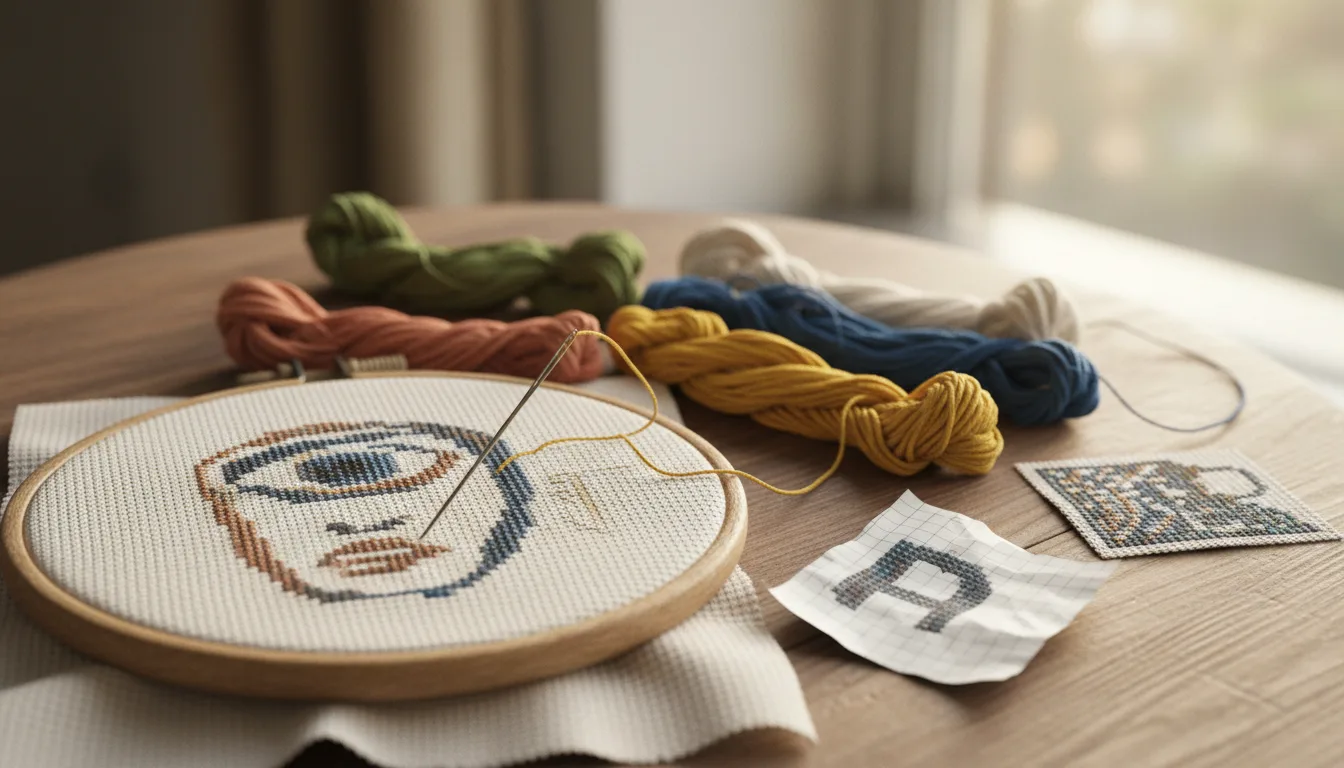
The question most people ask is "how big should my pattern be?" The better question is "how many stitches does the smallest thing I care about get?" A chart can be large on the wall and still turn an eye into a smudge, or small and perfectly recognizable, depending on how the photo is cropped.
This guide gives you the arithmetic to answer that for your own photo, the fabric sizes that follow from it, and the honest limits: what no stitch count can rescue.
Why fabric count doesn't add detail
Each stitch is one flat block of one color. A chart 150 stitches wide has 150 blocks across, whatever it's stitched on. DMC defines count as the number of stitches you can make in an inch, so a finer fabric makes the same 150 blocks smaller. It doesn't make more of them.
That's why the two decisions are separate:
- Stitch count decides how much of the photo survives.
- Fabric count decides how big the result is.
The Cross Stitch Guild puts it plainly: all that determines finished size is the number of stitches and the thread count of the fabric. So decide the stitch count from the detail, then choose the fabric to fit your frame.
The detail check: stitches per feature
You can run this on any photo before making a chart.
- Crop the photo the way you intend to stitch it.
- Measure the crop's width in any unit: pixels in a photo editor, or millimeters with a ruler on a print.
- Measure the feature in the same unit. For a portrait, measure one eye from corner to corner.
- Divide the feature by the crop width. That's its share of the picture.
- Multiply by the chart width you're considering.
As a worked example, not a measurement: a crop is 1,200 pixels wide and one eye is 120 pixels. The eye is 10% of the width. On a 100-stitch chart it gets 10 stitches; on a 60-stitch chart, 6; on a 40-stitch chart, 4.
How many stitches a feature needs
No manufacturer publishes a figure for this, so here is the reasoning rather than a rule someone measured. Count the parts that have to exist as separate stitches:
| Feature | Parts that need their own stitch | Minimum that can hold them |
|---|---|---|
| An eye (pet or person), across | Rim or lid, iris, pupil, catchlight, iris, rim | About 5 to 6 |
| A mouth, top to bottom | Upper lip, the line between the lips, lower lip | About 3 rows |
| A nose, across | Two nostrils with something between them | About 3 |
| A capital letter, top to bottom | Three bars and the two gaps in an E | 5 rows |
| A capital letter, across, with spacing | Two strokes, a gap, a space before the next letter | About 4 columns |
The minimum is exactly that. An eye with 5 stitches has room for a catchlight and a rim; an eye with 10 has room for the iris to shade from dark to light, which is where life comes from. With 2 or 3 stitches, the pupil, iris and rim merge into one dark shape. That's the problem cross stitching a pet portrait from a photo calls the dark blob, and it is one of the quickest ways for a photo pattern to disappoint.
Stitch widths vs recognizable detail
The table below is arithmetic from the check above, with the assumptions stated in the header. Measure your own photo; crops vary a lot.
| Chart width | One face, head and shoulders (eye ≈ 10% of width) | Two faces side by side (eye ≈ 5%) | Four faces in a row (eye ≈ 2.5%) |
|---|---|---|---|
| 60 stitches | 6 per eye | 3 per eye | 1–2 per eye |
| 80 stitches | 8 | 4 | 2 |
| 100 stitches | 10 | 5 | 2–3 |
| 120 stitches | 12 | 6 | 3 |
| 150 stitches | 15 | 7–8 | 3–4 |
| 200 stitches | 20 | 10 | 5 |
| 250 stitches | 25 | 12–13 | 6 |
Three things follow.
A single close crop is cheap. One face filling the frame reads at modest widths, where the total stitch count stays manageable.
Every extra person divides the budget. Four people in a row need four times the width for the same eye size. That's why a group portrait is a big project even when the finished piece is modest; family portrait cross stitch from one photo goes through that problem face by face.
Cropping beats enlarging. Tightening the crop so the face goes from 50% to 80% of the width raises the eye from 10% to 16% of the width at no cost in stitches. Cropping a photo for cross stitch covers how to do that without cutting off what matters.
Pets, houses and text
- Pets follow the same eye arithmetic. Fur is more forgiving than skin, so the rest of the chart can be rougher, but the eyes can't.
- Houses depend on windows. A window needs a frame and a pane, so about 3 stitches across at the least; count your smallest window the same way.
- Text in a photo almost never survives. A street sign or a cake inscription is usually a tiny share of the width. Erase it from the photo and add proper lettering to the chart.
Where the extra stitches come from: time and floss
More stitches buy detail, and you pay for them in hours and skeins. Total stitches grow with the square of the size:
| Chart size | Total stitches if fully stitched | Compared with 100 × 100 |
|---|---|---|
| 80 × 80 | 6,400 | 0.64× |
| 100 × 100 | 10,000 | 1× |
| 120 × 120 | 14,400 | 1.44× |
| 150 × 150 | 22,500 | 2.25× |
| 200 × 200 | 40,000 | 4× |
| 250 × 250 | 62,500 | 6.25× |
To turn stitches into time, measure yourself: stitch one 10 × 10 block (100 stitches) from a mid-detail area and time it. As arithmetic only: at 15 minutes per block, 22,500 stitches is 225 blocks, or about 56 hours. Counting the stitches in a cross stitch pattern explains how to count a chart that isn't fully stitched, which changes the total a lot when the background is left bare.
Floss rises the same way. Every color needs at least one skein; big areas need several. How much embroidery floss you need has the per-skein arithmetic.
Does the photo have enough pixels?
A chart can't hold more detail than the photo does. If the cropped area has fewer pixels across than the chart has stitches, each pixel gets spread over more than one stitch. The chart gets larger, not sharper.
As arithmetic: a face that is 90 pixels wide in the photo, charted so the face spans 150 stitches, gives each pixel about 1.7 stitches. That chart will look soft up close, and no color setting fixes it. The same face at 90 stitches wide uses the photo's full detail without stretching it.
So, as a floor: pixels across the crop ≥ stitches across the chart. Several times more is better, because the pattern maker averages groups of pixels into each stitch and that smooths out noise.
Two common traps:
- Photos sent through chat apps or saved from social media are usually smaller than the original. Find the original file.
- Printed photos can be scanned. The Library of Congress suggests scanning 4 × 6 and 5 × 7 inch prints at 300 dpi, or 400 to 600 dpi if you'll enlarge them. As arithmetic, a 4 × 6 inch print at 300 dpi is 1,200 × 1,800 pixels, so a face 1 inch wide in the print is about 300 pixels: room for a chart where the face spans a couple of hundred stitches.
If the photo is genuinely small, go smaller and simpler rather than bigger. Making a cross stitch pattern from a low-resolution photo covers that case.
From stitches to finished size
Once the stitch count is settled, the fabric decides the size. Zweigart, the German fabric maker, lists its Aida by stitches per centimeter as well as count. From its current range:
| Zweigart fabric | Stated count | Stated per cm | 100 stitches | 150 stitches | 200 stitches |
|---|---|---|---|---|---|
| Perl-Aida (1007) | 11 ct | 4.35/cm | 9.1 in (23 cm) | 13.6 in (34.5 cm) | 18.2 in (46 cm) |
| Stern-Aida (3706) | 14 ct | 5.4/cm | 7.1 in (18.5 cm) | 10.7 in (27.8 cm) | 14.3 in (37 cm) |
| Aida (3251) | 16 ct | 6.4/cm | 6.3 in (15.6 cm) | 9.4 in (23.4 cm) | 12.5 in (31.3 cm) |
| Fein-Aida (3793) | 18 ct | 7.0/cm | 5.6 in (14.3 cm) | 8.3 in (21.4 cm) | 11.1 in (28.6 cm) |
| Aida extra fine (3326) | 20 ct | 8.0/cm | 5.0 in (12.5 cm) | 7.5 in (18.8 cm) | 10.0 in (25 cm) |
| Cashel linen (3281), over two | 28 ct | 11.0/cm | 7.1 in (18.2 cm) | 10.7 in (27.3 cm) | 14.3 in (36.4 cm) |
Inches are stitches ÷ count; centimeters use Zweigart's own per-cm figure. On linen worked over two threads, each stitch uses two threads, which is why 28-count finishes the same size as 14-count Aida.
Then add the margin. DMC recommends a clear border of at least 8 cm / 3 inches all round, and the Cross Stitch Guild suggests allowing 5 inches for pictures. Work out your fabric size before you cut has the full method, and the Aida cloth count guide compares the counts themselves.
Choosing a size, step by step
Put the pieces together in this order, because each step constrains the next.
- Choose the must-read feature. Usually the eyes; on a house, the smallest window; on a sampler, the letters.
- Crop tight around the subject so that feature takes the biggest share of the width you can manage.
- Find the minimum width with the detail check: the width at which that feature gets about 5 stitches (or 5 rows for letters).
- Add room if you want shading inside the feature. Around double the minimum gives an eye room to go from dark to light.
- Check the photo's pixels across the crop against that width.
- Check the total stitches against the time you have, using your own timed block.
- Pick the fabric count that makes the finished size fit your frame, then add the margin.
If step 6 says no, go back to step 2, not step 7. A finer fabric doesn't reduce the stitching.
Checking the preview
Arithmetic gets you close; the preview settles it. Upload the photo, set the width you calculated, and zoom right in:
- Count the stitches across one eye. Does it match the arithmetic? If the crop changed, it won't.
- Look for the catchlight. A single pale stitch in each eye. If it's gone, the eye may be too small or the photo too soft, or the default Tidy up: Light may have erased a one-stitch highlight: try Off.
- Check the mouth. Two lips and a line between them, or one pink smear?
- Step back. Cross stitch is seen from across a room. A face that reads at arm's length on screen usually reads on the wall.
- Try one size up and one size down. If the smaller one looks the same, take it; it's weeks less stitching.
Color count interacts with size, too. A small chart with many close shades turns into speckle, while a big chart can carry them. How many colors a photo pattern should use shows how to compare.
What no stitch count can rescue
Say this before you buy fabric, because it saves a lot of disappointment:
- A blurry face stays blurry. More stitches reproduce the blur more faithfully.
- Eyes in deep shadow have no catchlight to keep. Try a different photo.
- Tiny faces in a crowd can't be cropped up without running out of pixels.
- Printed text in the scene needs to be replaced with stitched lettering.
For the whole process from photo to finished chart, the photo to cross stitch pattern guide is the place to start.
Frequently asked questions
What size should a cross stitch pattern from a photo be?
Size it by the smallest detail you need to recognize, not by the frame. Work out how many stitches that detail gets: chart width times the detail's share of the photo width. If a single eye gets five stitches or more, a portrait usually has room to read; if it gets two or three, crop tighter or go wider.
Does a higher fabric count give a photo pattern more detail?
No. Detail comes from the number of stitches in the chart. A 150-stitch-wide chart holds the same information on 11, 14 or 18-count; the higher count only makes it smaller. To get more detail you need more stitches, a tighter crop, or both, and each of those changes the stitching time.
How many stitches wide should a portrait of one face be?
It depends on the crop. As arithmetic: if the face fills half the photo width and one eye is about a tenth of the width, a 100-stitch chart gives each eye about 10 stitches, which is comfortable. The same face as one of four people in a group photo gets closer to 2 or 3 per eye.
Can text in my photo be turned into cross stitch?
Rarely at its original size. A capital E needs at least five rows, three for its bars and two for the gaps, plus a column between letters. Signs and captions in a photo are usually far smaller than that at stitch scale. Remove the text from the photo and add stitched lettering on purpose instead.
How many pixels does my photo need for a cross stitch pattern?
At least as many pixels across the cropped area as the chart has stitches, and ideally several times more. If a 150-stitch chart is made from a crop only 100 pixels wide, each pixel is stretched over more than one stitch and the chart gets bigger without getting any sharper.
How much bigger does the work get when I increase the stitch count?
It grows with the square of the width. Going from 100 by 100 to 150 by 150 stitches multiplies the width by 1.5 but the total stitches by 2.25, from 10,000 to 22,500. Double the width and you have four times the stitching, four times the floss, and roughly four times the hours.
Sources
- Zweigart — Aida range (article numbers, counts and stitches per cm)
- Zweigart — Linen range (Cashel 3281, 28 ct, 11.0/cm)
- The Cross Stitch Guild — Zweigart fabric facts (28-count over two equals 14-count Aida)
- The Cross Stitch Guild — Cross stitch FAQs (finished size formula, 5 inch margin for pictures)
- DMC — What fabric should I use? (count is the number of stitches per inch)
- DMC — How to prepare your fabric (border of at least 8 cm / 3 inches)
- Library of Congress — Scanning Your Personal Collections (300 dpi; 400 or 600 dpi to enlarge)
Keep stitching
 Guides
How to Turn a Photo Into a Cross Stitch Pattern
Learn how to turn a photo into a cross stitch pattern step by step: pick the photo, choose size and fabric, set colors, and read your DMC thread color key.
Read · 9 min Guides
Work Out Your Fabric Size Before You Cut
How to calculate cross stitch fabric size: the formula, worked examples on 11, 14, 16 and 18 count, and the margins to add before you cut.
Read · 9 min Guides
Using Photos for Cross Stitch: the Copyright Rules
Plain-English general information on cross stitch copyright: your photo versus someone else's, characters and artworks, and what changes if you sell.
Read · 12 min Guides
Best Photos for Custom Cross Stitch Patterns
Choose, crop and light a photo for a custom cross stitch pattern, balance colors and stitch count, and shoot pets and people so the chart reads well.
Read · 9 min Guides
Cat Cross Stitch Pattern From Your Own Photo
A custom cat cross stitch pattern from your photo: getting the eyes and pupils right, adding whiskers in backstitch, sizing the chart and picking colors.
Read · 11 min Guides
Cross Stitch Pattern Generators Compared: 2026 Prices
Pic2Pat, Stitchmate, Stitch Fiddle, StitchFromPhoto, Cross Stitched and more, compared on price and on what the PDF contains. Prices as of September 2026.
Read · 14 min