Technique
Half Stitch Cross Stitch: Soft Shading in Photos
How to work a half cross stitch, why it looks paler and uses less thread, and how to mark sky and background areas on a photo chart for half stitches.

By Antoine Duno
Updated October 30, 202610 min read
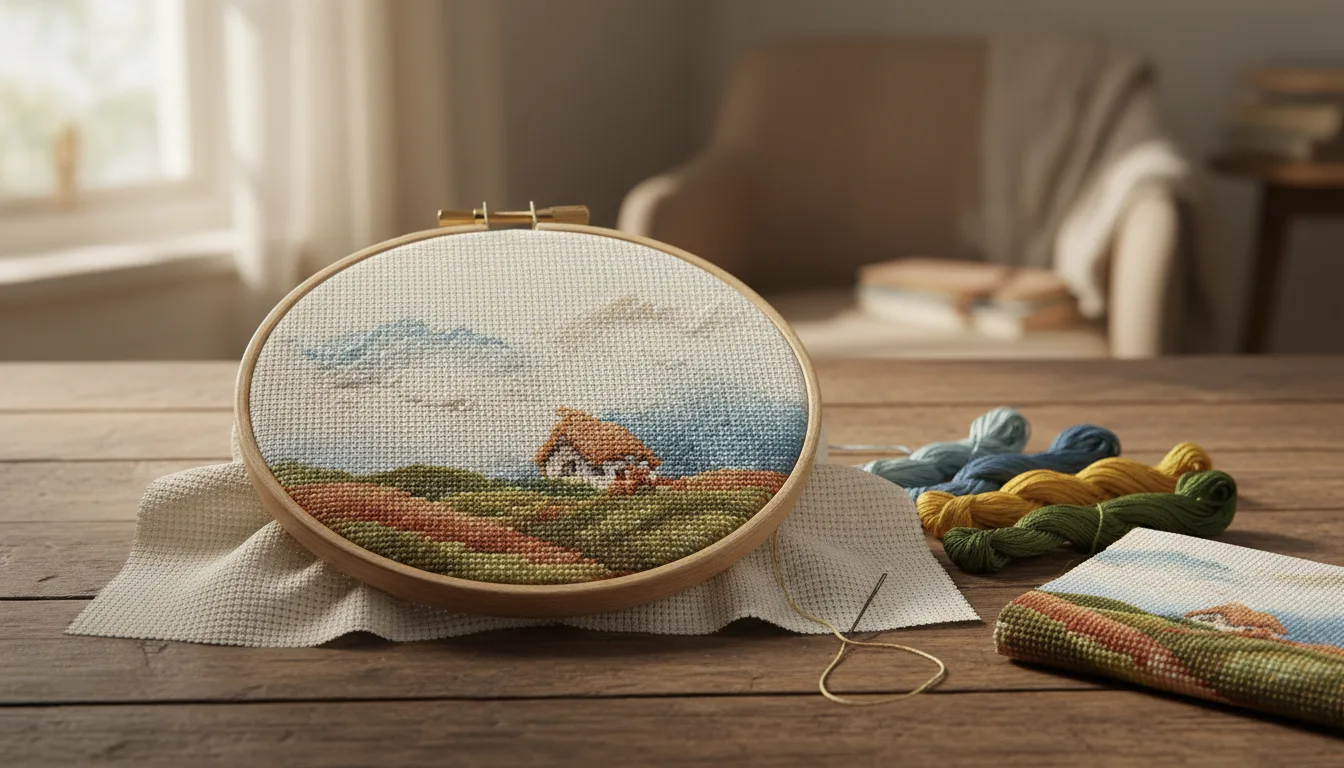
The half stitch is the quietest stitch in cross stitch, and one of the most useful on a photo pattern. Swap a sky or a blurred background from full crosses to half stitches and it drops back behind the subject, the way it does in the photograph, while you save thread and roughly half the needle passes in that area.
It isn't free, though. A half stitch changes the color of the area as well as its texture, and a chart that was designed in full crosses doesn't know you've changed your mind. This guide covers how to work the stitch, what it does to color, and how to plan half-stitched areas on a photo chart that doesn't include them.
Half stitch, full cross, or bare fabric
A photo chart gives every square a full cross. For large quiet areas you have three ways to stitch them, and each changes the piece differently.
| Full cross stitch | Half stitch | Unstitched fabric | |
|---|---|---|---|
| What goes in the square | Two diagonals | One diagonal | Nothing |
| How the color reads | As charted | Lighter; the fabric shows through | The fabric color |
| Texture | Raised, even | Flatter, lighter | Flat weave |
| Thread | As charted | Less, per DMC | None |
| Needle passes on the front, per square | 2 | 1 | 0 |
| Best for | The subject and anything close | Skies, far backgrounds, soft edges | Plain backgrounds, colored Aida |
The half stitch sits in between. It keeps the color of the photo, which bare fabric can't, while pushing it back, which full crosses can't. If you'd rather drop the background altogether, colored Aida for photo patterns covers using the fabric as the color.
How to work a half stitch
DMC's embroidery stitch guide says half cross stitch is worked in horizontal or vertical rows, and that it creates short perpendicular stitches on the back of the work. Those short stitches on the back are why it uses less thread.
- Decide the direction first. Look at a finished cross in your piece and note which way the top stitch leans. Your half stitches lean that way.
- Start at one end of the row. Bring the needle up at one corner of the first square.
- Cross the square diagonally and go down at the opposite corner.
- Travel on the back with a short straight stitch to the start of the next square, and come up there.
- Repeat to the end of the row, keeping the tension even.
- Start the next row the same way, so every diagonal leans in the same direction.
DMC's cross stitch diagrams warn that every diagonal should be worked in a consistent order, so the top stitches of complete and fractional crosses all lean the same way. The Cross Stitch Guild calls matching top stitches the one essential rule for a neat result. A half-stitched sky that leans against the crosses beside it shows a visible seam where the two meet.
Starting and ending threads
The back of a half-stitched area is a row of short straight stitches, which gives a thread tail less to run under than the back of full crosses. DMC's guide to securing thread describes an away knot, placed about 10 cm (4 inches) from where you start, and finishing by weaving under the last few stitches on the back. Where a half-stitched area meets full crosses, start and end threads under the full crosses.
What half stitches do to color
This is the part to test rather than assume. A half stitch lets fabric show between and across the stitches, so the color you see is a mix of thread and fabric.
- On white or cream Aida, a half stitch in a mid tone reads as a paler version of it. A sky charted in three blues becomes lighter overall.
- On colored fabric, the fabric tints the stitch. A half-stitched sky on pale blue Aida can look richer than the same thread on white.
- Pale threads on pale fabric can almost disappear, so check them first.
Run a test patch. On a scrap of the same fabric, stitch a 10 × 10 block of full crosses and a 10 × 10 block of half stitches side by side in the same color and strand count. Look at them from across the room in daylight. If the half-stitched block is too pale, you have two fixes: use the next darker shade already in your key for that area, or stitch the area in full crosses after all.
If you need a color between two shades, tweeding is the other tool: DMC describes combining strands of two colors in the needle. Blending threads in cross stitch covers it, and the two techniques can be combined.
Where half stitches earn their place in a photo pattern
A photograph already has depth: the subject is sharp and close, the background is softer. Full crosses everywhere flatten that out. Half stitches can put some of it back.
Good candidates:
- Skies. Large, smooth, and meant to recede. This is the classic use. Landscape cross stitch from a photo goes into skies, water and trees.
- Out-of-focus backgrounds. The blurred room or garden behind a portrait.
- Distant hills, far water, haze. Anything the photo shows as paler because it's far away.
- A soft halo of one or two shades around a head, instead of a full stitched background.
- Soft reflections in still water.
Poor candidates:
- Faces, eyes and fur. The likeness lives there, and it needs full coverage.
- Dark areas next to the subject. A black cat against a half-stitched dark background loses its outline.
- Small scattered areas. A few half stitches among full crosses look like mistakes, not shading.
- Anything that will be handled. DMC recommends half cross stitch for pieces that don't need to be hard-wearing, such as framed pictures. A cushion or bag is a different matter.
Planning half stitches on a full-cross chart
Our generator's charts are full cross stitches only, one DMC color per square, like most photo charts. Cross stitch stitch types explains why photo converters work that way. So choosing half-stitch areas is your decision, and it's easiest on paper before you start.
- Print the color chart and look at the whole picture. Decide which areas should recede.
- Outline each area with a pencil or highlighter, following the chart's squares, not a smooth curve.
- Stop the outline a few squares short of the subject, so the edge of a face or an animal stays in full crosses.
- Write the rule in the key, for example "outlined area: half stitch, same colors", so you don't forget it three months in.
- Stitch a test patch as described above, and adjust the plan if the area is too pale.
- Work the subject first, then the half-stitched areas, so you judge how far back they should sit against the finished subject.
Pattern Keeper users should note that the app only supports full cross stitches. It will still show your half-stitch areas as full crosses, so keep your paper note.
What a half-stitched area saves, as arithmetic
No reliable figure exists for stitching speed, because it depends on the stitcher. The counting is easy, though.
Take a sky across the top of a chart 150 stitches wide and 50 rows deep:
| Squares | Diagonals on the front | |
|---|---|---|
| Full crosses | 7,500 | 15,000 |
| Half stitches | 7,500 | 7,500 |
Half the diagonals on the front, and DMC's word that the back uses less thread too. What that means in hours depends on your pace and how often the color changes. To find out, time yourself over a 10 × 10 block of each kind in your test patch and multiply up.
The skein count. Our PDF works out skeins from a chart made entirely of full crosses. If you half-stitch an area, the colors in it will use less than the key says, so the count errs on the generous side for those colors. Don't cut back your purchase on a guess; the spare is useful if you later decide an area needs full crosses after all. How much embroidery floss you need shows the underlying arithmetic.
Half stitches inside a square
The same stitch has a second job. In designed charts, a half stitch can be used as a fractional stitch, alongside quarter and three-quarter stitches, to fill part of a square along a curve or diagonal edge. DMC's guide to reading a chart lists half, quarter and three-quarter stitches as less commonly used, and each designer marks them in the key. Fractional stitches in cross stitch covers that use.
Common problems
The area looks patchy. Usually uneven tension or a change of direction partway through. Keep rows running the same way and don't pull tight.
The fabric shows too much. Try the next darker shade from your key in a test patch, or check that you're using the same strand count as the rest of the piece. The Cross Stitch Guild says strand count depends mainly on the fabric count, so how many strands for cross stitch is worth a look before you adjust.
There's a visible line where half stitches meet full crosses. That's the lean. Check that the half stitch matches the top leg of the crosses beside it.
The thread tails show through. Bury them under nearby full-cross areas where you can.
When you're ready, upload a photo with a sky or a soft background, print the color chart, and mark the areas you want to recede before you stitch the first cross.
Frequently asked questions
What is a half stitch in cross stitch?
A half stitch is a single diagonal across one square of fabric, one leg of a full cross without the other. DMC describes it as a stitch that can be used as a fractional in cross stitch or for filling sections of a design. Because it covers less fabric, the area looks paler and flatter.
Which direction should a half stitch go?
The same direction as the top stitches of your full crosses. DMC says every diagonal should be worked in a consistent order so the top stitches all lean the same way, and the Cross Stitch Guild calls that the one essential rule for a neat result. A half stitch leaning the other way changes how the area catches light.
Does half stitch use less thread than full cross stitch?
Yes. DMC's stitch guide says half cross stitch worked in rows creates short stitches on the back of the work, so it uses less thread. It suits pieces that don't need to be hard-wearing, such as framed pictures. How much you save depends on your fabric, strands and the size of the area.
Will a half stitch look lighter than a full cross in the same color?
Yes. One diagonal covers less of the square than two, so more of the fabric shows through and the color reads lighter and softer. On white Aida a mid-blue half stitch looks like a paler blue. Stitch a small test patch of both on a scrap of your fabric before deciding.
Can a photo pattern generator add half stitches?
Ours doesn't: every square in the chart is a full cross stitch in one DMC color. You can still choose areas to work in half stitch yourself, such as a sky or a distant background, by outlining them on your printed chart. The skein counts then err on the generous side for those colors.
Sources
- DMC — Half cross stitch (used as a fractional or for filling sections)
- DMC — Step by step embroidery stitch guide (half cross stitch in rows, short stitches on the back, uses less thread, suits framed pictures)
- DMC — Step by step cross stitch guide (consistent top stitches, Danish method, tweeding)
- DMC — How to read a cross stitch chart (half, quarter and three-quarter stitches less commonly used)
- DMC — How to secure embroidery thread (away knot, weaving under stitches to finish)
- The Cross Stitch Guild — Stitch basics (top stitches in the same direction)
- The Cross Stitch Guild — Cross stitch FAQs (two-journey method, tweeding, strands depend on the fabric)
- Pattern Keeper — FAQ (only full cross stitches supported)
Keep stitching
 Technique
Cross Stitch Stitch Types: Full, Half, Quarter, Back
Every cross stitch stitch type explained: full, half, quarter and three-quarter stitches, backstitch and French knots, and which ones a photo pattern uses.
Read · 13 min Beginners
Cross Stitch for Beginners: Supplies and First Stitches
Cross stitch for beginners: the supplies you need, how to start without knots, how to make neat first stitches, and how to wash and finish your piece.
Read · 10 min Technique
White Dog or Cat Cross Stitch: Keep the Detail
Why white pets come out as flat blobs in photo patterns, how to photograph white fur, which pale DMC shades carry it, and the white-on-white Aida trap.
Read · 13 min Technique
How Many Colors Should a Photo Pattern Use?
How many colors for a cross stitch pattern? The trade-off between detail, confetti, skeins and time, with starting points by subject and finished size.
Read · 9 min Technique
Confetti Stitches: Why They Happen and How to Cut Them
What causes the scattered single stitches in photo cross stitch patterns, how to cut them before you convert, and how to stitch the ones that remain.
Read · 13 min Technique
Stitching a Black Dog or Cat Without a Silhouette
Black fur defeats most converters. How to photograph a black pet, and how to build depth with several near-blacks instead of one flat black.
Read · 13 min