Supplies
Colored Aida for Photo Patterns: Fabric as a Color
On colored Aida the fabric becomes the background of a photo pattern: fewer stitches, fewer skeins. How to pick the color, test show-through and plan it.

By Antoine Duno
Updated October 21, 20269 min read
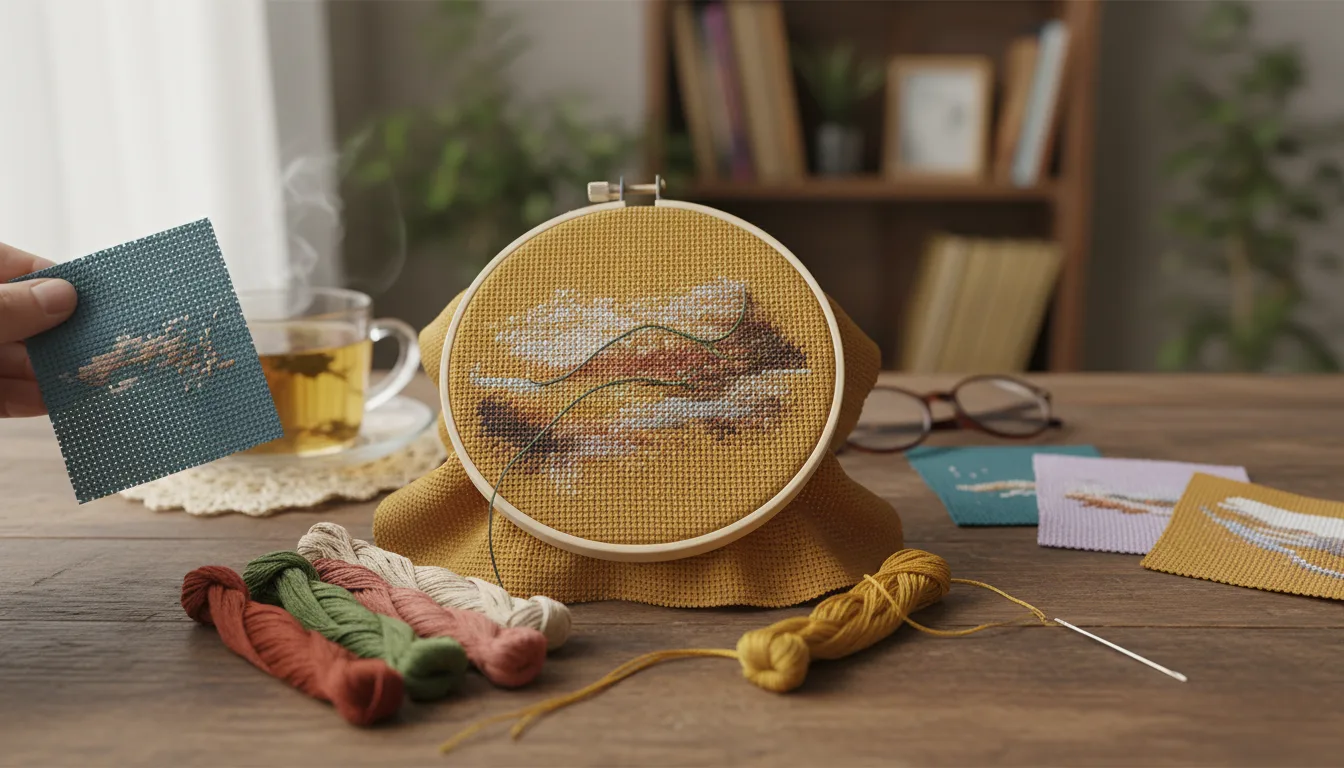
The background of a photo portrait is where the stitches go to hide. A sofa, a wall, a blurry garden: thousands of squares, several colors, weeks of work, and nobody looks at them once the piece is on the wall. Stitch the same portrait on colored Aida and leave the background bare, and the fabric does that job for free.
That's the idea behind this page: treat the fabric as one more color in the palette, the only one that costs no skeins and no hours. It works beautifully when it's planned, and it goes wrong in predictable ways when it isn't: pale stitches tinted by the fabric, an outline that disappears into a similar color, and dark fabric that makes counting slow.
What the fabric can replace, and what it can't
"Fabric as a color" covers two different jobs, and only one of them is easy.
| Job | How it works | Difficulty |
|---|---|---|
| The background | The area around the subject is left unstitched; the fabric is the backdrop | Easy. The chart just has empty squares |
| A color inside the subject | Every square of one pale key color, such as a cream chest, is left unstitched because the fabric is close to it | Harder. You change the chart by hand and test the match |
| A dark or strong color | Not realistically | The fabric would have to match exactly, and it rarely does |
The background is the one worth doing on almost every portrait. The second is a refinement for a cream or white animal on a fabric of nearly the same tone, and it only works when the fabric and the thread really do look alike in daylight.
The arithmetic: what bare fabric saves
The saving is simple to count: every background square left bare is one stitch you don't make. As worked examples, assuming a pace of 300 stitches an hour (use your own):
| Chart | Squares | Background share | Stitches saved | Hours saved at 300/hr |
|---|---|---|---|---|
| 80 × 100 | 8,000 | 30% | 2,400 | 8 |
| 120 × 150 | 18,000 | 40% | 7,200 | 24 |
| 150 × 200 | 30,000 | 50% | 15,000 | 50 |
The saving in floss can be even bigger than the saving in stitches. A photographed background is rarely one color: shadows and light across a wall can take several shades, and every color in a key costs at least one skein, however few squares it covers. When the background goes, the colors that only existed to describe it go with it. How many colors a photo pattern should use explains why backgrounds eat so much of a palette.
There's a visual gain too. A stitched background sits at the same height and texture as the subject; a bare one doesn't. The portrait stands up off the fabric.
Choosing the fabric color
The one rule that matters: the fabric has to contrast with the edge of the subject. The outline of the animal or person is what makes the piece readable from across a room, and the outline is where subject meets fabric.
| Subject | Fabric that tends to work | Fabric to avoid |
|---|---|---|
| Black or very dark pet | Cream, pale gray, pale blue-gray, natural linen tones | Black, navy, charcoal |
| White or cream pet | Mid gray, soft blue, sage, warm tan | White, cream, antique white |
| Golden or ginger pet | Cream, pale blue, soft gray | Tan, beige, gold |
| Gray pet | Cream, warm tan, soft blue | Mid gray |
| Human portrait | Cream or a soft neutral that doesn't compete with skin | Strong colors close to skin or hair |
| Bright, colorful subject | White, cream or pale gray | Strong colors that fight the subject |
Two subjects have their own guides, because they're the ones where fabric choice decides whether the piece works. Stitching a black dog or cat without a silhouette explains why dark animals need a clearly lighter fabric, and a white dog or cat covers the reverse.
Where to find the colors
DMC and Zweigart both sell colored Aida. As of September 2026:
- DMC lists 19 color options for its 100% cotton Aida, including the 14-count it recommends for beginners.
- Zweigart's 3706 Stern-Aida, 100% cotton at 14 count, lists around 30 color numbers, from white (100) and cream (101) upwards.
Color names and numbers on a screen are as approximate as thread colors are. Buy a small piece, or see the fabric in a shop, before you cut a large one.
Testing show-through before you commit
Cross stitch on Aida doesn't cover the fabric completely. The Cross Stitch Guild describes two strands as general practice on 14 and 16-count Aida, and at that coverage some fabric shows between the strands. On white Aida you never notice, because white doesn't shift the thread colors. On a colored fabric it does, and it shows most in:
- Whites and creams, which take on the fabric's tint.
- Pastels and pale skin tones, which can turn grayish or muddy on a cool or dark fabric.
- Large pale areas, where the tint is visible across the whole shape.
Dark colors barely change. So the test is aimed at the pale end of the palette:
- Pick the three or four palest colors from your chart's key.
- Stitch a small block of each in the fabric margin, with the strands you plan to use.
- Look in daylight, as the Guild suggests for checking coverage, and from a little distance.
- Compare with the same threads on white fabric, if you have a scrap.
- Decide: accept the tint, choose a paler fabric, or add a strand for those colors. The Guild notes it's perfectly acceptable to mix strand counts in one project, and how many strands for cross stitch goes through the trade-off.
This twenty-minute test is the difference between a fabric color you chose and one you discovered at week six.
Dark and black Aida
Black and very dark fabrics give a pale subject the strongest possible contrast. They also bring practical costs:
- Counting is slower. The holes are harder to see, especially in the evening under a lamp. Good daylight or a light under the work helps.
- Carried threads show, as above.
- Pale colors shift the most. The show-through test matters more here than on any other fabric.
- Dark subject colors vanish. Any near-black in the chart's key has nothing to contrast with. A photo chart of a pale subject on black fabric works best when the subject's edge is light.
Cross stitch on black Aida covers the technique in detail, including lighting and gridding.
Planning a photo chart for colored fabric
The order matters, because the chart and the fabric are chosen together.
- Choose a photo with a plain background. A wall, a sheet, a studio backdrop. A busy background is hard to remove cleanly from a chart and hard to leave out by hand.
- Crop to the subject. Less background in the crop means more stitches for the face at the same chart size. Cropping a photo for cross stitch shows how.
- Take the background out of the chart. Our generator has a background option that removes the background from the edges inwards and leaves those squares as bare fabric. It works best on plain backgrounds, and on a garden or a busy room it will take too much or too little. Removing the background from a cross stitch photo covers the options and their limits.
- Check the outline in the preview. Look for a ring of stray background-colored stitches around the subject, or bits of the subject removed along with the background. Adjust the setting until the edge is clean.
- Choose the fabric color for contrast with that outline, using the table above.
- Stitch the test patch of the palest colors.
- Decide about interior colors. If one pale key color is almost the fabric color, you can leave its squares unstitched too. Mark that symbol clearly on your printed key so you don't stitch it out of habit, and test the look in the margin first.
Other fabrics that work as a color
Colored Aida isn't the only way to let the ground do the work.
- Evenweave and linen come in natural and colored tones and give a softer look behind a portrait. Cross stitch fabric types compares them with Aida, including how counts differ.
- Clothes and bags can be the background too. A small pet portrait on a sweatshirt or a tote, stitched through waste canvas, uses the garment's color exactly the way colored Aida does. Waste canvas cross stitch explains the method.
Caring for colored fabric
Colored fabric adds one more dye to the piece. DMC says its Aida can be washed at 60°C with mild detergent and pressed with a pressing cloth on low heat; for the finished piece, DMC's washing guidance is gentler, with cold water and a stop if the rinse water becomes colored. If you're using a strong or dark fabric from any maker, wash a scrap first and check the water before you trust it next to white thread.
When you've found a photo with a plain background, try it with the background removed and look at the outline first: that edge decides the fabric color.
Frequently asked questions
Can I stitch a photo cross stitch pattern on colored Aida?
Yes, and for a portrait with a plain background it's often the better choice. Leave the background unstitched and the fabric color becomes the background, which removes those stitches and their skeins entirely. Test a few stitches of your palest thread on the fabric first, because some fabric shows between the strands and tints pale colors.
Does colored fabric change how the thread colors look?
It can, mostly in pale shades. With the usual two strands on 14 or 16-count Aida, some fabric shows between the stitches. On white Aida that's invisible; on a colored or dark fabric it tints whites, creams and pastels. Stitch a small patch of the palest colors in the margin and look at it in daylight.
What color Aida should I use for a pet portrait?
One that contrasts with the edge of the animal, so the outline reads. A black or dark brown pet needs a clearly lighter fabric, such as cream or pale gray. A white or cream pet needs a mid-tone, such as gray, soft blue or sage. Avoid fabric close to the coat color at the outline.
How many stitches does an unstitched background save?
Exactly the number of background squares. As arithmetic, a 120 by 150 chart has 18,000 squares; if the background is 40% of it, leaving it bare saves 7,200 stitches. At a pace of 300 stitches an hour, that's 24 hours of stitching, plus every skein the background colors would have needed.
Is black Aida harder to stitch on?
Usually, yes, because the holes are harder to see, especially under artificial light. Dark fabric also shows threads carried across the back, which DMC already warns can show through fabric. Stitch in good daylight or with a light below the work, and finish threads off rather than carrying them between areas.
Does the preview show my fabric color?
Not in our generator. When you remove the background, the preview shows those squares as bare fabric on a light cream ground, whatever fabric you plan to use. It tells you which squares will be empty, not how the colors will sit on your fabric. Judge that with a fabric swatch and a stitched test patch.
Sources
- DMC — Aida fabric (100% cotton, 19 color options, 14-count for beginners, washable at 60°C)
- Zweigart — 3706 Stern-Aida (100% cotton, 14 count, color numbers)
- DMC — How to begin cross stitch (long threads at the back show through the fabric)
- DMC — How to clean and wash finished needlework
- The Cross Stitch Guild — Thread basics (two strands on 14 and 16-count Aida, checking coverage in daylight, mixing strands)
- The Cross Stitch Guild — Cross stitching on Aida (available in many colors and counts)
Keep stitching
 Supplies
Cross Stitch Fabric Types: Aida, Evenweave, Linen
Aida, evenweave and linen compared for cross stitch: how counts work, which fabric suits a photo pattern, fabric color, what to cut and how each behaves.
Read · 13 min Technique
Stitching a Black Dog or Cat Without a Silhouette
Black fur defeats most converters. How to photograph a black pet, and how to build depth with several near-blacks instead of one flat black.
Read · 13 min Technique
How Many Colors Should a Photo Pattern Use?
How many colors for a cross stitch pattern? The trade-off between detail, confetti, skeins and time, with starting points by subject and finished size.
Read · 9 min Guides
Work Out Your Fabric Size Before You Cut
How to calculate cross stitch fabric size: the formula, worked examples on 11, 14, 16 and 18 count, and the margins to add before you cut.
Read · 9 min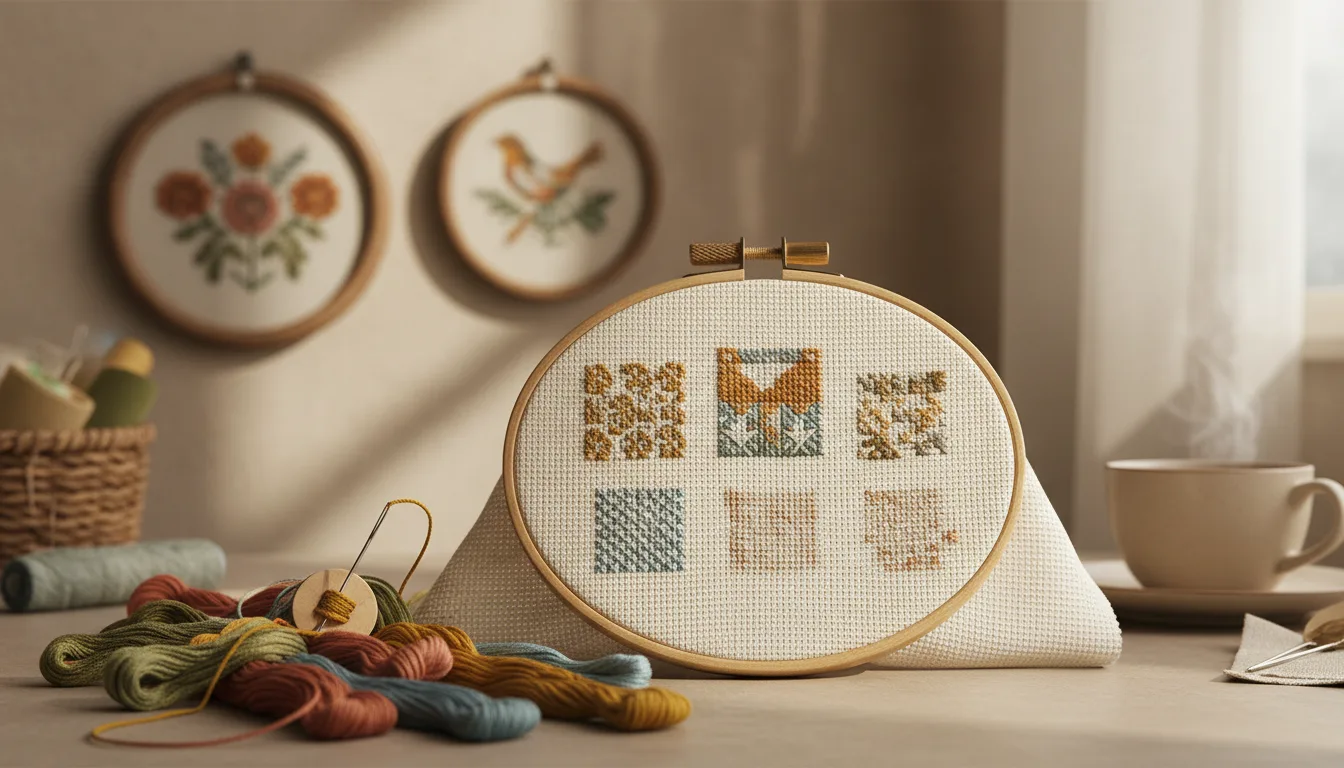 Supplies
Aida Cloth Count Guide: 11, 14, 16, 18 and 28 Over 2
Aida cloth count explained: compare 11, 14, 16, 18 and 28 over 2, calculate finished size in inches and cm, and choose a needle and strands.
Read · 9 min Supplies
DMC to Anchor Conversion: Why Matches Are Approximate
DMC to Anchor charts give the nearest shade, not the same one. What both makers state, where swaps go wrong on photo charts, and how to convert safely.
Read · 12 min