Supplies
Cross Stitch Fabric Types: Aida, Evenweave, Linen
Aida, evenweave and linen compared for cross stitch: how counts work, which fabric suits a photo pattern, fabric color, what to cut and how each behaves.

By Antoine Duno
Updated September 29, 202613 min read
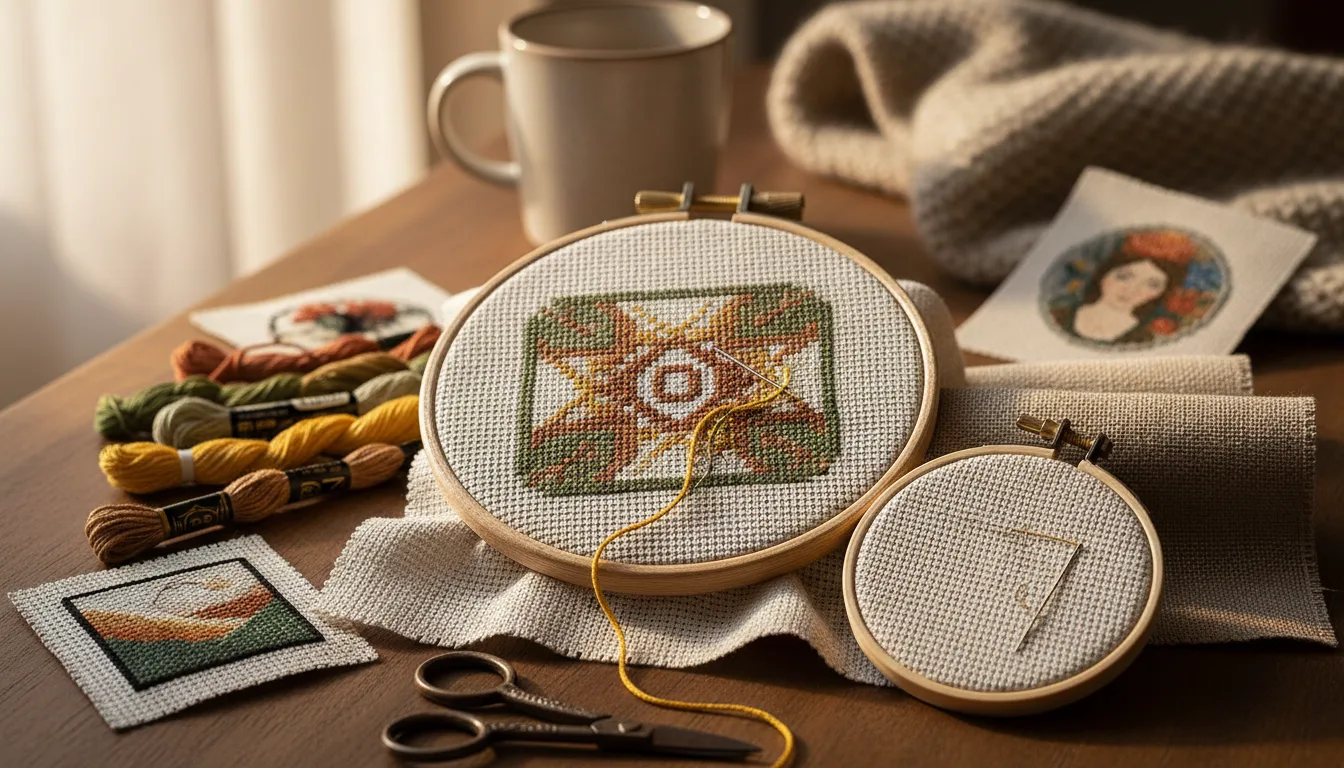
Every cross stitch sits on a grid, and the fabric is that grid. It decides how big your stitches are, how easy they are to count, whether three-quarter stitches are fiddly or simple, and what shows between the stitches. For a photo pattern, where you may be placing tens of thousands of stitches in close shades, that choice matters more than it looks.
This guide covers the three families of cross stitch fabric, how their counts are written, what each one is good at, and which to choose for a chart made from your own photo. The detailed guides for each topic are linked as you go, and the whole set lives on the fabric and sizing hub.
The three families at a glance
| Aida | Evenweave | Linen | |
|---|---|---|---|
| Weave | Threads grouped into blocks | Single threads, same count each way | Single flax threads, slightly irregular |
| One stitch covers | One block | Usually two threads each way | Usually two threads each way |
| Count means | Blocks per inch | Threads per inch | Threads per inch |
| Common counts (Zweigart range) | 11, 14, 16, 18, 20 | 18, 20, 25, 27, 28, 32 | 20, 25, 28, 32, 36, 40 |
| Holes | Large and obvious | Smaller | Smaller, uneven |
| Three-quarter stitches | Harder: you pierce the block | Easy: there's a hole in the middle | Easy |
| Beginner-friendly | Yes | With a little practice | With a little more practice |
| Suits photo patterns | Most of them | Charts with fractional stitches | Charts with bare backgrounds, heirloom pieces |
The counts come from Zweigart's current Aida, evenweave and linen ranges. The weave descriptions follow the Cross Stitch Guild's fabric basics, which divides counted embroidery fabric into two groups: Aida, woven in blocks, and evenweave, woven in single threads. Linen is a natural-fiber member of the evenweave group.
How counts are written, and why it confuses people
"Count" means different things depending on the weave, and manufacturers write it in two units.
- On Aida, count is blocks per inch. DMC defines it as the number of stitches you can make in an inch. 14-count Aida makes 14 stitches per inch.
- On evenweave and linen, count is threads per inch. Because you normally stitch over two threads, you make half as many stitches: 28-count gives 14 stitches per inch. The Guild's evenweave page puts it as 28 threads to 2.5 cm (1 in) = 14 blocks.
- European makers also give a per-centimeter figure. Zweigart lists its 14-count Stern-Aida as "5.4/cm" and its 28-count Cashel linen as "11.0/cm". DMC lists its 14-count Aida as 5.5 points per centimeter.
Those small metric differences are worth knowing if a piece has to fit an existing frame exactly. Fourteen per inch converts to about 5.5 per centimeter, so a manufacturer stating 5.4 is telling you its cloth runs very slightly larger. Measure a stitched test row on your own fabric when the fit is tight.
Equivalent sizes across fabrics
Here is what "the same size" looks like across the families, with the finished width of a 150-stitch chart as an example. Inches are stitches ÷ stitches per inch.
| Fabric | Stitches per inch | 150-stitch chart |
|---|---|---|
| 11-count Aida | 11 | 13.6 in |
| 25-count evenweave, over two | 12.5 | 12.0 in |
| 14-count Aida | 14 | 10.7 in |
| 28-count evenweave or linen, over two | 14 | 10.7 in |
| 16-count Aida | 16 | 9.4 in |
| 32-count evenweave or linen, over two | 16 | 9.4 in |
| 18-count Aida | 18 | 8.3 in |
| 36-count linen, over two | 18 | 8.3 in |
| 20-count Aida | 20 | 7.5 in |
| 40-count linen, over two | 20 | 7.5 in |
| 28-count evenweave, over one | 28 | 5.4 in |
The counts in that table all appear in Zweigart's range: for example Lugana at 25, Brittney at 28 and Murano at 32 in evenweave, and Cashel at 28, Belfast at 32, Edinburgh at 36 and Newcastle at 40 in linen. For finished size, margins and the full formula, work out your fabric size before you cut.
Aida
Aida is the fabric most people start on and many never leave. The Cross Stitch Guild describes it as a cotton fabric woven in blocks that gives obvious holes for the needle, which is why it's ideal for beginners, and notes that one block on the fabric corresponds to one square on the chart. DMC calls it the most popular fabric for cross stitch and recommends 14-count for beginners.
What's available. Zweigart's cotton Aida runs from very coarse cloths for children's work up to 20-count, with 11, 14, 16, 18 and 20 the ones you'll see in patterns. DMC's own Aida is 100% cotton, sold rolled in tubes to avoid creases, in pre-cut pieces of 15 × 18 in and 19.7 × 24 in and in 19 color options at the time of writing.
Variations worth knowing. Zweigart also makes:
- Easy Count Grid Aida in 14, 16, 18 and 20-count, printed with a washable grid every 10 stitches. On a photo chart full of similar shades, that grid does the counting job that tacking lines otherwise do.
- Linen-Aida, 100% linen woven in Aida blocks, in 14, 18 and 20-count. It gives a linen look with Aida's counting.
- Rustico Aida, a cotton, viscose and linen blend with a natural, flecked look, in 14 to 20-count.
Where Aida is weaker. The Guild notes that fractional stitches are more difficult to form on Aida: there's no hole in the middle of a block, so a three-quarter stitch means pushing the needle through the block itself. And on a design with a large bare background, the block texture is very visible, which some people love and others find too "craft kit".
For count-by-count detail, with needles and strands for each, see the Aida cloth count guide.
Evenweave
Evenweave has the same number of threads per inch in both directions, woven singly rather than in blocks. You count threads and, usually, cross two of them each way with every stitch. The Guild's view is that working on evenweave is not difficult, just different.
What's available. Zweigart's evenweaves include 100% cotton fabrics such as Davosa (18-count) and Linda (27-count), and cotton and modal blends such as Bellana (20), Lugana (25), Brittney (28) and Murano (32).
Why stitchers choose it:
- Fractional stitches. Stitching over two leaves a free hole in the middle of every stitch, so quarter and three-quarter stitches sit neatly. Photo charts that use them for smooth curves, such as the edge of a cheek, are much easier on evenweave.
- A smoother look. The holes are smaller, so bare fabric between stitched areas reads as cloth rather than as a grid.
- Two scales from one fabric. The Guild notes you can also work over one thread when very fine detail is required. On 28-count, a section over one packs 28 stitches per inch, which suits tiny lettering inside a larger piece.
What it costs you. Counting takes more attention, a miscounted stitch over two is easy to make and hard to spot, and evenweave is usually dearer than Aida. Stitching over two is covered step by step in cross stitch over two.
Linen
The Guild calls linen a lovely, if slightly more expensive, fabric made from flax that has been used for counted cross stitch for centuries. Flax threads vary in thickness, so the weave isn't perfectly regular. To even that out, cross stitch is worked over two threads in each direction.
What's available. Zweigart's 100% linen range runs from Cork at 20-count through Dublin (25), Cashel (28), Belfast (32), Edinburgh (36), Newcastle (40) and Bristol (46) up to Kingston at 56-count. DMC sells a 100% linen at 28-count (11 points per centimeter) and an undyed rustic linen. Blends such as Zweigart's Floba (viscose and linen) sit between linen and evenweave in look and price.
Why stitchers choose it:
- The background. Unstitched linen looks like a finished textile, which suits samplers, lettering and portraits with a bare background.
- Heirloom pieces. A wedding or birth sampler on linen feels different in the hand from one on Aida.
- Fine counts. Linen goes much finer than Aida, so a small piece can hold a big chart.
The honest trade-off. Irregular threads make counting slower, and the finest counts are hard on the eyes. On a fully stitched photo portrait almost none of the linen shows, so you pay for a texture nobody sees. Linen cross stitch covers the technique in detail.
Other fabrics you'll come across
- Hardanger. The Guild's Zweigart fabric facts note that it can be treated like Aida, because pairs of threads are woven over each other to give a blocked look.
- Fabrics with no grid, such as denim or plain cotton. DMC suggests stitching through its water soluble canvas laid over the fabric, then dissolving it. Keep designs simple; counting through two layers is slow.
- Very low counts, such as Zweigart's 6 and 8-count cloths, make large stitches for children's projects or bold motifs.
Choosing fabric for a photo pattern
A chart made from a photo is different from a designed pattern. It's usually full cross stitches (ours are full cross stitches only, with no fractional stitches), often dozens of close shades, sometimes no backstitch at all, and frequently every square is stitched. That changes what matters.
Detail comes from the chart, not the fabric
A finer fabric doesn't add detail. A 150-stitch chart has 150 stitches across on any cloth; a higher count just makes each one smaller. If the eyes in your preview are only two or three stitches wide, switching from 14-count to 32-count linen won't help. You need a tighter crop or a wider chart, which photo cross stitch pattern size works through with the arithmetic.
What fabric count does change is the finished size, and with it how close people stand to the piece. A 200-stitch portrait on 11-count Aida is over 18 inches wide and meant for a wall; the same chart on 18-count is about 11 inches and fits on a shelf.
Counting many similar shades
A photo chart may have five browns that differ by a shade. Counting accuracy matters more than on a chart with bold blocks of color, because a stitch one square out isn't obvious until the area looks muddy. Aida's visible blocks help, and Easy Count Grid Aida helps more. On evenweave or linen, run tacking lines every 10 threads-over-two before you start.
Full coverage vs a bare background
- Fully stitched charts hide the fabric. Choose for counting comfort, which usually means Aida, and for size.
- Charts with an unstitched background show the fabric. Here linen or evenweave looks softer, and the fabric color becomes part of the design.
Fractional stitches
Some photo charts use three-quarter stitches to smooth curved edges. If yours does, evenweave or linen makes them far easier, as the Guild notes. If the chart is all full stitches, Aida loses nothing.
Fabric color
A white or cream ground is the safe default for a fully stitched photo chart, because any fabric that peeks through the gaps between strands tints every color. For a bare background, color is a free design decision: a warm cream behind a golden dog, a soft grey behind a black cat. Both DMC and Zweigart sell Aida in many colors. Colored Aida for cross stitch covers which shades work behind which subjects, and why you should always stitch a test patch first.
Strands and coverage
Fabric and floss go together. The Guild says cross stitch is generally worked with two strands on 14 and 16-count Aida, and on evenweave the strands in the needle should be a similar weight to a thread pulled from the fabric's edge. If you're unsure, its FAQ suggests working a few stitches in the margin and choosing the coverage you like. The thread itself, how strands work and what the DMC numbers on a photo chart mean, is covered in the DMC floss guide.
Which fabric, by situation
| Your project | A sensible first choice | Why |
|---|---|---|
| First photo pattern | 14-count Aida, white | Easy counting; DMC's beginner recommendation |
| Detailed portrait, fully stitched | 14 or 16-count Aida | Counting comfort; the fabric won't show |
| Big chart that must fit a smaller frame | 18 or 20-count Aida | Same chart, smaller piece |
| Pet portrait with bare background | Colored Aida or evenweave | The fabric is the background |
| Chart with many three-quarter stitches | 28-count evenweave over two | A hole in the middle of every stitch |
| Wedding or birth sampler with lettering | 28 or 32-count linen over two | Heirloom look; fine lettering |
| Stitcher who finds small holes tiring | 11-count Aida | Bigger stitches; the piece gets bigger too |
How much to cut
Finished size first, then the margin. The formula is the Guild's: divide the stitches by the stitches per inch. DMC recommends a clear border of at least 8 cm / 3 inches all the way round, so add 6 inches to each dimension; the Guild suggests allowing more for pictures that will be framed.
As arithmetic with DMC's pre-cut Aida: a 15 × 18 inch piece of 14-count, minus 3 inches on every side, leaves a 9 × 12 inch stitching area. That holds a chart up to 126 × 168 stitches. The 19.7 × 24 inch piece leaves 13.7 × 18 inches, room for up to about 191 × 252 stitches.
A few habits save fabric:
- Cut straight along a thread or a row of blocks, not by eye.
- Stop the edges fraying. DMC suggests hemming them or covering them with masking tape.
- Check your frame before you cut. If you already own the frame, fit the chart to it rather than the other way round.
Caring for each fabric
Follow the maker's care label for the fabric and DMC's guidance for washing finished needlework: cold water, a little non-biological detergent, rinsing until the water runs clear, and stopping if the water becomes colored. DMC's Aida product page lists the fabric itself as washable at 60°C, but once it's stitched, the finished-work guidance is the one to follow. Press face down between towels with a warm, not hot, iron so the stitches aren't flattened.
Linen creases more readily than cotton Aida and relaxes with a gentle press. Store any fabric rolled rather than folded, as DMC ships its Aida, so a crease doesn't become a permanent line through your design.
Starting points by fabric
Whatever you choose, the start is the same. DMC recommends beginning in the middle of the design and the middle of the fabric, so the chart lands where you planned and the margin stays even. On evenweave and linen, check your first few stitches cross exactly two threads each way before you carry on; an error there repeats across the whole row.
If you're torn, buy a small piece of two fabrics and stitch the same 10 × 10 patch from your chart on each. Ten minutes of stitching answers the question better than any table. Then make the chart from your photo at the size that fabric gives you.
Frequently asked questions
What are the main types of cross stitch fabric?
There are two main groups: Aida, woven in blocks so each stitch covers one block, and evenweave, woven with single threads where each stitch usually covers two threads each way. Linen is a natural evenweave made from flax, with slightly irregular threads. Specialty fabrics such as Hardanger and blends sit between them.
Is Aida or evenweave better for cross stitch?
Aida is easier, because the holes are obvious and one block is one stitch; DMC recommends 14-count Aida for beginners. Evenweave is better when a chart has many three-quarter stitches, or when you want a softer background. Both give the same finished size at equivalent counts, such as 14-count Aida and 28-count over two.
What fabric is best for a cross stitch pattern made from a photo?
For most photo patterns, 14, 16 or 18-count Aida. Photo charts are mostly full cross stitches in many close shades, and Aida's clear grid makes counting them easier. Choose evenweave or linen if the chart uses fractional stitches, or if large areas are left unstitched and you want the fabric texture to show.
Is 28-count evenweave the same as 14-count Aida?
In finished size, yes, when you stitch over two threads. The Cross Stitch Guild explains that 28 threads to the inch worked over two give 14 stitches to the inch, the same as 14-count Aida. The look differs: evenweave has smaller holes and a smoother surface between stitches.
Does fabric count change the detail in a photo pattern?
No. Detail comes from the number of stitches in the chart; the fabric count only changes how big each stitch is. A 150-stitch-wide chart holds the same detail on 11-count Aida as on 36-count linen over two. Finer fabric makes the piece smaller, not sharper.
What color fabric should I use for a photo cross stitch?
White or cream for charts that are fully stitched, because a colored fabric can show through the gaps and tint every thread. For charts with an unstitched background, the fabric color is part of the design, so pick one that flatters the subject. Test a few stitches in the margin first.
Can I cross stitch on fabric that isn't Aida or evenweave?
Yes, with a temporary grid. DMC suggests its water soluble canvas for smoother fabrics such as denim or plain cotton: you stitch through the canvas and the fabric together, then dissolve the canvas. Counting is harder, so keep designs simple and the stitch count modest.
Sources
- Zweigart — Aida range (counts, stitches per cm, Easy Count Grid, Linen-Aida, Rustico)
- Zweigart — Evenweave (Zählstoffe) range (Davosa, Linda, Bellana, Lugana, Brittney, Murano)
- Zweigart — Linen range (Cork to Kingston, 20 to 56-count)
- The Cross Stitch Guild — Fabric basics for cross stitching (Aida, evenweave, linen over two)
- The Cross Stitch Guild — Cross stitching on evenweave (28 threads = 14 blocks; over one for fine detail)
- The Cross Stitch Guild — Cross stitching on Aida (fractional stitches more difficult)
- The Cross Stitch Guild — Zweigart fabric facts (Hardanger, evenweave names)
- The Cross Stitch Guild — Thread basics (two strands on 14 and 16-count Aida)
- The Cross Stitch Guild — Cross stitch FAQs (finished size formula, margins, testing strands)
- DMC — What fabric should I use? (count, Aida, evenweave, water soluble canvas, 14-count for beginners)
- DMC — Aida embroidery fabric (100% cotton, pre-cut sizes, color options, care)
- DMC — Fabrics (28-count linen at 11 points per cm, rustic linen, evenweave)
- DMC — How to prepare your fabric (border of at least 8 cm / 3 inches, hemming or taping edges)
- DMC — How to begin cross stitch (start in the middle of the design and fabric)
- DMC — How to clean and wash finished needlework
Keep stitching
 Supplies
Aida Cloth Count Guide: 11, 14, 16, 18 and 28 Over 2
Aida cloth count explained: compare 11, 14, 16, 18 and 28 over 2, calculate finished size in inches and cm, and choose a needle and strands.
Read · 9 min Guides
Work Out Your Fabric Size Before You Cut
How to calculate cross stitch fabric size: the formula, worked examples on 11, 14, 16 and 18 count, and the margins to add before you cut.
Read · 9 min Supplies
How Much Embroidery Floss Do I Need for Cross Stitch?
How much floss for cross stitch: skein length, the thread-per-stitch budget our generator uses, tables by fabric count and worked skein examples.
Read · 8 min Guides
Photo Cross Stitch Pattern Size: Stitches vs Detail
How many stitches wide a photo pattern needs for eyes, faces and lettering to read, with the arithmetic, fabric sizes by count and a check you can run.
Read · 11 min Guides
Cat Cross Stitch Pattern From Your Own Photo
A custom cat cross stitch pattern from your photo: getting the eyes and pupils right, adding whiskers in backstitch, sizing the chart and picking colors.
Read · 11 min Guides
Cross Stitch Pattern Generators Compared: 2026 Prices
Pic2Pat, Stitchmate, Stitch Fiddle, StitchFromPhoto, Cross Stitched and more, compared on price and on what the PDF contains. Prices as of September 2026.
Read · 14 min