Supplies
DMC Floss Guide: Numbers, Strands, Skeins, Colors
DMC embroidery floss explained: what the numbers mean, skein length, strands per fabric, how many shades exist, specialty threads and buying for a chart.
By Antoine Duno
Updated September 30, 202613 min read
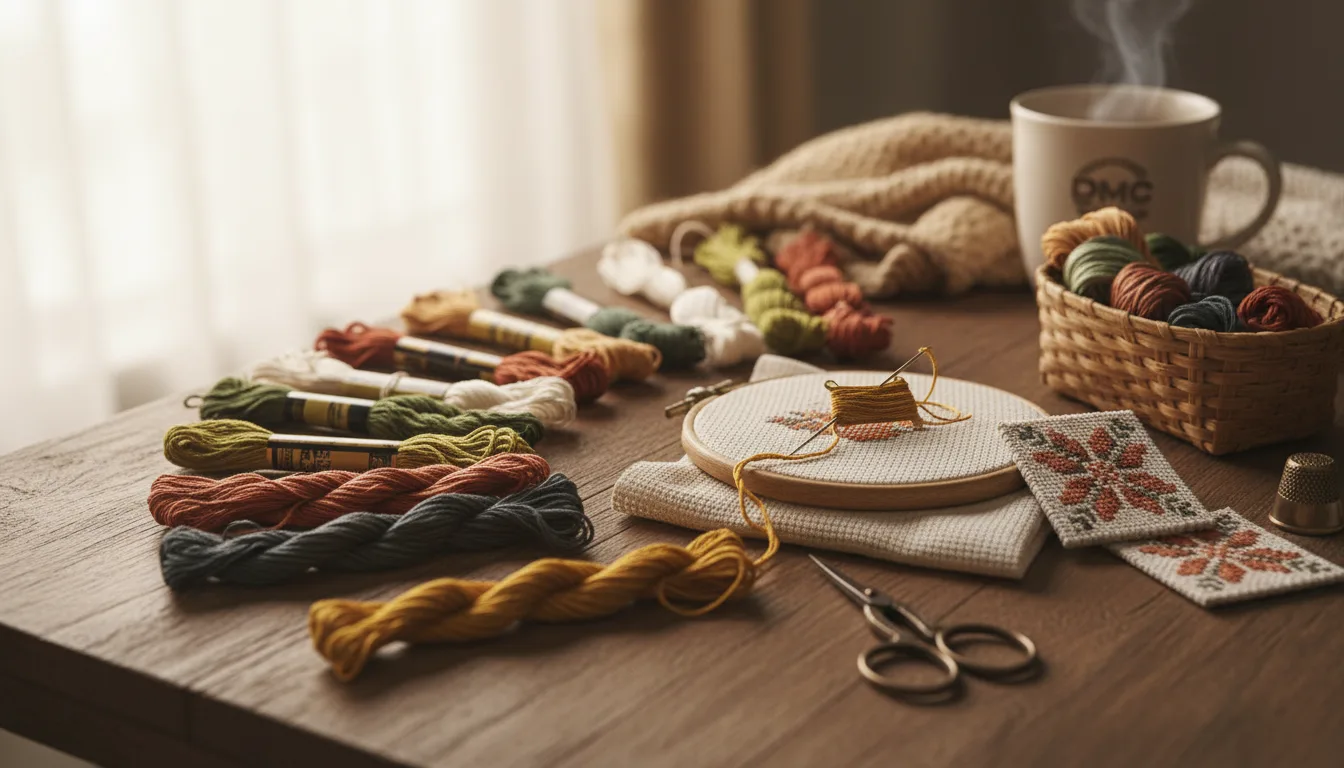
Open almost any cross stitch chart and the color key speaks DMC: 310, 3865, Blanc, B5200. DMC describes its six-strand floss as the standard color reference in embroidery patterns, and in practice that means a number on a chart tells every stitcher in the world which thread to buy.
A chart made from your own photo works the same way. Every symbol in the key is matched to a DMC number, and the skein counts are worked out in DMC skeins. This guide explains what that thread is, how the numbers work, how many strands to use on which fabric, what the specialty threads are for, and the honest limits: why the thread never quite matches the screen, and why conversions to other brands are always approximate.
What DMC floss is
DMC was founded in Mulhouse, France, in 1746, and created its stranded embroidery thread, Mouliné Spécial, in 1898. According to DMC's About page, all its thread is still made in the same Mulhouse factory.
DMC's US site calls it Six-Strand Embroidery Floss; the product is Mouliné Spécial, article reference 117, and European sites often call it stranded cotton. DMC's product page gives the specification:
| Property | What DMC states |
|---|---|
| Fiber | 100% cotton, long staple, mercerized twice for sheen |
| Skein length | 8.7 yards / 8 meters |
| Strands | Six, which separate easily |
| Colors | 500 shades (504 options listed on the page) |
| Dyes | Colorfast, "highly fade resistant" |
| Certification | Oeko-Tex Standard 100 |
DMC says it mercerizes the cotton twice to give embroidery its sheen, which is the soft shine you see on a finished piece.
How many colors, really?
DMC's own pages don't agree, and it's better to know that than to wonder why a website says 489 and another says 500. As of September 2026:
- The product page says 500 shades and lists 504 color options.
- The About page says over 500 colors.
- The US printed color card covers 489 colors of Six-Strand Embroidery Floss, listed separately from 18 variegated colors.
- The thread swatch card describes 485 solid and 18 variegated six-strand colors.
The totals depend on what's counted (whites, variegated shades, which edition of a card). For charting a photo, "about 500 solid shades" is the useful number: enough to match almost any color closely, never enough to match every color exactly. Our DMC color chart lists the 454 solid shades our generator matches to, searchable by number or name. To see which shades come up most often, read the DMC colors our free patterns use most.
How DMC color numbers work
A DMC number names one color, and that's all it does. Look at the colors in a single DMC assortment and you'll see why a number can't tell you what a color looks like. DMC's Top 50 Floss Colors pack, for example, lists:
- Low numbers such as 01 to 09 and 29
- Three-digit numbers such as 310, 317, 321 and 815
- Four-digit numbers such as 3021, 3371, 3799 and 3865
- Names instead of numbers: B5200, BLANC and ECRU
Three habits follow from that:
- Never guess a shade from its number. The number doesn't describe the color, so look at the thread or the card. DMC's printed card groups colors by family so you can see light, mid and dark tones together, and adds a numerical locator for exactly this reason.
- Copy numbers exactly. A dropped or added digit points to a different thread, or to none. Write numbers on your floss cards from the chart key, not from memory.
- Watch the whites. DMC sells three: Blanc, B5200 and Ecru are listed as separate colors, and DMC's Top 50 pack includes all three. They are different shades, so when a photo chart asks for one of them, don't substitute another; compare them on a thread card if you want to see the difference.
Skeins: how far one goes
The skein is 8 meters of six strands. You rarely stitch with all six, so a skein goes further than it looks: with two strands, you get three 8-meter lengths of working thread.
How many stitches that makes depends on fabric count, strands and your own habits, and DMC publishes no figure. Our generator budgets 0.55 inch of one strand per cross on 14-count, which gives about 1,708 stitches per skein on 14-count with two strands. That is our planning assumption, not a DMC specification; how much embroidery floss you need sets out the method step by step. As a worked example with that figure (the stitch counts are invented for the arithmetic):
| A color in your chart | Stitches | Skeins (stitches ÷ 1,708, rounded up) |
|---|---|---|
| A catchlight white | 40 | 1 |
| A mid-brown in a dog's coat | 2,450 | 2 |
| A cream background, fully stitched | 9,800 | 6 |
Two rules matter more than the arithmetic:
- Every color needs at least one skein, even if it's used for twelve stitches. On a photo chart with 40 colors, the minimum is 40 skeins, which is why the color count drives the floss bill more than the size does. How many colors a photo pattern should use shows how to weigh that.
- Big colors deserve a spare. Running out of the dominant shade halfway through is the classic way a project stalls.
Working lengths and separating strands
DMC's guidance on using stranded thread is short and worth following:
- Find the end under the larger label and pull slowly, so the skein doesn't knot.
- Cut a working length of about fingertip to elbow, and no more than 50 cm (18 inches); longer lengths wear and fray as they're pulled through the fabric.
- Separate one strand at a time: tap the cut end to loosen the strands, then pull one straight up.
- Recombine the number of strands you need. The Cross Stitch Guild notes that when you use two or more strands, you separate and then realign them before threading, which lets them lie flat.
Cutting the end at a 45-degree angle with sharp scissors, as DMC suggests, makes threading easier.
Strands: how many for which fabric
There isn't a single right answer, and the best sources say so. The Cross Stitch Guild states that cross stitch is generally worked with two strands on 14-count and 16-count Aida. For evenweave, it gives a test rather than a number: pull a thread from the edge of the fabric and match the weight of the strands in your needle to it.
When you're unsure, the Guild's FAQ suggests working a few stitches in the fabric margin and deciding which coverage you prefer. A few general tendencies:
- Lower counts make bigger stitches that usually need more strands to cover.
- Higher counts make smaller stitches, where extra strands can crowd the holes.
- Backstitch is usually finer. DMC suggests a single strand for fine outlines, and multiple strands for a bolder line.
- Mixing is allowed. The Guild says it's perfectly acceptable to use different numbers of strands within one project.
Strand count changes coverage, and coverage changes how the colors look: fewer strands let more fabric show through, which lightens every shade. That's one reason to test on your actual fabric. How many strands for cross stitch goes count by count, and cross stitch fabric types explains how Aida, evenweave and linen change the decision.
Blending two colors in one needle
Sometimes a chart lists two DMC numbers for one symbol. The Guild calls this tweeding: you put one strand of each color in the needle and stitch them as one. It creates an in-between shade that isn't in the DMC range, which is useful for skin and fur.
DMC's other stranded threads
DMC sells several stranded threads besides the classic floss. All come in 8.7 yard / 8 meter skeins of six strands, but they behave differently:
| Thread | What it is | Use in a photo chart |
|---|---|---|
| Six-Strand Embroidery Floss (117) | Solid-color cotton | The standard; what photo charts are matched to |
| Color Variations (417F) | Cotton that shifts shade within one color family | Decorative; the shifts don't follow your photo |
| Coloris (517) | Cotton with four complementary colors per skein | Decorative; not for matched shading |
| Satin (1008F) | 100% rayon, glossy | Occasional highlights; more slippery to stitch |
| Light Effects (317W) | 100% polyester: metallic, pearlescent or glow in the dark | A sparkle in a Christmas piece; DMC advises lengths under 12 inches to prevent fraying |
| Étoile (617) | Cotton flecked with lurex glitter | A subtle twinkle; DMC says it's easier to stitch with than other metallics |
For a chart generated from a photo, the colors are matched to solid six-strand floss. Swapping in a variegated thread breaks the shading the chart relies on. Specialty threads are best added deliberately, a stitch or a line at a time, once the portrait is done.
DMC's product pages for Satin, Light Effects and Étoile say they can be washed at 30°C; the classic floss page says its dyes are colorfast without giving a temperature. Either way, follow DMC's finished-work washing guidance when the piece is done.
Colors on screen vs colors in thread
A DMC number is exact; a picture of it on a screen isn't. Your phone, laptop and the shop's website all show color differently, and the same thread looks different in daylight and under a warm lamp. Any pattern maker's preview, including ours, shows an approximation of each thread.
DMC's own solution is physical. It sells a printed color card and a separate card with real thread swatches of every shade. If exact color matters, say for skin tones in a family portrait, check the numbers against real thread before you stitch. DMC colors on screen vs real thread goes into why the gap exists and how to narrow it.
Colorfastness, fading and dye lots
DMC makes three claims about its six-strand floss on the product page:
- Colorfast dyes, so work can be washed without the color fading or bleeding.
- Highly fade-resistant dyes, so needlework lasts for generations.
- Faithfully reproduced colors, "so you can always complete a project using exactly the same color."
That third claim speaks to dye lots, the worry that two skeins of the same number bought months apart won't match. DMC doesn't publish more detail than that sentence. The cautious approach costs little: for a large area of one color, such as a background or a dog's coat, buy all the skeins together, and if two ever look different in daylight, change skeins at a natural edge in the design rather than mid-area. Floss dye lots covers what to do if you're already halfway.
Colorfast dyes don't mean careless washing. DMC's guidance for finished work is cold water, a small amount of non-biological detergent, rinsing until the water runs clear, and stopping if the rinse water becomes colored. The Guild adds a quick check: press a damp white tissue against the back of the stitches, and if it picks up color, the thread isn't colorfast.
DMC and other brands
Many charts list DMC and Anchor, and conversion charts between them are everywhere. They're useful, with one caveat most of them leave out: two brands' shade ranges were never designed to match, so a conversion gives the nearest equivalent, not the same color. On a bold motif the difference rarely shows. On a photo chart with five close browns, two "equivalents" can land on the same shade, or swap order from light to dark.
If you're working from a photo chart matched to DMC, the safest path is to stitch in DMC. If you must convert, check every converted pair against real thread. DMC to Anchor conversion explains how to do that and where conversions go wrong.
Keeping a big palette in order
Photo charts use a lot of colors, and organization is what keeps them usable. Organizing floss for a large pattern sets out a full card system for 40 or more colors.
- Wind each color onto a card and write its DMC number and chart symbol next to it. DMC suggests keeping threads on project cards with the symbols next to each color.
- Order the cards by the chart key, not by DMC number, so the next color you need is beside the one you just used.
- Keep similar shades apart on the ring or in the box, or mark them clearly; close browns are hard to tell apart under a lamp.
- Keep the leftover lengths of each color until the piece is finished and washed. A few inches can repair a stitch.
Buying floss for a photo chart
When your chart is ready, the buying is mechanical:
- Use the key's DMC numbers exactly as printed, including Blanc, Ecru and B5200.
- Buy at least one skein per color, and the skein count from the key for the big ones.
- Add a spare of the two or three dominant colors.
- Buy the big colors together, from the same shop on the same day.
- Check close shades in daylight before you start, against the chart's color symbols.
If you haven't made the chart yet, upload your photo and look at the key in the preview: the number of colors it lists is the number of skeins you'll buy at least.
Frequently asked questions
How long is a skein of DMC embroidery floss?
A skein of DMC Six-Strand Embroidery Floss, Mouliné Spécial article 117, is 8 meters, or 8.7 yards, long. It has six strands that separate easily, so if you stitch with two strands at a time, one skein gives you three 8-meter lengths of working thread.
How many colors of DMC floss are there?
About 500 solid colors, but DMC's own pages give different totals as of September 2026: 500 shades on the product page, over 500 on the About page, and 489 on the US printed color card. The differences come from what each page counts, such as whites and variegated shades.
What do the numbers on DMC floss mean?
Each number identifies one color, and patterns use it so everyone buys the same shade. The numbers are identifiers, not a light-to-dark scale, which is why DMC's color card groups shades by family and adds a numerical locator. A few colors have names instead of numbers, such as Blanc and Ecru, and one, B5200, mixes a letter and digits.
How many strands of DMC floss should I use for cross stitch?
Usually two on 14 and 16-count Aida, which is what the Cross Stitch Guild says is general practice. On evenweave, match the strands to the weight of a thread pulled from the fabric edge. If unsure, stitch a few crosses in the margin with different strand counts and choose the coverage you like.
Is DMC floss colorfast?
DMC says its six-strand floss uses colorfast dyes, so work can be washed without the color fading or bleeding, and highly fade-resistant dyes. For finished pieces, DMC still recommends cold water, a little non-biological detergent, and stopping if the rinse water becomes colored.
Do I need to buy all my DMC floss at once?
For large areas of one color, it is the cautious choice. DMC states its colors are faithfully reproduced so a project can be finished in exactly the same color, but buying every skein of a dominant shade together removes any doubt and saves a trip halfway through.
Sources
- DMC — Cotton Embroidery Floss (Mouliné Spécial): fiber, 8.7 yard / 8 meter skeins, six strands, 500 shades, colorfast and fade-resistant dyes, Oeko-Tex
- DMC — About us (founded 1746 in Mulhouse; Mouliné Spécial created 1898; standard color reference)
- DMC — Embroidery floss range (Six-Strand, Coloris, Color Variations, Satin, Light Effects, Étoile)
- DMC — Printed color card (489 six-strand colors, numerical locator)
- DMC — Embroidery shade card, printed version (colors grouped by family)
- DMC — Thread color card with real swatches (485 solid and 18 variegated)
- DMC — Top 50 Floss Colors (example color numbers)
- DMC — Black & White Bundle (310, B5200, Blanc)
- DMC — Light Effects (polyester; lengths under 12 inches)
- DMC — Étoile (washable at 30°C; easier than other metallics)
- DMC — Satin Floss (100% rayon)
- DMC — How to use stranded thread (separating strands, 50 cm working length)
- DMC — Use back stitch to accentuate your cross stitch (single strand for fine outlines)
- DMC — How to read a cross stitch chart (organizing threads by symbol)
- DMC — How to clean and wash finished needlework
- The Cross Stitch Guild — Thread basics (two strands on 14 and 16-count Aida; mixing strands)
- The Cross Stitch Guild — Cross stitch FAQs (testing strands, tweeding, colorfastness check)
Keep stitching
 Supplies
How Much Embroidery Floss Do I Need for Cross Stitch?
How much floss for cross stitch: skein length, the thread-per-stitch budget our generator uses, tables by fabric count and worked skein examples.
Read · 8 min Supplies
Cross Stitch Fabric Types: Aida, Evenweave, Linen
Aida, evenweave and linen compared for cross stitch: how counts work, which fabric suits a photo pattern, fabric color, what to cut and how each behaves.
Read · 13 min Supplies
DMC to Anchor Conversion: Why Matches Are Approximate
DMC to Anchor charts give the nearest shade, not the same one. What both makers state, where swaps go wrong on photo charts, and how to convert safely.
Read · 12 min Supplies
Colored Aida for Photo Patterns: Fabric as a Color
On colored Aida the fabric becomes the background of a photo pattern: fewer stitches, fewer skeins. How to pick the color, test show-through and plan it.
Read · 9 min Supplies
Aida Cloth Count Guide: 11, 14, 16, 18 and 28 Over 2
Aida cloth count explained: compare 11, 14, 16, 18 and 28 over 2, calculate finished size in inches and cm, and choose a needle and strands.
Read · 9 min Guides
Cross Stitch Frame Sizes: Stitch Counts for 5x7 to 16x20
How many stitches fit a 5x7, 8x10, 11x14 or 16x20 frame on 11 to 18-count Aida, with the frame lip, mats and the fabric to cut worked out.
Read · 12 min