Guides
Cross Stitch Frame Sizes: Stitch Counts for 5x7 to 16x20
How many stitches fit a 5x7, 8x10, 11x14 or 16x20 frame on 11 to 18-count Aida, with the frame lip, mats and the fabric to cut worked out.

By Antoine Duno
Updated November 5, 202612 min read
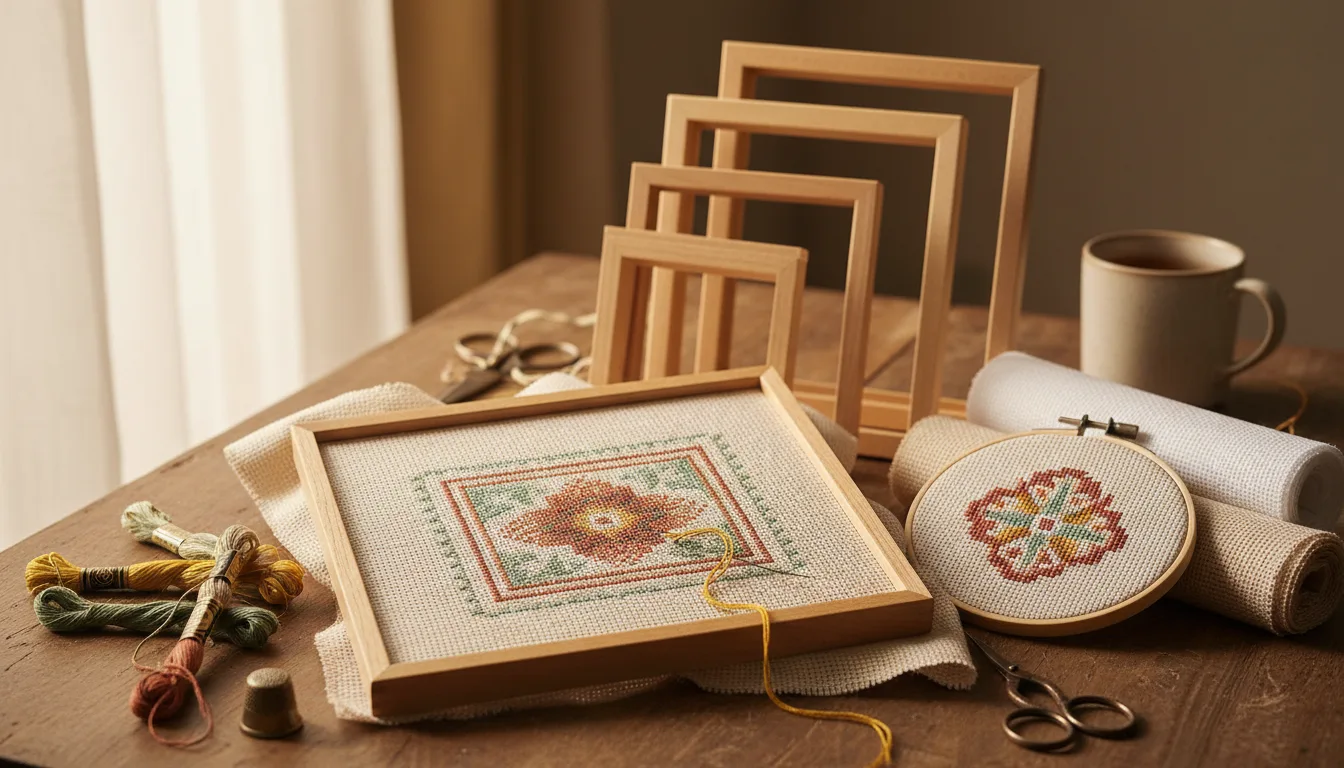
Frames are sold by the size of the thing they hold, and cross stitch is sized in stitches. This page connects the two: pick a standard frame, pick a fabric count, and read off the chart size to make. It works backwards from the frame because that's the cheap order. A chart made to fit a frame you already own costs nothing extra to hang; a chart made first often needs a custom mat.
Why the frame size isn't the space you get
Three things eat into the number on the label.
The lip. Every frame has a front edge that overlaps the artwork. American Frame describes it as overlapping by about 1/4 inch to hold the work in place. Frame Amo's sizing guides put a figure on it for their own frames: an unmatted 8x10 frame has a visible display area of approximately 7.5 × 9.5 inches, a quarter inch less on every side.
The mat, if there is one. A mat window is cut smaller than the thing behind it. American Frame cuts windows 1/8 inch smaller on each side than the artwork; Frame Amo's standard mats for 8x10 art have a 7.5 × 9.5 inch opening. Either way, the window is what you see.
The breathing room you want. A design that runs right up to the lip looks cramped, and anything important in that last quarter inch disappears. Most stitched pieces look better with some bare fabric showing inside the opening.
Frame sizes vary between makers, so treat the openings below as a starting point and measure the frame you'll use, from the front, before you chart.
Stitch counts for common frame openings
The visible areas come from Frame Amo's sizing guides for 5x7, 8x10, 11x14 and 16x20 art, as of September 2026. The same guides list the same opening for a larger frame matted down to that art size, so each row covers both.
The formula is DMC's definition of count, the number of stitches you can make in an inch, turned round: stitches = inches × count, rounded down so the design fits. All figures are width × height for a portrait-oriented frame; turn them round for landscape.
With ½ inch of bare fabric showing on each side
| Opening (visible) | Also the mat window of | Stitched area | 11-count | 14-count | 16-count | 18-count |
|---|---|---|---|---|---|---|
| 4.5 × 6.5 in (5x7) | 6x8, 8x10, 11x14 frames matted for 5x7 | 3.5 × 5.5 in | 38 × 60 | 49 × 77 | 56 × 88 | 63 × 99 |
| 7.5 × 9.5 in (8x10) | 10x12, 11x14 frames matted for 8x10 | 6.5 × 8.5 in | 71 × 93 | 91 × 119 | 104 × 136 | 117 × 153 |
| 10.5 × 13.5 in (11x14) | 16x20 frame matted for 11x14 | 9.5 × 12.5 in | 104 × 137 | 133 × 175 | 152 × 200 | 171 × 225 |
| 15.5 × 19.5 in (16x20) | 18x24, 20x24 frames matted for 16x20 | 14.5 × 18.5 in | 159 × 203 | 203 × 259 | 232 × 296 | 261 × 333 |
With 1 inch of bare fabric showing on each side
A wider border suits an unmatted frame, where the bare fabric does the job a mat would.
| Opening (visible) | Stitched area | 11-count | 14-count | 16-count | 18-count |
|---|---|---|---|---|---|
| 4.5 × 6.5 in (5x7) | 2.5 × 4.5 in | 27 × 49 | 35 × 63 | 40 × 72 | 45 × 81 |
| 7.5 × 9.5 in (8x10) | 5.5 × 7.5 in | 60 × 82 | 77 × 105 | 88 × 120 | 99 × 135 |
| 10.5 × 13.5 in (11x14) | 8.5 × 11.5 in | 93 × 126 | 119 × 161 | 136 × 184 | 153 × 207 |
| 15.5 × 19.5 in (16x20) | 13.5 × 17.5 in | 148 × 192 | 189 × 245 | 216 × 280 | 243 × 315 |
The ceiling: design fills the opening
This is the most a frame can show. Use it for a full-coverage design that's meant to run under the lip or the mat, not as a target for a portrait with a face near the edge.
| Opening (visible) | 11-count | 14-count | 16-count | 18-count |
|---|---|---|---|---|
| 4.5 × 6.5 in (5x7) | 49 × 71 | 63 × 91 | 72 × 104 | 81 × 117 |
| 7.5 × 9.5 in (8x10) | 82 × 104 | 105 × 133 | 120 × 152 | 135 × 171 |
| 10.5 × 13.5 in (11x14) | 115 × 148 | 147 × 189 | 168 × 216 | 189 × 243 |
| 15.5 × 19.5 in (16x20) | 170 × 214 | 217 × 273 | 248 × 312 | 279 × 351 |
Real fabric is not exactly its count
Here's the detail that trips people up on a tight fit. A count is a nominal figure. Zweigart lists its fabrics in stitches per centimeter: its 14-count Aida at 5.4 per cm, 16-count at 6.4 and 18-count at 7.0. Multiplied by 2.54, those come to about 13.7, 16.3 and 17.8 stitches per inch.
Those per-centimeter figures are rounded, so don't read too much into the second decimal. The practical lesson is simple: a design sized to the exact inch on paper can come out a little larger or smaller on the cloth. As arithmetic, 217 stitches at 13.7 per inch is 15.8 inches, which would no longer fit a 15.5-inch opening. That is one more reason to chart with a margin rather than to the ceiling table, and to stitch a small test square on your own fabric if the fit is tight.
Worked example: an 8x10 portrait, unmatted
You own an unmatted 8x10 frame and want a pet portrait on 14-count Aida.
- Measure the opening from the front. Say it's 7.5 × 9.5 inches, as in the table.
- Choose the bare border. Half an inch each side leaves 6.5 × 8.5 inches of stitching.
- Convert to stitches. 6.5 × 14 = 91; 8.5 × 14 = 119. Chart 91 × 119.
- Check the detail. 91 stitches across is enough for a head-and-shoulders crop with the face filling the frame, not for a whole dog on a lawn. Photo cross stitch pattern size shows how to count the stitches that land on an eye before you commit.
- Size the board. The mount board fits inside the frame, so it's a little under 8 × 10 inches. The Minnesota Historical Society's mounting sheet says the board should fit easily inside the frame without sticking.
- Cut the fabric. DMC recommends a clear border of at least 8 cm / 3 inches around the design for framing: 6.5 + 6 by 8.5 + 6, so 12.5 × 14.5 inches. That leaves (12.5 − 8) ÷ 2 = 2.25 inches of fabric to wrap behind the board on each side.
Work out your fabric size before you cut has the same arithmetic for any chart and count.
Worked example: the same design in a matted 11x14
Now put that 91 × 119 design in an 11x14 frame with a mat cut for 8x10 art. The window is 7.5 × 9.5 inches, so the chart doesn't change. The fabric does.
The board now fills the 11x14 frame, not the 8x10 window. DMC's 3-inch border gives the same 12.5 × 14.5 inch piece, which leaves only (12.5 − 11) ÷ 2 = 0.75 inch to wrap at the sides and (14.5 − 14) ÷ 2 = 0.25 inch at the top and bottom. That's not enough to lace.
So for a matted frame, work the fabric out from the board instead:
Fabric to cut = board size + 2 × the wrap you want
As arithmetic, with 2 inches of wrap on every side of an 11 × 14 board, cut 15 × 18 inches. The framing guide uses 2 inches of wrap in its examples and explains why less is tight to lace.
Mat or no mat?
The choice changes the stitch count less than you'd think and the fabric more than you'd expect.
| Unmatted frame | Matted frame | |
|---|---|---|
| Stitch count | Set by the frame's visible area | Set by the mat window |
| Bare fabric showing | Needed, and it's your only border | Optional; the mat is the border |
| Keeping the glass off the stitches | Needs a spacer in the frame | The mat does it |
| Fabric to cut | Design + DMC's 3 inches is often enough | Board size + wrap, usually more |
| Cost of a size mismatch | Uneven bare margins | A mat window can be cut to the design |
The glass point matters more than it looks. Cross stitch is raised, and the framing guide cites conservation advice to keep glazing at least 3/8 inch off the stitching. A mat creates that gap for free; an unmatted frame needs a spacer and a rabbet (the recess behind the molding) deep enough for it.
When the chart can't grow
Very large frames on fine fabric. Our generator makes charts from 20 to 250 stitches wide. Filling a 16x20 opening with a half-inch border takes 261 stitches across on 18-count, which is over that limit, while 14 and 16-count fit. If you want 18-count in a 16x20 frame, add a mat or a wider bare border to bring the design under 250 stitches wide.
Small frames and detailed subjects. A 5x7 frame on 14-count holds a design around 49 stitches wide with a half-inch border. That's a silhouette, a simple pet head or an initial, not a family group. For a small piece of a detailed photo, choose a finer count: the same 3.5-inch width is 63 stitches on 18-count. Or pick the next frame size up and let the detail breathe.
Shape mismatches. The openings aren't the same shape. 3.5 × 5.5 is a narrower rectangle than 6.5 × 8.5, so a crop made for one frame won't sit evenly in another. Cropping a photo for cross stitch covers choosing the crop to match the opening, and its quick table works from a frame's named size rather than its visible area, which leaves a slimmer bare border than the tables here.
Hoops and non-standard shapes
A hoop has no lip and no mat: the design sits inside the inner ring. The arithmetic is the same (inches × count), but measure the inside of the inner ring and remember a square chart loses its corners in a circle. Finishing cross stitch in a hoop covers sizing and backing a hoop, and how to finish cross stitch sets out the order: wash, press, then mount, whatever the display.
For anything else, the method never changes:
- Measure the visible opening.
- Subtract twice the bare border you want.
- Multiply by your fabric count and round down.
- Size the fabric from the board, or from DMC's 3 inches if that's larger.
From the numbers to a chart
Once you have a stitch count, set the photo up to match it. In the generator you choose the chart width in stitches and drag the crop; the chart's height follows the crop, and the readout shows the stitches, the finished size and the fabric to cut for your fabric count as you go. Set the width to 91, drag the crop until the height reads 119, and the chart fits the 8x10 opening from the example.
Frequently asked questions
How many stitches fit in an 8x10 frame?
About 91 by 119 stitches on 14-count Aida if you leave half an inch of bare fabric showing on each side. That comes from a visible area of about 7.5 by 9.5 inches, which is what one frame maker lists for an unmatted 8x10 frame once the lip covers the edges. On 18-count the same space holds 117 by 153.
Is an 8x10 frame's opening really 8 by 10 inches?
No. The named size is what the frame is built to hold, and the lip at the front covers about a quarter inch of the edge. Frame Amo lists the visible area of its unmatted 8x10 frame as approximately 7.5 by 9.5 inches. Measure the opening of the frame you actually own before charting.
What size cross stitch fits a 5x7 frame?
On 14-count, about 49 by 77 stitches with half an inch of bare fabric showing on each side, or up to 63 by 91 if the design runs to the edge of the visible area. The frame maker's listed visible area is about 4.5 by 6.5 inches. Small frames suit simple subjects rather than detailed portraits.
Do I need more fabric if I use a mat?
Usually yes. With a mat, the mounting board fills the whole frame, not just the mat window, and the fabric has to wrap around that bigger board. An 8x10 design in an 11x14 frame needs fabric at least the board size plus the wrap on every side, which is more than DMC's 3-inch border gives.
Can a 16x20 frame be filled on 18-count Aida?
Not with our generator in one chart. Filling the 15.5 by 19.5 inch visible area on 18-count means a chart about 279 stitches wide, and our charts go up to 250 stitches wide. On 14 or 16-count the same frame fits within that limit, with the finished piece holding less detail per inch.
Should I pick the frame or the chart first?
The frame, if the piece is going on a wall. A standard ready-made frame fixes the opening, which fixes the stitch count on your fabric, which fixes the crop of your photo. Charting first and framing later often means a custom mat or a custom frame to make up the difference.
Sources
- Frame Amo — 5x7 frame sizing guide (visible area approx. 4.5 × 6.5 in; 4.5 × 6.5 in mat openings)
- Frame Amo — 8x10 frame sizing guide (visible area approx. 7.5 × 9.5 in; 10x12 and 11x14 frames matted for 8x10)
- Frame Amo — 11x14 frame sizing guide (visible area approx. 10.5 × 13.5 in; 16x20 matted for 11x14)
- Frame Amo — 16x20 frame sizing guide (visible area approx. 15.5 × 19.5 in; 18x24 to 22x24 frames matted for 16x20)
- American Frame — Measuring art for custom framing (lip overlaps about 1/4 inch; mat window 1/8 inch smaller each side)
- Zweigart — Aida range (14-count 5.4, 16-count 6.4, 18-count 7.0, 11-count 4.35 stitches per cm)
- DMC — What fabric should I use? (count is the number of stitches you can make in an inch)
- DMC — How to prepare your fabric (clear border of at least 8 cm / 3 inches for framing)
- Minnesota Historical Society — Mounting flat needlework textiles on a fabric-covered board (board fits easily inside the frame), hosted by the GWU Textile Museum
Keep stitching
 Guides
How to Frame Cross Stitch: Lacing, Mounting, Glass
How to frame cross stitch so it lasts: sizing the board, lacing or stitching it on, spacers that keep it off the glass, UV glazing, and what never to use.
Read · 13 min Guides
How to Finish Cross Stitch: Wash, Press, Frame, Sew
How to finish cross stitch in the right order: check, test for colorfastness, wash, press, then frame, hoop or sew it, with museum advice on framing.
Read · 13 min Guides
Crop a Photo for Cross Stitch: 7 Framing Rules
How to crop a photo for a cross stitch pattern: give the subject the stitches, match the frame or hoop, check pixels, with stitch counts for common frames.
Read · 10 min Guides
Cross Stitch Ornament Finishing: 4 Simple Methods
Four ways to finish a cross stitch ornament: flat felt back, stuffed pillow, padded board or ready-made frame, plus washing, trimming and hanging.
Read · 10 min Guides
Baby Birth Sampler Cross Stitch: Name, Date, Photo
Plan a birth sampler around a photo: what to include, how many rows lettering takes, charting the name by hand, and what to stitch before the birth.
Read · 11 min Guides
Stitch Fiddle Alternative: Photo Patterns, No Editor
Stitch Fiddle is a chart editor from $2.75 a month. If you just want a photo charted with DMC skein counts, here's how the two compare (September 2026).
Read · 11 min