Supplies
14 vs 18 Count Aida: Size, Detail and Eyesight
14 vs 18 count Aida compared on one chart: finished size, when 18-count adds detail and when it doesn't, strands, needles and what it asks of your eyes.

By Antoine Duno
Updated November 12, 20269 min read
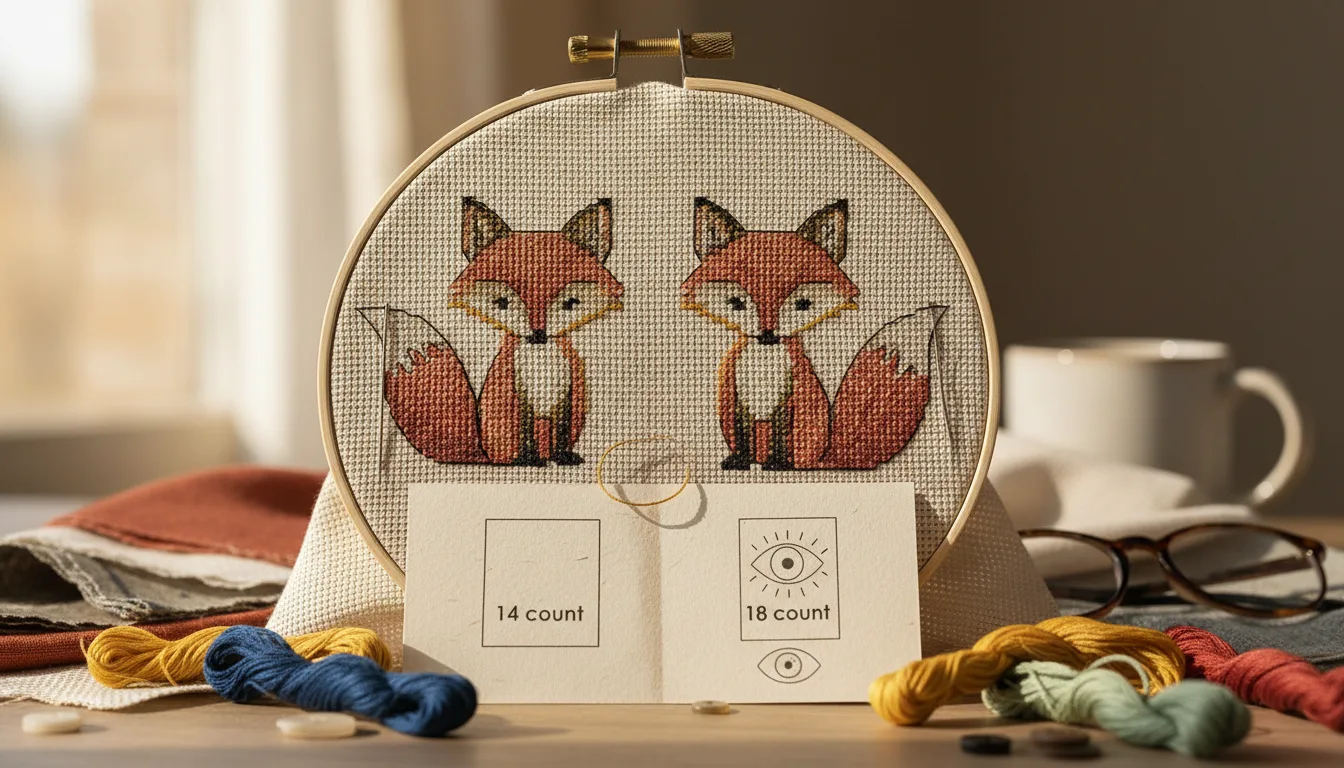
The difference between 14 and 18-count Aida is one number: how many stitches fit in an inch. Everything else follows from it, including a few things the fabric shop won't tell you. A finer count doesn't add detail to a chart. It makes the same chart smaller, and it makes the holes smaller too.
So the real question isn't which fabric is better. It's whether you're keeping the chart and changing the size, or keeping the size and changing the chart.
The two fabrics side by side
| 14-count Aida | 18-count Aida | |
|---|---|---|
| Stitches per inch | 14 | 18 |
| Zweigart's own label | 3706 Stern-Aida: "54 St./14 ct." | 3793 Fein-Aida: "70 St./18 ct." |
| Size of the same chart | 100% | about 78% as wide and tall |
| Stitches in a 10 in width | 140 | 180 |
| Strands | The Cross Stitch Guild: generally two | No maker's rule; test one and two |
| DMC's view | Recommended for beginners, most popular in its range | Not singled out |
| Holes | Easier to see | Smaller; needs good light |
Zweigart, which makes both of those fabrics, lists them on its own shop with a metric figure and the count: Stern-Aida 3706 at 54 St./14 ct. and Fein-Aida 3793 at 70 St./18 ct. The metric figures line up with stitches per 10 cm. DMC defines the count the same way everyone does: the number of stitches you can make in an inch, and the higher the count, the smaller the stitches.
Same chart, both counts: the finished size
Finished size is stitches ÷ count. The Cross Stitch Guild gives the worked example in its FAQs: 140 stitches on 14-count Aida is a design 10 inches wide. Here's the same arithmetic for chart widths you're likely to meet, including the 250-stitch maximum of our generator.
| Chart width | On 14-count | On 18-count |
|---|---|---|
| 70 stitches | 5.0 in (12.7 cm) | 3.9 in (9.9 cm) |
| 100 stitches | 7.1 in (18.1 cm) | 5.6 in (14.1 cm) |
| 140 stitches | 10.0 in (25.4 cm) | 7.8 in (19.8 cm) |
| 180 stitches | 12.9 in (32.7 cm) | 10.0 in (25.4 cm) |
| 250 stitches | 17.9 in (45.4 cm) | 13.9 in (35.3 cm) |
Do the same division for the height. Every width shrinks to about 78%, so every area shrinks to about 60%: a piece that fills a 10 × 10 inch space on 14-count fills roughly 7.8 × 7.8 on 18-count.
That's the whole effect if you keep the chart. The number of stitches, the colors, the hours of stitching and the look of the design at arm's length stay the same. The piece is smaller, and each stitch is smaller within it.
The fabric you cut doesn't shrink by the same proportion, because the bare border around the design is a fixed width. DMC recommends at least 8 cm / 3 inches all round for work you plan to mount and frame. As arithmetic, for a 140 × 140 chart that's 16 × 16 inches of 14-count or about 13.8 × 13.8 inches of 18-count. Our fabric size calculator runs the numbers for any chart and count.
When 18-count really does add detail
It adds detail when the size is fixed and you let the chart grow to fill it. A frame, a hoop, a card mount or a spot on the wall sets the space, and a finer count puts more stitches into that space. More stitches across a face means more of its shape survives.
As arithmetic, for a frame opening of 8 × 10 inches with half an inch of bare fabric inside it on each side, the stitched area is 7 × 9 inches:
| 14-count | 18-count | |
|---|---|---|
| Chart size | 98 × 126 stitches | 126 × 162 stitches |
| Total stitches (fully stitched) | 12,348 | 20,412 |
| Stitches across the subject, if it fills 80% of the width | about 78 | about 101 |
The extra detail isn't free. The 18-count version has about 65% more stitches, so at the same pace it takes about 65% longer, uses more floss, and may be worth a few more colors to make use of the extra resolution. How long does cross stitch take shows how to turn those stitch counts into hours at your own speed.
So the choice for a photo chart comes down to this:
- Keep the chart, change the fabric: 18-count makes a smaller piece with the same detail and the same stitching time.
- Keep the size, change the chart: 18-count holds more stitches, more detail, and more hours.
For a portrait, the second one is usually why people reach for 18-count. How big a photo cross stitch pattern should be covers how many stitches a face needs before the eyes read clearly, which is the number to decide first.
Strands, needles and coverage
On 14-count the starting point is settled. The Cross Stitch Guild says cross stitch is generally worked with two strands on 14-count and 16-count Aida. For 18-count, neither DMC nor the Guild publishes a fixed strand number, and stitchers genuinely differ: some use one strand for a lighter look, others keep two for full coverage.
The Guild's advice works for both counts. Its FAQs say the number of strands depends mainly on the count of the fabric, and suggest working a few crosses in the fabric margin and deciding which you prefer. The same page offers a second check: pull a thread from the edge of the fabric and compare it with the strands; they should be a similar weight. On its thread page the Guild adds that you should look at the test crosses in daylight, and that some colors may need a different number of strands.
Coverage matters more on a photo chart than on a motif. If fabric shows between the strands, it lightens every shade a little, and a white ground shows through dark colors most. Test with your darkest color, not a light one.
Needles follow the thread. DMC's tapestry needle page matches size 24 to 3–4 strands, size 26 to 2–3 strands and size 28 to 2 strands of its floss, and on DMC's numbering the smaller the number, the larger the needle. A needle that's too thick for 18-count's small holes pushes the blocks apart. Our Aida cloth count guide sets out the common needle and strand pairings for every count.
How many strands for cross stitch goes count by count, including what strand choice does to the floss you buy.
Eyesight: the part nobody likes to mention
An 18-count hole is smaller than a 14-count hole, and there's no technique that changes that. The Cross Stitch Guild's article on care of your eyesight, by Dr Christine Hamilton, is direct about it: you don't want to be working on 18-count if your vision is not too good, though you might manage 11-count.
The same article notes that many people find, from their forties, that the distance at which they see close work clearly moves further away. Its advice:
- Work in good light, ideally daylight by a window.
- Try a magnifier, from the simple hang-round-the-neck type upward.
- Get your eyes tested by a qualified optician, whether or not you already wear glasses.
- Enlarge the chart. A bigger printout helps on any count.
A practical test before a big project: stitch a 10 × 10 block on a scrap of each count, in the light and the chair you'll really use, and time both. If 18-count is noticeably slower or leaves you squinting after an hour, the extra detail may not be worth months of that. 11-count Aida is the step the other way, for bigger stitches and bigger holes.
What the choice changes in a chart from our generator
When you make a chart from your photo, fabric count is a setting next to the chart width. Changing it between 14 and 18 doesn't redraw the pattern: the stitches and colors stay put. What changes is:
- Finished size and fabric to cut, shown under the free preview for the count you choose.
- The skein estimate, because smaller stitches use less thread each. The same chart usually needs fewer or equal skeins on 18-count, color by color, and never more.
What the setting doesn't do is add stitches. If you're switching to 18-count to get more detail in the same frame, raise the chart width too, then check the total stitch count under the preview before you commit to it.
Which one to pick
- Pick 14-count if you're new to cross stitch, if you're stitching a large piece and want it to feel large, if your eyes tire on fine work, or if the chart already has as much detail as you want.
- Pick 18-count if the piece has to fit a small frame, card or ornament, or if you want a portrait's detail inside a fixed size and you're comfortable with the extra stitches, the smaller holes and good lighting.
- Not sure? Stitch the same small block on both. The Guild's margin test takes ten minutes and answers the strand question at the same time.
For the full range, including evenweave and linen worked over two, cross stitch fabric types compares every common option.
Frequently asked questions
What is the difference between 14 and 18 count Aida?
The size of each stitch. 14-count gives 14 stitches per inch and 18-count gives 18, so the same chart stitched on 18-count comes out about 22% narrower and taller, and covers about 40% less area. The chart, the colors and the number of stitches don't change.
Does 18 count Aida give more detail?
Only if the chart has more stitches. The same 140-stitch chart shows exactly the same detail on 14 or 18-count, just smaller. Where 18-count helps is a fixed frame: a 10 inch wide area holds 140 stitches on 14-count and 180 on 18-count, and those extra stitches are where the extra detail comes from.
Is 18 count Aida harder to stitch?
The holes are smaller, so it asks more of your eyes and your light. The Cross Stitch Guild's eyesight article advises against 18-count if your vision is not too good, and recommends good daylight, a magnifier and an eye test. Stitch a few crosses in the margin before committing to a large piece.
How many strands do you use on 18 count Aida?
Test it on your fabric, because no maker's rule covers 18-count. The Cross Stitch Guild says two strands is general practice on 14 and 16-count, and suggests comparing a thread pulled from the fabric with your floss. On 18-count, stitch a few crosses with one strand and with two, then compare the coverage in daylight.
Should a beginner use 14 or 18 count?
14-count. DMC recommends 14-count Aida for beginners and calls it the most popular Aida in its range. The holes are easier to see, mistakes are easier to spot, and two strands of floss is the usual starting point. Move to 18-count once counting and tension feel automatic.
Does 18 count use less floss than 14 count?
For the same chart, usually yes, because each stitch is smaller and uses less thread. But if you move to 18-count to fit more stitches into the same frame, the stitch count rises and so does the floss. Recalculate skeins from the stitch count on the fabric you'll actually use.
Sources
- Zweigart — 3706 Stern-Aida (54 St./14 ct., 100% cotton)
- Zweigart — 3793 Fein-Aida (70 St./18 ct.)
- DMC — What fabric should I use? (count is the number of stitches in an inch; 14-count for beginners)
- DMC — Aida fabric (14-count is the most popular Aida in the range)
- DMC — How to prepare your fabric (at least 8 cm / 3 inches all round for framing)
- DMC — Tapestry needles (needle size by number of strands)
- DMC — Cross stitch needles (the smaller the number, the larger the needle)
- The Cross Stitch Guild — Thread basics (two strands on 14 and 16-count Aida; test in daylight)
- The Cross Stitch Guild — Cross stitch FAQs (design size formula, margin test for strands)
- The Cross Stitch Guild — Care of your eyesight, by Dr Christine Hamilton
Keep stitching
 Supplies
Aida Cloth Count Guide: 11, 14, 16, 18 and 28 Over 2
Aida cloth count explained: compare 11, 14, 16, 18 and 28 over 2, calculate finished size in inches and cm, and choose a needle and strands.
Read · 9 min Guides
Work Out Your Fabric Size Before You Cut
How to calculate cross stitch fabric size: the formula, worked examples on 11, 14, 16 and 18 count, and the margins to add before you cut.
Read · 9 min Supplies
Cross Stitch Fabric Types: Aida, Evenweave, Linen
Aida, evenweave and linen compared for cross stitch: how counts work, which fabric suits a photo pattern, fabric color, what to cut and how each behaves.
Read · 13 min Supplies
Colored Aida for Photo Patterns: Fabric as a Color
On colored Aida the fabric becomes the background of a photo pattern: fewer stitches, fewer skeins. How to pick the color, test show-through and plan it.
Read · 9 min Supplies
DMC to Anchor Conversion: Why Matches Are Approximate
DMC to Anchor charts give the nearest shade, not the same one. What both makers state, where swaps go wrong on photo charts, and how to convert safely.
Read · 12 min Supplies
DMC Floss Guide: Numbers, Strands, Skeins, Colors
DMC embroidery floss explained: what the numbers mean, skein length, strands per fabric, how many shades exist, specialty threads and buying for a chart.
Read · 13 min