Guides
Pet Portrait Cross Stitch Time: Hours by Size
How long a pet portrait cross stitch takes, from your own pace: hours and weeks by chart size, with or without a background, and what fits a deadline.
By Antoine Duno
Updated November 11, 20267 min read
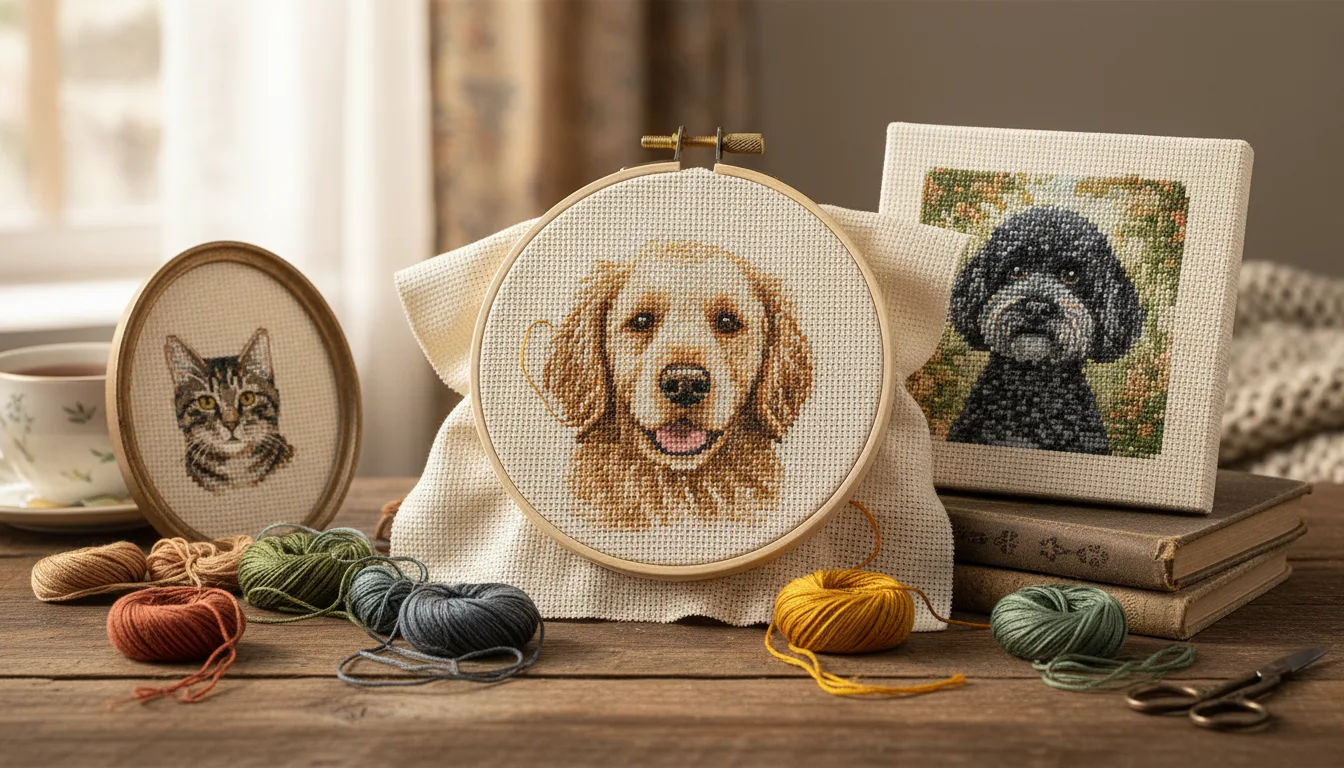
A pet portrait is usually a gift, and gifts have dates. That makes "how long will it take?" the question that decides whether the whole project works, and it's the one most often answered with a guess.
This page answers it with arithmetic instead: the stitches in the chart, your own measured pace, and the hours you really have each week.
Hours by portrait size
The rates are examples to show the calculation, not claims about how fast people stitch. Finished size is on 14-count Aida, which is stitches ÷ 14, since DMC defines count as the number of stitches you can make in an inch.
| Chart | Typical use | Finished on 14-count | Stitches, fully stitched | At 150/hr | At 300/hr |
|---|---|---|---|---|---|
| 60 × 60 | Mini portrait, ornament | 4.3 × 4.3 in | 3,600 | 24 h | 12 h |
| 80 × 100 | Small head | 5.7 × 7.1 in | 8,000 | ~53 h | ~27 h |
| 100 × 125 | Head and shoulders | 7.1 × 8.9 in | 12,500 | ~83 h | ~42 h |
| 120 × 150 | Detailed head | 8.6 × 10.7 in | 18,000 | 120 h | 60 h |
| 150 × 200 | Detailed portrait | 10.7 × 14.3 in | 30,000 | 200 h | 100 h |
| 200 × 250 | Large portrait | 14.3 × 17.9 in | 50,000 | ~333 h | ~167 h |
With the background left as bare fabric
A bare background is the biggest time saving in a pet portrait. How much it saves depends on the photo. As arithmetic, if 60% of the squares are stitched:
| Chart | Stitched squares at 60% | At 150/hr | At 300/hr |
|---|---|---|---|
| 60 × 60 | 2,160 | ~14 h | ~7 h |
| 100 × 125 | 7,500 | 50 h | 25 h |
| 120 × 150 | 10,800 | 72 h | 36 h |
| 150 × 200 | 18,000 | 120 h | 60 h |
| 200 × 250 | 30,000 | 200 h | 100 h |
You don't have to guess the share. When you remove the background in our generator, the preview's total stitches count only the squares you'll stitch, and it shows how much of the photo was taken out.
From hours to weeks
Divide the hours by what you really stitch in an ordinary week. As arithmetic, at 5 hours a week:
| Chart, fully stitched | Weeks at 150/hr | Weeks at 300/hr |
|---|---|---|
| 60 × 60 | ~5 | ~2.5 |
| 100 × 125 | ~17 | ~8 |
| 120 × 150 | 24 | 12 |
| 150 × 200 | 40 | 20 |
| 200 × 250 | ~67 | ~33 |
That table is why a detailed pet portrait is a project of months for most schedules, and why the size decision matters more than any stitching technique.
Measure your pace on the portrait, not a sampler
The general method is in how long cross stitch takes: stitch a 10 × 10 block with a timer running and divide 6,000 by the minutes. For a pet portrait, three details change the answer.
Time the fur. The coat is most of the stitching, and it's where the chart changes color most often. The pet portrait guide explains why fur is supposed to look busy on a chart; that busyness is also what makes it slower than a plain area. A block timed in the background will flatter you.
Time a dark or pale area if the coat has one. Black and white animals are charted in families of very close shades. On the chart, near-identical colors mean more checking of symbols. The Cross Stitch Guild notes that many stitchers prefer black and white charts because shades are easier to tell apart, and DMC suggests organizing threads on cards with the symbol next to each color. Both help; neither makes those areas as quick as a solid patch.
Include the eyes in your expectations. The eyes and nose are small, but they're where the most careful stitching happens, and where unpicking is most likely.
As arithmetic, if a background block takes 15 minutes and a fur block takes 30, and the chart is mostly fur, plan with the 30-minute figure: 200 stitches an hour, not 400.
The gift deadline check
Work backwards from the date, and leave room around the stitching. The Christmas gift timeline uses about two weeks for making the chart, buying floss and fabric, washing and finishing, and that's a minimum.
As arithmetic for a Christmas portrait started on November 11, 2026: there are six whole weeks to Friday, December 25. Take off two, and four weeks at 5 hours a week is 20 stitching hours.
| Your pace | Stitch budget | Largest square chart | What fits |
|---|---|---|---|
| 150/hr | 3,000 | about 54 × 54 | A mini portrait, a tight crop of the face |
| 300/hr | 6,000 | about 77 × 77 | A small head, or a 100 × 100 chart with a bare background at 60% stitched |
A 100 × 125 head-and-shoulders portrait fully stitched needs 12,500 stitches. At these assumptions it doesn't fit, and the honest thing is to say so now rather than on December 20.
What does fit:
- A mini portrait. A small chart of the face only. Mini pet portrait cross stitch covers how small a chart can go and still look like your pet.
- The same photo, cropped tighter, with the background left bare.
- The chart and a started piece, wrapped with a note about when it will be finished.
Two pets double the job
For the same detail, two animals side by side need roughly twice the chart width, and so about twice the stitches. Two pets in one cross stitch works through the layouts, including overlapping heads to save width, and when two matching panels are the better plan. Panels have a time advantage too: the first one can be finished and given while the second is still in progress.
Cutting hours without losing the likeness
In order of how much they usually save:
- Leave the background as bare fabric. It's often the largest block of stitches that nobody looks at.
- Crop tighter. The face keeps its stitches while the edges lose theirs.
- Reduce the width. Stitches fall with area: a chart 20% narrower, with height following, has about a third fewer stitches. Check the eyes are still several stitches across.
- Use fewer colors. Fewer thread changes, fewer scattered single stitches. Compare the previews at two color counts before choosing.
A finer fabric doesn't belong on this list. It makes the same stitches smaller, not fewer.
Frequently asked questions
How long does a pet portrait cross stitch take?
It depends on the chart size and your pace, so work it out rather than guess. As arithmetic, a 100 by 125 head-and-shoulders chart is 12,500 stitches: about 83 hours at 150 stitches an hour or 42 at 300. Leaving the background unstitched can take a large share off that.
Can I finish a pet portrait cross stitch by Christmas?
Only a small one, if you start in mid-November. As arithmetic, from November 11, 2026 there are six whole weeks to December 25; leave two for supplies and finishing and, at 5 hours a week, that's 20 stitching hours. At 300 stitches an hour that's 6,000 stitches, well short of a detailed portrait.
Why is a pet portrait slower than other cross stitch?
Fur is made of many close shades with frequent changes, and dark or light coats use shades that are hard to tell apart on the chart. Every change means rethreading, and every near-identical symbol means more checking. Time a block from the coat, not from the background, to get a realistic pace.
How can I make a pet portrait quicker to stitch?
Stitch fewer squares. Leave the background as bare fabric, crop tighter so the head fills the chart, and reduce the chart width, since stitches fall with area. Fewer colors also means fewer thread changes. A finer fabric doesn't help: it makes the same number of stitches smaller.
How do I measure my stitching pace for a portrait?
Stitch one 10 by 10 block from the portrait chart itself, in the fur rather than the background, with a timer running and color changes included. Divide 6,000 by the minutes it took to get stitches per hour. Then re-check your rate after a few sessions on the real piece.
Sources
- DMC — What fabric should I use? (count is the number of stitches you can make in an inch)
- DMC — How to read a cross stitch chart (larger grid lines; organizing threads on cards with symbols)
- The Cross Stitch Guild — Cross stitch chart and key basics (black and white charts make shades easier to differentiate)
Keep stitching
 Guides
Cross Stitching a Pet Portrait From a Photo
Choosing the photo, getting the eyes right, handling fur and backgrounds, sizing the chart, and how long a pet portrait cross stitch really takes.
Read · 13 min Guides
Two Pets in One Cross Stitch: Combining Photos
Two pets in one cross stitch: one photo or a composite, the chart width each face costs, layouts that save stitches, and when two panels work better.
Read · 10 min Guides
Christmas Cross Stitch Gift: When to Start by Size
When to start a Christmas cross stitch gift, by chart size: start-by dates worked back from December 25, 2026, and the largest chart you can still finish.
Read · 7 min Guides
Cross Stitch Skin Tones: Charting Faces From Photos
Why faces turn orange, grey, blotchy in photo cross stitch charts, how to fix the photo and palette, and how to check skin shades against real DMC thread.
Read · 12 min Technique
White Dog or Cat Cross Stitch: Keep the Detail
Why white pets come out as flat blobs in photo patterns, how to photograph white fur, which pale DMC shades carry it, and the white-on-white Aida trap.
Read · 13 min Guides
Family Portrait Cross Stitch From One Photo
Why faces need far more stitches than pets, the chart width where a family's faces stop reading, and the photo, layout and color choices that keep them.
Read · 11 min