Supplies
How Many Strands for Cross Stitch on Each Count
How many strands of floss to use on 11, 14, 16 and 18-count Aida and evenweave, the quick test that settles it, and how strands change the floss you buy.
By Antoine Duno
Updated November 18, 20267 min read
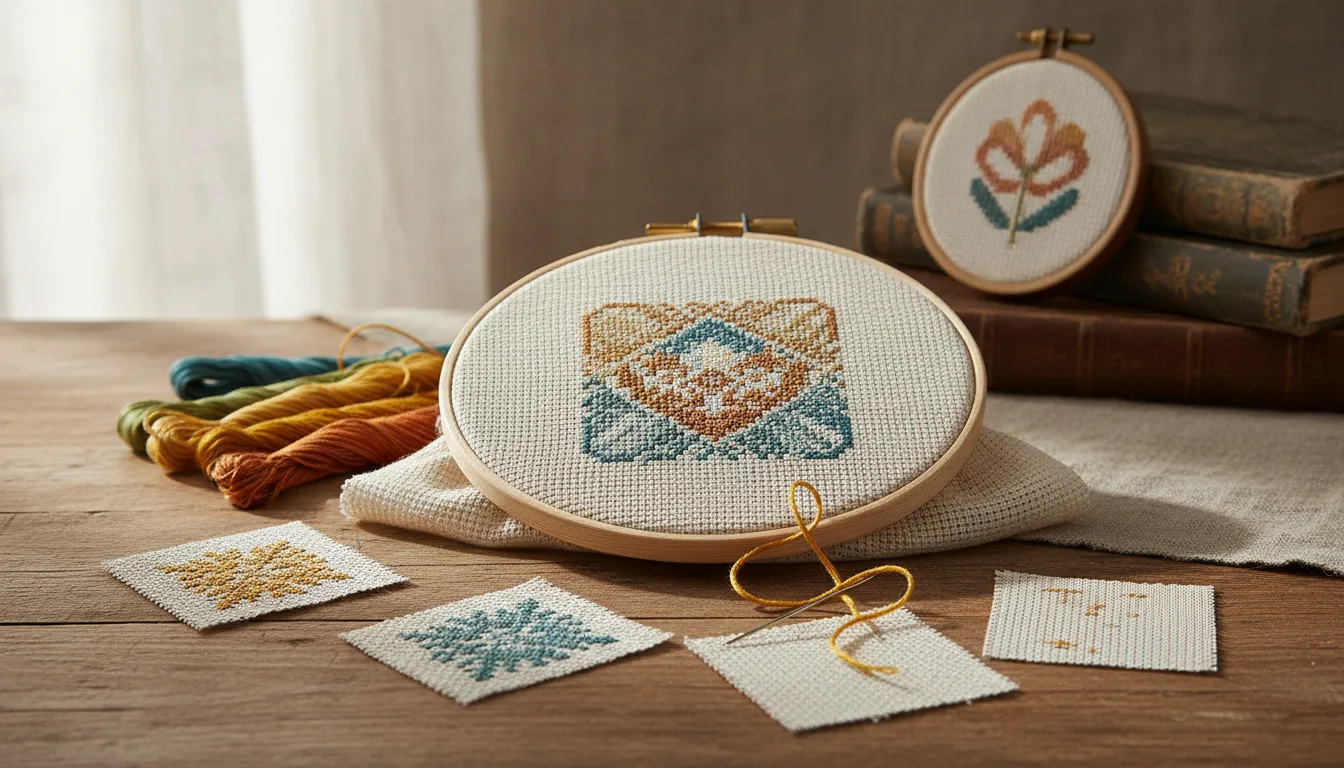
The number of strands decides how solid your stitches look. Too few and the fabric shows through, lightening every color. Too many and the stitches crowd the holes, distort the weave and use floss you didn't need to buy. The right number depends mostly on the fabric count, and for two counts there's a clear published answer. For the rest, there's a quick test that's more reliable than any table.
Strands by fabric count
| Fabric | Stitches per inch | Starting point | Where it comes from |
|---|---|---|---|
| 11-count Aida | 11 | Test 2 and 3 | No published maker's figure; bigger stitches usually need more cover |
| 14-count Aida | 14 | 2 | The Cross Stitch Guild: generally two strands |
| 16-count Aida | 16 | 2 | The Cross Stitch Guild: generally two strands |
| 18-count Aida | 18 | Test 1 and 2 | No published maker's figure |
| 28-count evenweave over two | 14 | 2, then check | Same stitch size as 14-count Aida (Cross Stitch Guild) |
| 32-count evenweave over two | 16 | 2, then check | As arithmetic, 32 ÷ 2 = 16 stitches per inch |
| Backstitch on any of these | — | 1 | DMC and the Cross Stitch Guild |
The Guild's thread basics page gives the two-strand figure for 14 and 16-count Aida. Its fabric facts page explains that working over two threads on 28-count evenweave gives stitches the same size as 14-count Aida. Zweigart's own shop lists its fabrics the same way, from Aida at 64 St./16 ct. to Murano evenweave at 32 count.
For every count, the Guild adds two things worth taking seriously: it's perfectly acceptable to mix the number of strands in one project, and some colors may need the number adjusting to suit the piece.
The quick test that settles it
A table gives you a starting point. Your fabric, your tension and your floss give you the answer. The Cross Stitch Guild's FAQs say the number of strands depends mainly on the count of the fabric, and suggest this:
- Stitch a few crosses in the fabric margin with each strand count you're considering, side by side.
- Use your darkest color for one set and your lightest for another. Show-through is most visible where the thread and fabric contrast.
- Look at them in daylight, as the Guild's thread page recommends, from your normal stitching distance and from across the room.
- On evenweave, pull a thread from the edge of the fabric and lay it next to your strands. The Guild says they should be a similar weight.
- Choose, and write the number on your chart so every session matches.
What you're looking for: with too few strands, fabric shows between the arms of each cross and the color looks paler than the skein. With too many, stitches bulge above the fabric, the holes look stretched, and neighboring stitches crowd each other.
Strands for photo patterns
A chart made from a photo leans harder on coverage than a motif. Its shading comes from many close colors side by side, and if the fabric shows through, every one of them lightens slightly and the steps between shades soften.
- Test the key's darkest and lightest colors, not a mid-tone. Dark floss on white fabric shows gaps most.
- Stay consistent across a gradient. If a face or a sky is shaded with close colors, use the same number of strands for all of them, or the shading stops matching the chart.
- Finer fabric for detail changes the answer. If you've moved to 18-count to fit more stitches in a frame, run the test again. 14 vs 18 count Aida covers that trade.
Needles follow strands
More strands need a bigger eye and a thicker needle to open the hole. DMC's tapestry needle page matches sizes to strands of its floss:
| DMC tapestry needle | Strands of six-strand floss |
|---|---|
| 22 | 4 |
| 24 | 3–4 |
| 26 | 2–3 |
| 28 | 2 |
On DMC's numbering, the smaller the number, the larger the needle. The Aida cloth count guide pairs needles with counts as well.
Backstitch and specialty threads
For backstitch, DMC suggests a single strand for fine outlines, and more strands or two rows for a bolder line. The Guild agrees on one strand with a slightly smaller needle.
Metallic and other specialty threads don't follow the six-strand rules, because they're made differently. Metallic floss for cross stitch covers those. And if two or more strands twist and look uneven, railroading is the technique for laying them flat.
Starting a thread: odd and even strands
Strand count also changes how you start. The Guild's knotless loop start only works with an even number of strands, 2, 4 or 6: you fold one long strand in half and thread the two ends. With 1 or 3 strands, use a waste knot or away waste knot start instead.
Separate strands the way DMC describes in its guide to stranded thread: cut a maximum of 50 cm (18 inches), tap the end, pull one strand straight up at a time, then recombine the number you want.
How strands change the floss you buy
DMC's six-strand floss is sold in 8 meter (8.7 yard) skeins of six strands that separate easily. That makes the effect of strands easy to work out, as arithmetic:
| Strands in the needle | 8-meter lengths of working thread per skein | Floss per stitch compared with 2 strands |
|---|---|---|
| 1 | 6 | about half |
| 2 | 3 | the baseline |
| 3 | 2 | about 1.5 times |
So a switch from two strands to three on the same chart needs roughly half as much floss again. How much embroidery floss you need turns this into skeins per color.
In a chart from our generator
Strands aren't a setting in our generator. The skein counts are worked out for two strands on the fabric count you choose, and the note under the thread list in the free preview says so. If you'll stitch with a different number, adjust the counts in the PDF's color key color by color:
- Three strands: multiply each color's skeins by 1.5 and round up. As arithmetic, 2 skeins becomes 3, and 3 becomes 5.
- One strand: halve and round up, and keep at least one skein of every color.
- Mixed: if only a few colors change, adjust just those rows.
Because the counts are already rounded up per color, scaling them up errs slightly on the generous side, which is the safe direction when you want every skein from one dye lot.
For the whole floss picture, including DMC numbers and how many shades there are, start with the DMC floss guide. When your strands are decided, make the chart and write the number on the first page.
Frequently asked questions
How many strands do you use for cross stitch on 14-count Aida?
Two. The Cross Stitch Guild says cross stitch is generally worked with two strands of stranded cotton on 14-count and 16-count Aida, and it's the usual starting point in charts. A few colors may look thin or crowded, so stitch a couple of test crosses in your darkest and lightest colors first.
How many strands for 18-count Aida?
Neither DMC nor the Cross Stitch Guild publishes a fixed number for 18-count, and stitchers use either one or two. The Guild's advice covers it: stitch a few crosses in the margin with each and choose, looking at them in daylight. One strand gives a lighter look; two give fuller coverage.
How many strands for backstitch?
Usually one. DMC suggests a single strand for fine outlines and more strands, or two rows, for a bolder line. The Cross Stitch Guild also says to use one strand and a slightly smaller needle for backstitch outlining, worked after the cross stitches are finished.
Does using more strands use more floss?
Yes, in proportion. A DMC skein is 8 meters of six strands, so it makes three 8-meter lengths of two-strand thread but only two of three-strand thread. As arithmetic, three strands use about 1.5 times the floss per stitch of two, and one strand about half.
How do I know if I'm using the right number of strands?
Look for fabric showing between the stitches, or stitches so full they crowd the holes. The Cross Stitch Guild suggests working a few crosses in the fabric margin, and on evenweave, comparing a thread pulled from the fabric's edge with your strands: they should be a similar weight.
Sources
- The Cross Stitch Guild — Thread basics (two strands on 14 and 16-count Aida; mixing strands; check in daylight)
- The Cross Stitch Guild — Cross stitch FAQs (strands depend on fabric count; margin test; compare a pulled thread)
- The Cross Stitch Guild — Zweigart fabric facts (28-count over two equals 14-count Aida)
- The Cross Stitch Guild — Knotless loop start (even numbers of strands only)
- The Cross Stitch Guild — Away waste knot start and backstitch (one strand, smaller needle)
- DMC — Six-strand embroidery floss (8 m / 8.7 yd skeins, six separable strands)
- DMC — How to use stranded thread (50 cm maximum, separating and recombining strands)
- DMC — Use back stitch to accentuate your cross stitch (single strand for fine outlines)
- DMC — Tapestry needles (needle size by number of strands)
- Zweigart — 3251 Aida (64 St./16 ct.)
- Zweigart — 3984 Murano (126 threads / 32 count)
Keep stitching
 Supplies
DMC Floss Guide: Numbers, Strands, Skeins, Colors
DMC embroidery floss explained: what the numbers mean, skein length, strands per fabric, how many shades exist, specialty threads and buying for a chart.
Read · 13 min Supplies
How Much Embroidery Floss Do I Need for Cross Stitch?
How much floss for cross stitch: skein length, the thread-per-stitch budget our generator uses, tables by fabric count and worked skein examples.
Read · 8 min Supplies
Aida Cloth Count Guide: 11, 14, 16, 18 and 28 Over 2
Aida cloth count explained: compare 11, 14, 16, 18 and 28 over 2, calculate finished size in inches and cm, and choose a needle and strands.
Read · 9 min Supplies
DMC to Anchor Conversion: Why Matches Are Approximate
DMC to Anchor charts give the nearest shade, not the same one. What both makers state, where swaps go wrong on photo charts, and how to convert safely.
Read · 12 min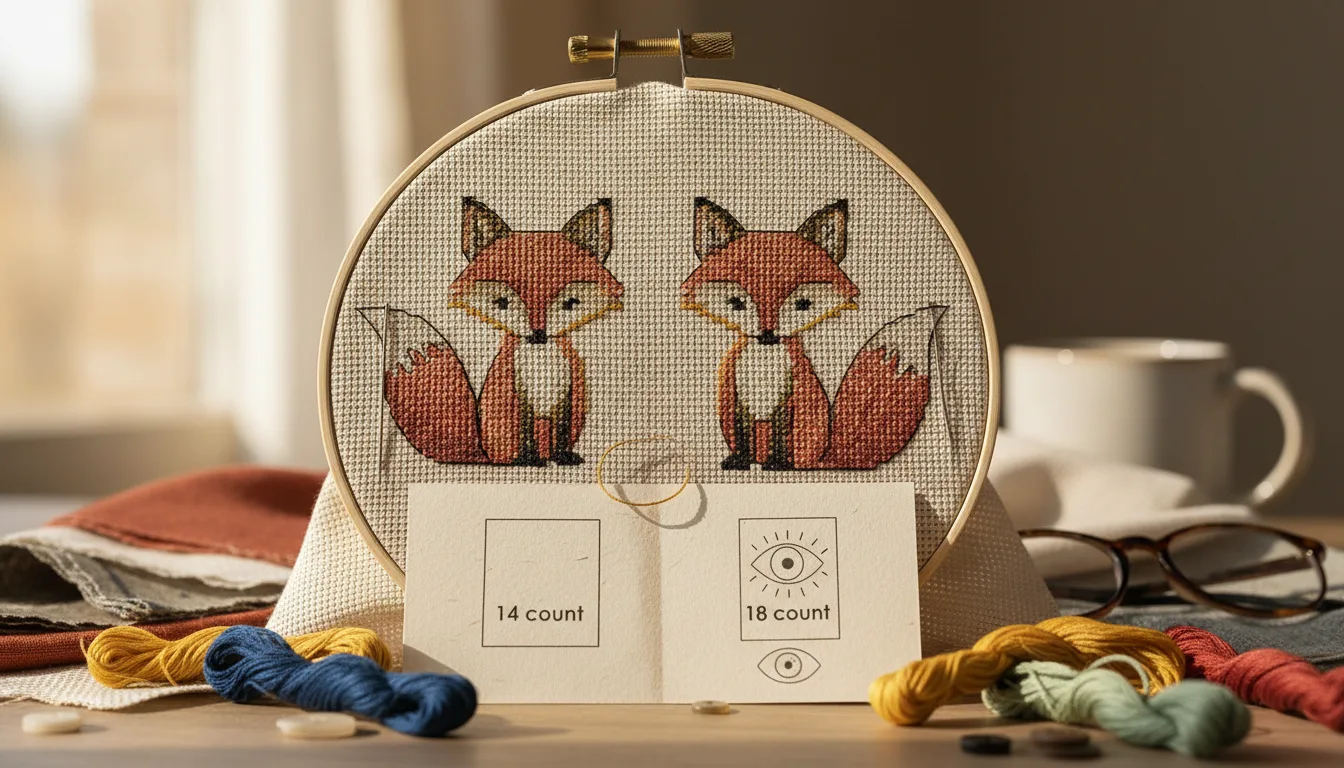 Supplies
14 vs 18 Count Aida: Size, Detail and Eyesight
14 vs 18 count Aida compared on one chart: finished size, when 18-count adds detail and when it doesn't, strands, needles and what it asks of your eyes.
Read · 9 min Supplies
Colored Aida for Photo Patterns: Fabric as a Color
On colored Aida the fabric becomes the background of a photo pattern: fewer stitches, fewer skeins. How to pick the color, test show-through and plan it.
Read · 9 min