
Guides
How to Wash Cross Stitch Without Colors Bleeding
The damp tissue test, DMC's cold-water method step by step, which care label wins when floss and fabric disagree, and what to do if a red runs.

By Antoine Duno
Updated November 20, 20269 min read
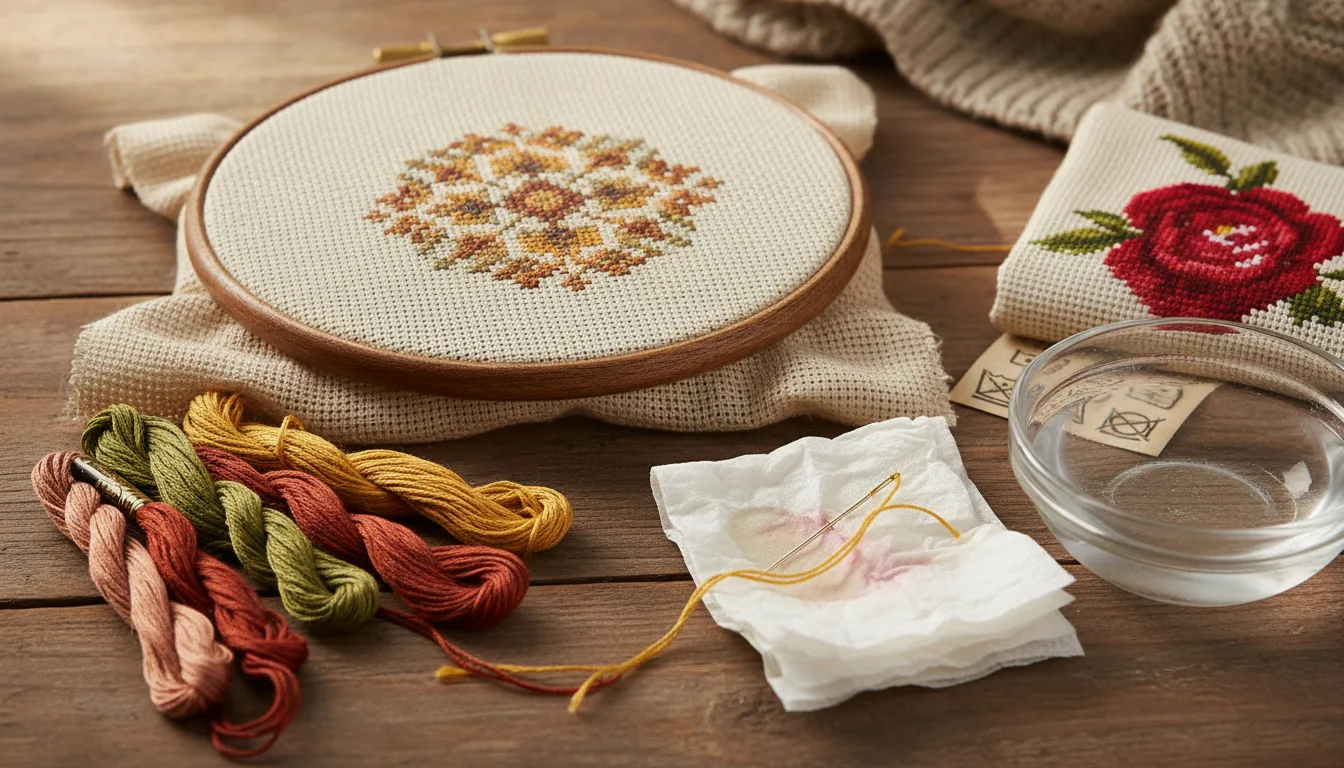
Washing is the step people are most nervous about, and for a good reason: it's the only point in a project where weeks of stitching can be damaged in five minutes. A red that runs into white Aida is very hard to undo.
The good news is that the risk is small with reputable floss, easy to test for, and mostly controlled by how you wash. Here's the method, the test that comes before it, and the honest answer on what to do if a color bleeds anyway.
What the makers say about colorfastness
| Product | What the maker says about washing |
|---|---|
| DMC six-strand cotton floss | Colorfast dyes, so work can be washed "without fear of the color fading or bleeding"; highly fade resistant |
| DMC Light Effects (metallic and specialty) | Colorfast, can be washed at 30°C |
| DMC Aida fabric | Washable at 60°C with mild detergent; press with a pressing cloth on low heat |
| Anchor stranded cotton | "Excellent colourfastness"; label allows machine wash at 95°C or below, no bleach, no tumble dry |
| Finished needlework (DMC's guidance) | Cold water, hand wash, non-biological detergent, no chlorine bleach, not dry cleaned, never a hot iron |
The row that matters is the last one. The thread and fabric labels describe each material on its own, and they're generous. The finished piece is several materials at once, stitched under tension, and DMC's own Aida page says to take into account the care instructions for all the threads and fabrics you've used. In practice that means the gentlest instruction in the piece wins, and DMC's finished needlework guidance is gentler than any single label.
Before you wash: the damp tissue test
The Cross Stitch Guild's colorfastness test takes a minute:
- Lay the work face down on a clean surface.
- Dampen a clean white tissue and press it against the back of the stitches.
- Check the tissue. Any trace of color means the colors aren't fast. The Guild's instruction is simple: don't wash, and don't tea-dye either.
Test every strong color, not just one spot. The Guild says you should have no trouble with well-known brands such as DMC, Anchor and Madeira, and singles out Christmas reds for extra care. The colors most likely to show on a pale ground are the ones worth pressing hardest on: reds, deep pinks, dark blues and near-blacks.
With a chart from our generator, the color key lists the DMC number of every thread, so you know exactly which reds and darks to test. Our charts use DMC's six-strand cotton palette, the floss DMC describes as colorfast, and any specialty thread you add yourself carries its own care instructions.
How to wash cross stitch, step by step
This is DMC's method for cleaning and washing finished needlework, in order.
- Rinse the piece under clean, cold running water.
- Mix in a small amount of non-biological detergent and gently hand wash. Press the suds through the fabric rather than scrubbing the stitches.
- Rinse several times in cold water until the water runs clear.
- Stop washing if the water becomes colored while rinsing. (More on that below.)
- Roll the piece between two clean towels, squeezing gently. Don't wring it.
- Unroll and lay it on a dry towel. Let it air dry until it's just damp.
- Press face down between two clean towels with a warm iron. DMC says the towels protect the stitches from being crushed, and to use the steam setting only to lift creases or fold lines. Ironing cross stitch covers pressing in detail.
And DMC's list of things not to do: no chlorine bleach, no biological powder, no harsh detergents, no protective coating sprays, no hot iron, don't wash it with other items, and don't dry clean it.
Why cold, gentle and alone
Every item on that list protects against one of three things: dye moving, fibers roughening, or the fabric distorting.
- Cold water runs through every step of DMC's method for finished work, from the first rinse to the last, whatever a single thread or fabric label allows.
- Non-biological detergent, no bleach: the list rules out the strongest cleaning products. A finished piece needs lifting of oils and grime, not stain removal.
- No wringing, no machine: wet cotton stretches, and a piece that's twisted or tumbled can dry out of square.
- Nothing else in the water: a new red towel in the same sink can stain a piece that was perfectly colorfast.
When a color runs
Here's the inconvenient part. Neither DMC nor the Cross Stitch Guild publishes a rescue method. DMC's instruction is to stop washing if the rinse water becomes colored. The Guild's is not to wash at all when the tissue test shows color. After that, you're on your own, and anyone who promises a guaranteed fix is guessing.
What you can do, in order of risk:
- Stop and don't apply heat. Don't iron a piece with a visible stain or put it somewhere hot to dry quickly, because the pressing step comes after a clean wash, not instead of one.
- Look at where the color went. A faint haze in the fabric right next to a red stitch is a very different problem from a pink tide across the whole background.
- Consider a dye-suspending detergent. Products exist for exactly the problem of loose dye. Jacquard describes its Synthrapol as a pH-neutral detergent that "keeps loose dye suspended during washing, thus preventing backstaining." Be aware of the conflict: Jacquard's directions are written for people dyeing fabric, and for cotton they call for hot water, which is the opposite of DMC's cold-water guidance for finished needlework. If you go this way, try it first on the stitched test scrap from earlier, not on the piece.
- For an heirloom, ask a professional. A textile conservator or a specialist needlework finisher can assess a stained piece before anything else is tried.
Stained fabric can't be swapped out from under the stitches, so for a small piece the realistic alternative to a rescue is stitching it again on new fabric. For a photo chart, the PDF is yours to keep and print as often as you like, so starting over costs time and floss, not the pattern.
Marks, not dye
Most washes are for ordinary grime rather than bleeding:
- Skin oils and handling marks come out with DMC's normal method. They're the reason most finished pieces benefit from a wash at all.
- Fabric marker and gridding lines: check the marker's own instructions before any heat touches the piece. If you plan to grid the fabric, choose a removal method before you start stitching.
- Hoop creases: DMC's pressing step, with steam for stubborn fold lines, is the fix. Washing relaxes them first.
Specialty threads and extras
Photo charts from our generator use full cross stitches in DMC cotton floss only, but plenty of pieces get extras added by hand: a metallic star, a name in backstitch, beads, buttons.
- DMC Light Effects: DMC's product page says it's colorfast and can be washed at 30°C, which fits inside a cold wash.
- Anything else: find the maker's care instructions before you wash. If a thread, bead or embellishment has none, the tissue test on that item, or leaving the piece unwashed, are the safe options.
- Pieces that will be washed again, such as cushions, need planning at the finishing stage. Cross stitch pillow finishing covers making a cover that can be removed.
Drying, shrinkage and what comes next
DMC's Aida page gives a washing temperature but doesn't state a shrinkage figure, and neither do the thread pages. So don't cut a piece to its exact final size before it has been washed and pressed. Does Aida shrink? looks at what the makers do and don't say. Let the piece dry completely before you trim, mount or frame it.
Washing is one step in a longer sequence: check, test, wash, dry, press, then finish. How to finish cross stitch puts the whole order together. And if the next project is still a photo on your phone, start the chart here and check the key for reds before you buy the floss.
Frequently asked questions
How do you wash cross stitch without the colors running?
Test first, then wash cold and gently. Press a damp white tissue on the back of the stitches; if any color transfers, the Cross Stitch Guild says don't wash. If it's clean, follow DMC's method: cold water, a little non-biological detergent, rinse until clear, roll in a towel, never wring.
Is DMC floss colorfast?
DMC says so. Its six-strand cotton floss page states that its colorfast dyes let your work be washed without fear of the color fading or bleeding. The Cross Stitch Guild agrees you should have no trouble with reputable brands such as DMC, Anchor and Madeira, but advises extra care with Christmas reds.
Can I put cross stitch in the washing machine?
DMC's instructions for finished needlework are hand washing only, in cold water, and not with other items. Anchor's floss label allows machine washing at 95°C, but that's the thread alone. A finished piece also has fabric, any specialty threads and your stitching tension to protect, so hand wash it.
What should I do if a red bleeds while washing?
Stop and don't put it on to dry in a hurry or iron it. DMC's only instruction is to stop washing if the rinse water becomes colored, and neither DMC nor the Cross Stitch Guild publishes a rescue method. Anything beyond that is a judgment call; test it on a stitched scrap first.
Can you dry clean cross stitch?
DMC says it is not recommended for cross-stitched pieces. That's worth knowing even though Anchor's floss label lists dry cleaning as allowed: the label is for the thread on its own, and DMC's advice is about the finished piece, where fabric, other threads and stitches are all involved.
Should I wash cross stitch before framing?
Usually, if it has been handled for weeks or has marks on it, because washing lifts skin oils and marker lines and relaxes the stitches. It isn't compulsory. If the damp tissue test shows any color, or a specialty thread's care is unknown, leaving a clean piece unwashed is the safer choice.
Sources
- DMC — How to clean and wash finished needlework (cold water, non-biological detergent, stop if water becomes colored, no bleach, no dry cleaning, warm iron)
- DMC — Cotton embroidery floss (colorfast, highly fade resistant dyes)
- DMC — Aida fabric (washable at 60°C; consider care instructions of all threads and fabrics used)
- DMC — Mouliné Light Effects (colorfast, washable at 30°C)
- Anchor — Stranded cotton mouliné (care label and colourfastness)
- The Cross Stitch Guild — Cross stitch FAQs (damp tissue colourfastness test; extra care with Christmas reds)
- Jacquard — Synthrapol (keeps loose dye suspended; directions and water temperatures)
Keep stitching
 Guides
How to Finish Cross Stitch: Wash, Press, Frame, Sew
How to finish cross stitch in the right order: check, test for colorfastness, wash, press, then frame, hoop or sew it, with museum advice on framing.
Read · 13 min Guides
Cross Stitch Frame Sizes: Stitch Counts for 5x7 to 16x20
How many stitches fit a 5x7, 8x10, 11x14 or 16x20 frame on 11 to 18-count Aida, with the frame lip, mats and the fabric to cut worked out.
Read · 12 min Guides
Cross Stitch Ornament Finishing: 4 Simple Methods
Four ways to finish a cross stitch ornament: flat felt back, stuffed pillow, padded board or ready-made frame, plus washing, trimming and hanging.
Read · 10 min Guides
How to Frame Cross Stitch: Lacing, Mounting, Glass
How to frame cross stitch so it lasts: sizing the board, lacing or stitching it on, spacers that keep it off the glass, UV glazing, and what never to use.
Read · 13 min Guides
Remove the Background From a Cross Stitch Photo
How to leave a photo's background unstitched: which photos it works on, the tolerance setting, checking the edge, and measuring the stitches you save.
Read · 10 min Guides
Cross Stitch Software vs Online Generator: Which to Use
PCStitch, WinStitch and MacStitch against an online photo-to-pattern generator: prices as of September 2026, what each does, and who actually needs which.
Read · 9 min