
Technique
Parking Method Cross Stitch: Step by Step for Confetti
How the parking method works on a confetti-heavy photo chart: block by block, across page joins, where to leave the threads and when not to bother.

By Antoine Duno
Updated November 19, 202611 min read
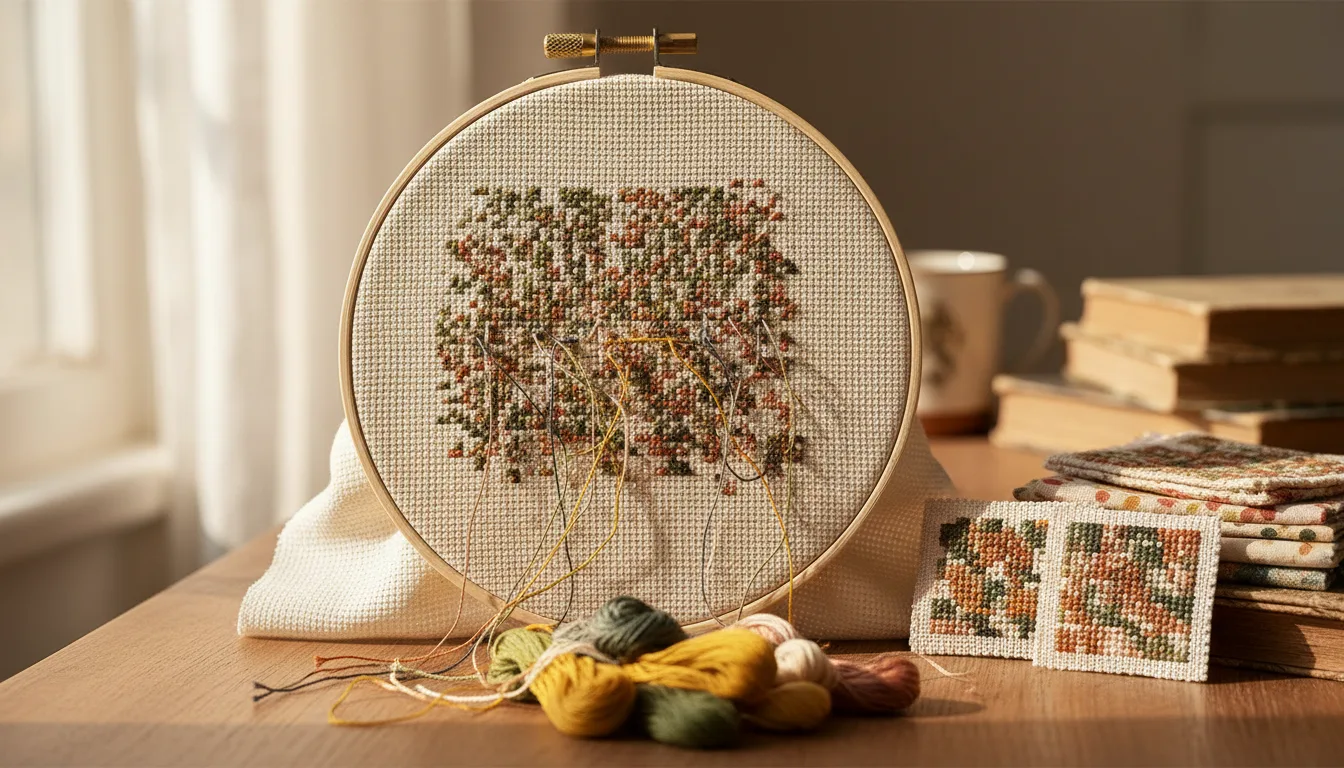
A photo chart doesn't give you big tidy shapes. It gives you a cheek made of six browns, a sky that changes shade every few squares, and runs of single stitches where one color touches another. Stitch that one color at a time across the whole piece and you spend the evening hunting for isolated squares. Stitch it square by square with a fresh thread each time and you spend it starting and finishing.
Parking is the middle way, and it's the technique that makes a confetti-heavy chart feel stitchable.
Parking, cross country and square by square
There are three broad ways to work a chart. None is wrong; each suits a different kind of chart.
| Method | How it works | Suits | Costs you |
|---|---|---|---|
| Cross country | One color at a time across a large area, then the next color | Designs with large shapes and few colors | Hunting for isolated stitches; long jumps you have to finish off |
| Square by square | Each stitch in order, changing thread whenever the color changes | Almost nothing | A start and a finish for nearly every color change |
| Parking | A small block one color at a time; each thread left waiting in the next block | Photo charts, fur, skin, sky, confetti | Many needles or threads hanging from the fabric at once |
Cross country cross stitch covers the first method properly. If you're not yet sure what the symbols and fractional marks on a chart mean, the cross stitch stitch types come first; parking only concerns the full crosses that make up most of a photo chart.
Why photo charts need it
A chart made from a photo gives every square the nearest thread color to that part of the picture. Where tones change gradually, the chart steps through close shades, and where two shades meet, you get single stitches with no neighbor of their own color. Confetti stitches explains where they come from and how to reduce them before you stitch. Whatever remains is what parking is for.
The two problems parking solves are specific:
- Starts and finishes. Every isolated stitch worked with a new thread is a start and a finish. A parked thread is already started.
- Distance on the back. DMC's guide to beginning cross stitch says to avoid long stretches of thread on the back, because they can distort the fabric, cause tangles and show through, and to secure and cut the thread rather than carry it to a distant area. Parking keeps each thread's next stitch close, so you rarely face that choice.
Parking step by step
This is block parking, the version most suited to photo charts. It assumes a chart with heavier grid lines every 10 squares, which DMC describes as there to help you count blocks of stitches.
- Choose your start and your direction. The Cross Stitch Guild notes that stitchers traditionally begin from the middle of the chart and the middle of the fabric so the design is centred. For parking, starting at a corner of the design and working in one direction, across and down, is easier to manage, because the parked threads then always hang over unworked fabric. Either works; pick one and don't change halfway. The Guild also warns that if you turn your work and chart, you should never turn halfway, or your stitches will face the wrong way.
- Mark the first block on your printout: 10 squares by 10.
- Pick any color in that block and stitch every square of it inside the block.
- Look at the next block (to the right, or below, depending on your direction). Find the nearest square of the same color.
- Bring the needle up through that square from the back and leave the thread hanging on the front. Take the needle off, or leave it threaded if you use several needles. That thread is parked.
- Repeat with every color in the block. Colors that don't appear in the next block, or only appear far away, get finished off under stitches on the back instead.
- Move to the next block. Pick up each parked thread, stitch its color in this block, and park it again one block further on.
- Mark the block as done on the chart. Marking off a cross stitch chart covers ways to do that on paper and in apps.
After a block or two, you stop starting threads almost entirely. Most colors arrive in a block already parked.
Working row by row instead of block by block
Some stitchers park in rows rather than square blocks: they complete a row of 10 or so squares in every color, then park each thread in the row below. The logic is the same. Rows keep the parked threads in one line and make it easy to see what's next; blocks give you a finished square to mark off. Try both on the same chart and keep whichever lets you count more reliably.
Keeping crosses neat when you park
Parking changes the order you make stitches in, which can tempt you to form crosses in different ways. Don't. The Cross Stitch Guild's stitch basics say all the top stitches should face the same direction for the neatest result, whatever order the squares were worked in. If you normally work half crosses along a row and come back, you can still do that inside a block, color by color.
Where to leave a parked thread
The square you park in matters more than it sounds.
- The nearest square of that color in the next block, not the first one you happen to see. The shorter the jump, the less thread travels across the back.
- Never into a square you'll stitch before that color is picked up. If a parked thread crosses squares you still have to fill, it gets caught in their stitches.
- Flip parked threads away from where you're working. Pull them toward unworked fabric and hold them clear, so your needle doesn't split them.
- Don't park a nearly finished thread. Finish it off and start fresh when you reach that block. DMC notes that thread handled too long becomes worn, frayed or dirty from passing through the fabric too many times, and a parked thread is handled over several blocks. DMC's suggested maximum length is about 50 cm, or 18 inches, fingertip to elbow.
What parking saves, as arithmetic
No standard figure exists for how much time parking saves, and it depends on the chart and on you. You can estimate the part that is countable: starts and finishes.
Take one 10 by 10 block with 12 colors in it, as an illustration:
| Approach | Threads started in this block | Threads finished in this block |
|---|---|---|
| New thread for each color in each block | 12 | 12 |
| Parking, where 9 of the 12 colors carry on from the last block and into the next | 3 | 3 |
Over a chart 150 stitches wide and 200 tall, that's 15 × 20 = 300 blocks. At 24 starts and finishes per block, that is 7,200; at 6 per block, 1,800. Those numbers are an example, not a measurement. Count the colors in two or three real blocks of your own chart, and how many of them continue into the next block, to get your version.
The same count tells you whether parking is worth it at all. If most blocks have three or four colors and they rarely continue, parking gains little.
Parking a chart that runs across several pages
A photo chart large enough to hold real detail gets split across pages. Our PDF splits big patterns across pages with overlap: a strip of the neighboring page is repeated at the edge so you can line the two up. Page overlap on large charts explains how to read it.
Parking across a page join works like parking into any other block, with one extra step:
- Finish the last block at the edge of the current page.
- On the next page, find the overlap strip and match it to the stitches you've already made on the fabric.
- Park each thread into the first square past the overlap where its color appears. Never into the overlap itself: those squares were stitched from the previous page.
- Check the color against the key on the new page as you pick each thread up. A parked thread in the wrong square is an early warning that your count slipped at the join.
If you park across the join vertically too, from the bottom of one page to the top of the page below, the same rule applies: overlap is for lining up, not for stitching twice.
Reduce the confetti before you park it
Parking makes confetti bearable. Fewer isolated stitches make it unnecessary. In our generator, two settings change how scattered the chart is, and the free preview shows the result before you pay:
- Colours. Fewer thread colors means fewer boundaries between close shades, which is where single stitches appear. How many colors a photo pattern should use covers where to set it.
- Tidy up stray stitches. Set to Light by default, it gives lone single stitches to the color that surrounds them; Medium and Strong also absorb small clusters of up to three and up to six stitches. Turn it down if fine detail, such as a catchlight in an eye, disappears.
Dithering, which scatters stitches deliberately to smooth banding, is off by default. The settings panel itself warns that on fabric every one of those stitches is a thread change, so leave it off unless banding in a large sky genuinely bothers you.
The charts are full cross stitches only, with no fractional stitches or backstitch, so everything in the chart can be parked.
When not to park
- Big solid shapes. A block of one color for 40 squares is quicker worked across, then finished.
- Very few colors per block. If a thread rarely continues into the next block, you're parking for nothing.
- Travel projects. A dozen hanging threads don't survive being folded into a bag well. Some stitchers park at home and work solid areas elsewhere.
- Large bare backgrounds. If you've left the background unstitched, as in removing the background from a photo, don't park across it. A thread carried behind bare fabric can show.
Planning a big photo piece with parking in mind, including gridding and floss storage, is the subject of full coverage cross stitch. If you'd rather have a grid to count against on the fabric itself, gridding cross stitch fabric pairs well with block parking, because your blocks and your grid lines are the same squares.
When you have a photo in mind, make the chart, look at how scattered the preview is, and decide whether you'll be parking before you buy the floss.
Frequently asked questions
What is the parking method in cross stitch?
It's a way of working a small area one color at a time without finishing off each thread. When a color is done in the current block, you bring it up in the next square where it's needed, just ahead, and leave it hanging. When you reach that square, the thread is already there waiting.
Is parking faster than cross country?
On a chart full of scattered single stitches, usually, because you start and finish far fewer threads and never hunt for isolated squares across the fabric. On a design with big solid shapes, not really: working one color across a large area is simpler, and a dozen hanging needles only gets in the way.
How far ahead should I park a thread?
Only into the next block or the next row, never across the piece. DMC advises against long stretches of thread on the back because they can distort the fabric, tangle and show through. If a color's next square is far away, finish it off and start a new length there.
Do parked threads tangle?
They can, especially with many colors in play. Keep lengths short, as DMC suggests about 50 cm or 18 inches, flip the parked threads away from the area you're stitching, and finish a thread off rather than parking it when it's nearly used up.
How do I park across a page break in a large chart?
Finish the block at the edge of the page, then find the first new squares on the next page by matching its overlap strip to the stitches you've already made. Park into those first unshaded squares. Never park into the overlap itself: those stitches belong to the previous page.
Does parking work with half stitches or backstitch?
Parking is for the full crosses that make up the chart. DMC says to add backstitch after the cross stitches are complete, so it doesn't need parking. Whatever you do, keep every top stitch crossing in the same direction, even when you complete stitches in a different order than usual.
Sources
- DMC — How to begin cross stitch (avoid long stretches of thread at the back; secure and restart for distant areas)
- DMC — How to read a cross stitch chart (larger grid lines for counting blocks; project cards with symbols)
- DMC — How to use stranded thread (about 50 cm maximum; long threads wear and fray)
- DMC — Use back stitch to accentuate your cross stitch (add backstitch after the cross stitches)
- The Cross Stitch Guild — Stitch basics (all top stitches facing the same direction)
- The Cross Stitch Guild — Cross stitch chart and key basics (starting from the middle; never turn the work halfway)
Keep stitching
 Technique
Confetti Stitches: Why They Happen and How to Cut Them
What causes the scattered single stitches in photo cross stitch patterns, how to cut them before you convert, and how to stitch the ones that remain.
Read · 13 min Technique
Cross Stitch Stitch Types: Full, Half, Quarter, Back
Every cross stitch stitch type explained: full, half, quarter and three-quarter stitches, backstitch and French knots, and which ones a photo pattern uses.
Read · 13 min Technique
Backstitch in Cross Stitch: Outlines for Photo Patterns
How to backstitch in cross stitch, and when photo patterns need it: whiskers, eyes, lettering and fine lines, planned on paper and added after the crosses.
Read · 10 min Technique
Half Stitch Cross Stitch: Soft Shading in Photos
How to work a half cross stitch, why it looks paler and uses less thread, and how to mark sky and background areas on a photo chart for half stitches.
Read · 10 min Beginners
Cross Stitch for Beginners: Supplies and First Stitches
Cross stitch for beginners: the supplies you need, how to start without knots, how to make neat first stitches, and how to wash and finish your piece.
Read · 10 min Technique
Symbol Chart vs Color Chart: Which to Stitch From
Symbol chart or color chart? What each shows, why photo patterns with many close shades need symbols, when color helps, and how to use both together.
Read · 9 min