Guides
Photo Christmas Ornament Cross Stitch: Small Charts
Turn a pet or baby photo into a cross stitch Christmas ornament: chart sizes that still read, finished size by fabric count, lettering, sparkle and timing.
By Antoine Duno
Updated October 19, 202611 min read
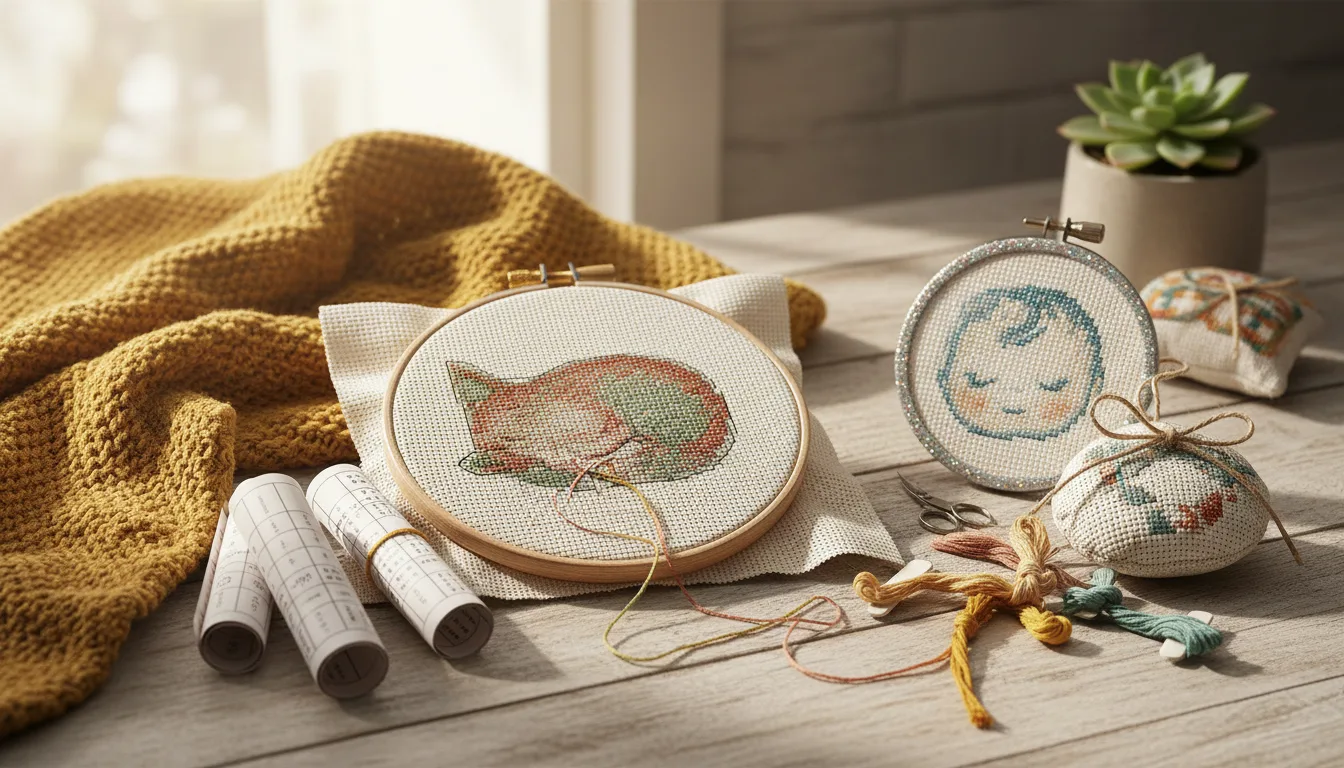
A photo ornament is the most forgiving way to turn a picture into a Christmas gift. It's small enough to finish in weeks rather than months, it gets taken out of the box every December, and it doesn't need a framer. The catch is also its size: a pet's face or a baby's smile has to survive being described in a few thousand stitches, and most photos don't.
This guide covers choosing a photo that holds up at ornament size, how many stitches the chart needs, what fabric count does to the finished piece, and the extras people add by hand: a name, a year and a little sparkle.
Ornament sizes by stitch count and fabric
Finished size depends on two numbers: stitches in the chart and the fabric count. DMC defines the count as the number of stitches you can make in an inch, so the finished width in inches is simply stitches ÷ count.
| Chart width | Stitches if square | On 11-count | On 14-count | On 16-count | On 18-count |
|---|---|---|---|---|---|
| 40 | 1,600 | 3.6 in | 2.9 in | 2.5 in | 2.2 in |
| 50 | 2,500 | 4.5 in | 3.6 in | 3.1 in | 2.8 in |
| 60 | 3,600 | 5.5 in | 4.3 in | 3.8 in | 3.3 in |
| 70 | 4,900 | 6.4 in | 5.0 in | 4.4 in | 3.9 in |
| 80 | 6,400 | 7.3 in | 5.7 in | 5.0 in | 4.4 in |
Two things matter here.
The detail is in the stitch count, not the fabric. A 60-stitch chart holds the same information on 11-count as on 18-count; the finer fabric only makes it smaller. If the ornament has to be small, use a finer count rather than fewer stitches, and the face keeps its detail.
The work is in the stitch count too. A 60-stitch chart takes the same number of stitches whatever the fabric, so a smaller finished ornament isn't a quicker one. Aida cloth counts covers the counts in more detail; the Cross Stitch Guild notes that Aida is sold in counts from 8 to 20.
For your fabric, leave generous extra around the design while you stitch. DMC's recommendation of at least 8 cm / 3 inches all round is written for framing, but it's a sensible default for an ornament too, because you need something to hold and to hoop, and the excess is trimmed when you finish.
Choosing a photo that survives being small
At full portrait size, a chart can rescue an average photo. At 50 stitches, it can't. The photo has to do most of the work.
| Works at ornament size | Falls apart at ornament size |
|---|---|
| One face, filling most of the frame | A whole dog on a lawn, a group around a tree |
| A plain background in a contrasting tone | A cream dog on a cream rug, a baby on a patterned blanket |
| Strong, simple markings: a white blaze, a dark mask | Subtle tabby stripes, fine freckles |
| Soft daylight from the side | Flash, heavy shadows, a lit Christmas tree behind |
| Eyes sharp and open, with a visible catchlight | Eyes half closed or in shadow |
Pets are easier than people. Fur hides small irregularities, and a dog or cat reads from its markings and outline. A human face at 50 stitches leaves only a few stitches for eyes, nose and mouth, and faces show small errors, so baby ornaments work best as a close crop of the face with a strong hairline or hat. A mini pet portrait goes further into the smallest charts that still read as a particular animal.
Crop before you size. Cropping tighter gives the face more of the chart's stitches without making the ornament bigger. A face that fills 90% of the crop gets nearly twice the stitches across of a face that fills half of it.
Check the eyes with a quick sum
Before choosing a chart width, measure how many stitches an eye will get.
Stitches across one eye = chart width × (eye width in the photo ÷ crop width in the photo)
Measure both widths on the cropped photo, in pixels or with a ruler on the screen. As arithmetic: an eye 40 pixels wide in a crop 600 pixels wide is 1/15 of the crop. At a 60-stitch chart that's 4 stitches; at 45 stitches, 3.
If the answer is two stitches or fewer, the eye will turn into a dark dot. Crop tighter, or widen the chart. Cross stitching a pet portrait from a photo explains why the catchlight, often a single pale stitch, matters so much.
Colors: fewer than you'd think
A small chart has little room for gradual shading. On a 60-stitch chart, a muzzle might be 10 stitches across, and 10 stitches can't hold six shades of brown in any meaningful way. The extra shades just alternate and become scattered single stitches, which are slow to stitch and invisible on the tree.
A practical method:
- Generate the same photo at two color counts, one low and one moderate.
- Look only at the eyes and the outline. If they read at the lower count, take it.
- Check for near-duplicate shades in the key. If you can't tell two apart on screen, you won't in thread.
- Use the tidy-up setting in our generator, which removes lone stitches of one color surrounded by another, and check the preview again.
Every color also costs at least one skein, however few stitches it covers. How many colors a photo pattern should use has the full trade-off.
Background: let the fabric do it
On an ornament, a stitched background is almost always wasted effort. It adds stitches, adds colors, and competes with a face that already has very little room.
- Leave it unstitched. Choose fabric in a color that contrasts with the subject, so the outline reads. Our generator's background option takes out a plain background from the edges inwards and leaves it as bare fabric. It works best on a wall or a sheet; on a busy room it will take too much or too little, and you'll see that in the preview.
- Stitch a circle, not a square. Most ornaments are round. The chart is rectangular, so draw the circle on your printed chart and leave the corners unstitched. As arithmetic, a circle fills about 78.5% of its square, so a 60 × 60 chart stitched as a circle is about 2,830 stitches instead of 3,600.
- Keep a margin inside the finished edge. Whatever the finishing method, a seam, a frame or a felt backing takes some of the edge. Don't put an ear or a nose right against the circle.
Colored Aida for photo patterns explains how to choose a fabric color that works as part of the design.
A name and a year
Most photo ornaments carry a name or a year, and at this size the lettering needs planning, not improvising.
Measure the letters first. Count the width of the alphabet you plan to use. As arithmetic, with capitals 5 stitches wide and 1 stitch of space, each character takes about 6 stitches, and "BISCUIT 2026" is 12 characters, including the space, which is about 72 stitches: wider than a 60-stitch ornament. Options:
- Front: the name. Back: the year. The back of an ornament is usually a plain piece of fabric or felt, and a year stitched there reads as a date, not decoration.
- Initials and the year on the front, if the name is long.
- A second, smaller piece on the back for a longer message.
Stitch the lettering last, in backstitch. DMC advises adding backstitch after the cross stitches, with a single strand for fine outlines and small lettering, and a darker shade of a color already in the design rather than black for a softer look. It also warns that pulling backstitch too tight puckers the fabric, which shows badly on a small, round piece. Use a thread already in the key so you don't buy another skein. Our photo charts are full cross stitches only, so the lettering is something you draw onto the printed chart and add by hand.
Check the spelling and the year twice. An ornament comes out every December; a typo does too.
A little sparkle
Metallic thread belongs on a Christmas ornament, but not in the face. The photo chart is matched to solid cotton floss, and swapping a shade for a metallic breaks the shading. Add sparkle deliberately, after the portrait is done: a collar, a bow, a star in a corner, a line around the circle.
What DMC says about its two sparkly six-strand threads:
| Thread | What DMC states |
|---|---|
| Light Effects | 100% polyester, 8.7 yd / 8 m skeins, six strands; use lengths under 12 inches to prevent fraying; can be combined with stranded floss for a hint of shimmer |
| Étoile | Cotton blended with lurex glitter, six strands; the cotton content makes it easier to stitch with than other metallic threads; washable at 30°C |
Sources: DMC Light Effects and DMC Étoile.
The easiest effect is DMC's own suggestion: one strand of Light Effects alongside one strand of ordinary floss in the needle, for shimmer without a solid metallic line. Metallic floss in cross stitch covers the handling in more detail.
How long it takes, and when to start
Time one 10 × 10 block from a chart like yours and multiply. As arithmetic at two example paces:
| Chart | Stitches | At 150 stitches/hr | At 300 stitches/hr |
|---|---|---|---|
| 40 × 40 | 1,600 | ~11 hours | ~5 hours |
| 60 × 60 | 3,600 | 24 hours | 12 hours |
| 60 × 60 stitched as a circle | ~2,830 | ~19 hours | ~9 hours |
| 80 × 80 | 6,400 | ~43 hours | ~21 hours |
Then add time for finishing, which on an ornament is sewing or gluing a backing, adding a hanging loop and, if you want, a trim. When to start a Christmas cross stitch gift works start-by dates back from December 25 for each size, and the gifts from photos guide has the same method for any occasion.
If you're making several, for grandparents or for each child's first Christmas, multiply before you promise. Four 60 × 60 ornaments are 14,400 stitches, the size of one fair-sized portrait.
Finishing it as an ornament
An ornament gets handled and packed away every year, so a firm backing matters more than a perfect edge. The usual options are a fabric or felt back sewn around the edge with a little stuffing, a card or board insert behind the stitching, or a ready-made ornament frame with a window. Wash and press the stitching before you finish it: DMC's washing guidance is cold water, a little non-biological detergent, and pressing face down between towels with a warm iron, never a hot one.
Cross stitch ornament finishing walks through the methods step by step. If you'd rather make something bigger for the mantelpiece with a name on it, a personalized Christmas stocking uses the same lettering approach at a larger scale.
When you have a photo in mind, make a small chart from it and look at the eyes in the preview before anything else.
Frequently asked questions
What size should a photo cross stitch ornament be?
Usually somewhere around 40 to 80 stitches across. Finished size is stitches divided by fabric count, so 60 stitches is about 4.3 inches on 14-count Aida and 3.3 inches on 18-count. Smaller charts only work with a close crop and a simple, high-contrast photo, because the face has very few stitches to live in.
Can a small cross stitch ornament look like my pet?
Yes, if the photo is cropped to the face and the eyes get several stitches each. Measure it: divide the eye's width in the photo by the width of your crop, then multiply by the chart width. If an eye comes out at two stitches or fewer, crop tighter or make the chart wider.
How many colors should a photo ornament use?
Fewer than a full-size portrait. A small chart has little room for gradual shading, so extra shades mostly turn into scattered single stitches. Generate the same photo at two color counts, such as a low and a moderate one, and keep the lowest count where the face still looks like itself in the preview.
How long does a photo ornament take to cross stitch?
It depends on your pace, so time yourself on a 10 by 10 block first. As arithmetic, a 60 by 60 chart is 3,600 stitches: 12 hours at 300 stitches an hour, or 24 hours at 150. Leaving the background unstitched, or stitching only a circle, cuts that further.
Can I add the name and year to a photo ornament?
Yes, but plan the space first, because letters are wide at this scale. As arithmetic, a name and year of 12 characters at 6 stitches per character needs 72 stitches, more than a 60-stitch chart. Put a short name on the front and the year on the back, worked in a single strand of backstitch.
Should I use metallic thread on a Christmas ornament?
A little can work, added by hand after the photo chart is stitched. DMC advises using its Light Effects thread in lengths under 12 inches to prevent fraying, and says its Étoile thread is easier to stitch with than other metallics. Keep sparkle to the edges, a collar or a star, not the face.
Sources
- DMC — What fabric should I use? (count is the number of stitches per inch)
- DMC — How to prepare your fabric (at least 8 cm / 3 inches around the design)
- DMC — Use back stitch to accentuate your cross stitch (after the crosses, single strand, darker shade, tension)
- DMC — Light Effects (polyester, lengths under 12 inches, combine with floss)
- DMC — Étoile (cotton and lurex, easier than other metallics, washable at 30°C)
- DMC — How to clean and wash finished needlework
- The Cross Stitch Guild — Fabric basics (Aida counts from 8 to 20)
Keep stitching
 Guides
Cross Stitch Gifts From Photos: Ideas and Start Dates
Photo cross stitch gift ideas by occasion, with the arithmetic to work out when to start: chart size, your stitching pace, hours a week and finishing time.
Read · 15 min Guides
Christmas Cross Stitch Gift: When to Start by Size
When to start a Christmas cross stitch gift, by chart size: start-by dates worked back from December 25, 2026, and the largest chart you can still finish.
Read · 7 min Guides
Wedding Cross Stitch From a Photo: Names and Date
Plan a wedding cross stitch from a photo: choosing and sizing the couple photo, a white dress on white fabric, names and date lettering, and when to start.
Read · 11 min Guides
Memorial Cross Stitch From a Photo of a Loved One
A memorial cross stitch when the only photo is old, small or shared by text: scanning, choosing, sizing a face, black and white charts and lettering.
Read · 10 min Guides
Pet Memorial Cross Stitch: Charting a Pet Who's Gone
How to make a pet memorial cross stitch when you can't take a new photo: finding the best original, scanning prints, sizing, lettering and time.
Read · 12 min Guides
Stitchmate Alternative for Photo Cross Stitch Patterns
Stitchmate vs a simpler photo-to-pattern generator: same $5.99 single price, very different tools. What each PDF includes, as of September 2026.
Read · 10 min