Guides
Cross Stitch Gifts From Photos: Ideas and Start Dates
Photo cross stitch gift ideas by occasion, with the arithmetic to work out when to start: chart size, your stitching pace, hours a week and finishing time.
By Antoine Duno
Updated September 22, 202615 min read
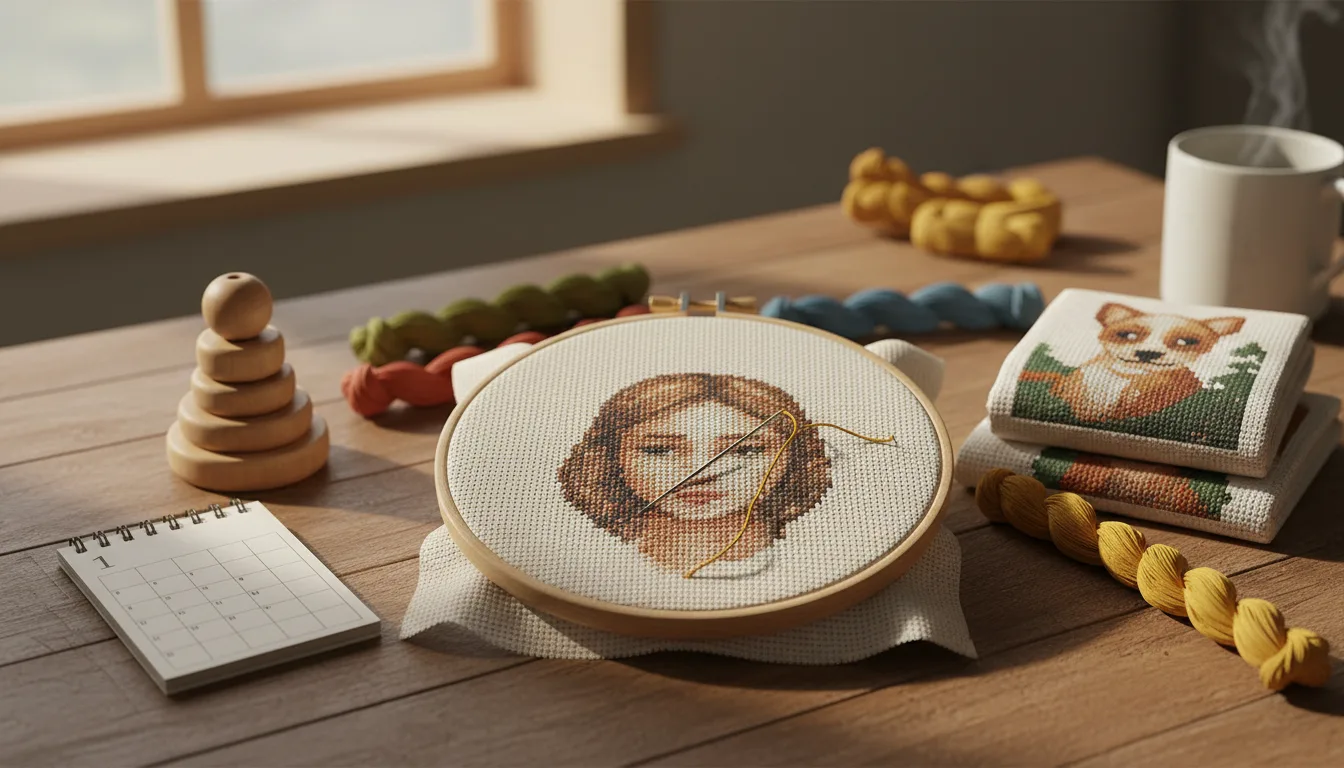
A stitched gift made from a photo is slow on purpose. That is what makes it land: the dog who died last spring, the house a couple just bought, a child's drawing kept long after the child has grown up. It is also what makes these gifts go wrong, because the most common failure isn't the stitching. It's starting too late, or starting too big.
This guide is the hub for every occasion-specific guide on this site. It covers which photos make good gifts, how big each kind of gift should be, and a simple method to work out the date you need to start, using your own stitching pace instead of someone else's average.
Gift ideas by occasion
Not every photo gift is the same size of project. The table below pairs each occasion with a realistic scale and the thing that most often goes wrong, with a link to the full guide for each.
| Occasion | What to stitch | Typical scale | What catches people out | Full guide |
|---|---|---|---|---|
| Pet memorial | The pet's head, sometimes with name and dates | Medium to large | The best-loved photo is often too blurry | Pet memorial cross stitch |
| Birthday, just because | A living pet's portrait | Medium to large | Eyes too few stitches across | Pet portrait tips |
| Memorial for a person | A face from an old or small photo | Medium | The only photo can't carry fine detail | Memorial cross stitch from a photo |
| Wedding or anniversary | The couple, names and date | Large | The photo belongs to the photographer | Wedding cross stitch from a photo |
| New baby | Name, date, weight, and a small image | Small to medium | Details change or arrive late | Baby birth sampler |
| Christmas | Ornaments, a pet in a hat, a stocking name | Small | Starting in November | Christmas gift timeline |
| New home | The house from the street | Medium | Straight lines and windows need clean edges | House portrait cross stitch |
| Grandparents | A child's drawing | Small to medium | Needs few colors, not many | Drawing to cross stitch pattern |
| Family milestone | Several people in one photo | Large | Faces need far more stitches than pets | Family portrait cross stitch |
| Valentine's Day | A couple photo, small and simple | Small | Too much detail for a small chart | Valentine's cross stitch gift |
Every occasion guide is also collected on the gifts and occasions topic page.
Which photos make good gifts
A photo that means a lot and a photo that stitches well are not always the same picture. For a gift, you need both.
What stitches well is the same for every occasion: a subject that fills the frame, even daylight, sharp eyes if there are eyes, and a plain background that contrasts with the subject. Cross stitching a pet portrait from a photo goes through each of these in detail, and most of it applies to people and houses too.
What means a lot is something only the recipient knows. For some gifts that is easy: a new home, a new baby. For others, especially memorials and portraits of people, the photo you would choose may not be the one they would. When in doubt, ask. You can ask a partner or sibling to find "their favorite photo of the dog" without giving the gift away.
Where the photo came from matters too. US copyright law protects photographs as soon as they are taken, and preparing derivative works is one of the owner's exclusive rights, according to the US Copyright Office. UK guidance on ownership of copyright works says the creator, not the person who commissioned the work, is the first owner unless agreed otherwise in writing. In practice, a professional wedding or studio photo usually belongs to the photographer. Ask them before charting it, or use a photo a guest took. Using photos for cross stitch: the copyright rules explains this in more detail. It's general information, not legal advice.
Old printed photos
Memorial and anniversary gifts often start from a print. Scan it rather than photographing it if you can. The Library of Congress guide to scanning personal collections recommends 300 dpi for 4 × 6 and 5 × 7 inch prints, and 400 or 600 dpi if you plan to enlarge them to 8 × 10 inches or more. Clean the scanner glass first, because a speck of dust can turn into a stray stitch.
How big each gift should be
Finished size depends on two numbers: the stitches in the chart and the fabric count. DMC defines count as the number of stitches you can make in an inch, so finished size in inches is stitches divided by count. DMC also recommends a clear border of at least 8 cm / 3 inches all round, which adds 6 inches to each dimension of the fabric you cut.
| Chart size | Total stitches | Finished on 14-count | Fabric to cut | Suits |
|---|---|---|---|---|
| 60 × 60 | 3,600 | 4.3 × 4.3 in | 10.3 × 10.3 in | An ornament, a simple silhouette, a drawing |
| 80 × 80 | 6,400 | 5.7 × 5.7 in | 11.7 × 11.7 in | A small keepsake or a simple pet head |
| 100 × 125 | 12,500 | 7.1 × 8.9 in | 13.1 × 14.9 in | A pet head with a name below |
| 150 × 150 | 22,500 | 10.7 × 10.7 in | 16.7 × 16.7 in | A detailed pet portrait, a house |
| 150 × 200 | 30,000 | 10.7 × 14.3 in | 16.7 × 20.3 in | A couple or a fuller portrait |
Two things follow from this. First, detail comes from the stitch count, not the fabric: the same chart on 18-count holds the same detail in a smaller piece. Second, work grows with area, not width. Going from 100 × 125 to 150 × 200 more than doubles the stitches. For other counts, work out your fabric size before you cut.
If a frame is already chosen, size the chart to fit it; cross stitch frame sizes works backwards from standard frames to stitch counts.
Working out your start date
Nobody can tell you how fast you stitch. People vary widely, and so do charts: a pet portrait full of scattered single stitches is slower than a house with large blocks of one color. So instead of an average, use your own number.
Step 1: measure your pace
Stitch one 10 × 10 block, 100 stitches, from a chart like the one you're planning, with a timer running. Pick an area of middle difficulty, not a flat background. Multiply to get stitches per hour: if the block took 20 minutes, your rate is 300 stitches an hour. How long cross stitch takes covers the method in more detail.
Step 2: be honest about your week
Count the hours you actually stitch in a normal week, not a good week. Evenings lost to work, travel and other plans all count.
Step 3: do the division
Hours = total stitches ÷ stitches per hour. Weeks = hours ÷ hours per week.
The table shows the arithmetic at two example rates and 5 hours a week. These are examples to show the calculation, not claims about how fast people stitch. Put your own numbers in.
| Chart size | Stitches | Hours at 150/hr | Weeks at 150/hr, 5 hr/week | Hours at 300/hr | Weeks at 300/hr, 5 hr/week |
|---|---|---|---|---|---|
| 60 × 60 | 3,600 | 24 | 4.8 | 12 | 2.4 |
| 80 × 80 | 6,400 | 42.7 | 8.5 | 21.3 | 4.3 |
| 100 × 125 | 12,500 | 83.3 | 16.7 | 41.7 | 8.3 |
| 150 × 150 | 22,500 | 150 | 30 | 75 | 15 |
| 150 × 200 | 30,000 | 200 | 40 | 100 | 20 |
Step 4: add the weeks around the stitching
The stitching is not the whole project. Add time for:
- Choosing the photo and making the chart. Quick if you already have the photo; slow if you need to ask family or scan old prints.
- Buying supplies. Every color in the key needs at least one skein of floss, and some shades may not be in stock locally. How much embroidery floss you need shows the skein arithmetic.
- Washing and pressing. DMC's guidance on washing finished needlework has the piece air dry until damp before pressing face down between towels with a warm iron. Allow a day or two.
- Framing or sewing up. If a framer is doing it, ask about their turnaround before you start, especially near the holidays. How to finish cross stitch covers framing, hoops, ornaments and pillows.
- Life. A cushion for illness, holidays and the week the stitching stalls. Choose the margin yourself; as an example, a quarter of the stitching time adds almost 4 weeks to a 15-week project.
Step 5: count back from the date
A worked example, as arithmetic: a 150 × 150 pet portrait for Christmas, at 300 stitches an hour and 5 hours a week, is 15 weeks of stitching. Add 2 weeks for the chart and supplies at the start. That's 17 weeks, so counting back from December 25, 2026, the start date is August 28, 2026, before any time for framing or a cushion.
The same person with a 100 × 125 chart needs about 8.3 weeks of stitching, call it 9, plus 2 weeks: a start date of October 9, 2026. The size of the chart moves the start date by seven weeks.
For Christmas specifically, when to start a Christmas cross stitch gift has the deadlines worked through by size.
Gift by gift: what to know
Pet portraits and pet memorials
The most requested photo gift, and the most forgiving subject, because fur hides small irregularities that would spoil a human face. Size the chart so each eye is several stitches across, and don't stitch a busy background. Cross stitching a pet portrait from a photo is the full guide.
A memorial is different in one way: you can't take a better photo. Pet memorial cross stitch covers finding the best version of the photos that exist, and why a simpler, bolder chart often suits a blurry favorite better than a large detailed one. Don't tie a memorial to a date you might not meet.
Memorials for people
Often the only photos are old, small or shared through a chat app. Faces don't forgive what fur does: a nose one stitch out of place changes the likeness. Choose the sharpest photo, keep the chart modest, and consider a simple treatment with a name and dates. A memorial cross stitch from a photo of a loved one goes through the options gently.
Weddings and anniversaries
A couple photo with names and a date underneath. Two faces in one chart need a larger stitch count than one pet, and lettering adds rows. The copyright point above matters most here, since the best photos usually come from a professional. Wedding cross stitch from a photo covers composition, lettering and timing. For a smaller anniversary or Valentine's piece, a Valentine's cross stitch gift from a couple photo keeps the chart small.
New babies
A birth sampler often carries the name and date, and sometimes the weight and time of birth. The catch is that those details only exist after the birth, so stitch the border and any image first and leave the lettering for last. Baby birth sampler cross stitch explains how to plan that.
Christmas
Small charts win. From the table above, a 60 × 60 ornament is 2.4 to 4.8 weeks of stitching at the example rates, while a 150 × 150 portrait at the same rates needs to start in late summer or earlier. See photo Christmas ornament cross stitch for small charts, and cross stitch ornament finishing for turning them into something that hangs.
New homes
A house stitches well from a straight-on photo in flat daylight, with no cars or bins in front. Straight edges and windows need clean color boundaries, so fewer colors often look better than more. House portrait cross stitch covers the photo and the chart.
Children's drawings
A crayon drawing for a grandparent is one of the quickest, cheapest photo gifts, because it needs only a handful of colors and usually a small chart. Keep the wobbly lines; they are the point. Drawing to cross stitch pattern explains how to photograph the drawing flat.
Family portraits
The biggest project on this list for its size. Each face needs enough stitches for eyes and a mouth to read, so a group photo needs a much wider chart than a single pet. Family portrait cross stitch from one photo sets out what a chart can carry.
Before you commit: check the preview
The cheapest moment to change your mind is before you buy floss. Make the chart at two or three sizes and color counts and compare them.
- Look at the detail that makes it theirs. The eyes, the blaze on the dog's chest, the front door of the house, the smile.
- Count stitches across one eye. If it's two or three, crop tighter or go bigger.
- Check the color count. Each shade costs at least one skein. How many colors a photo pattern should use shows how to compare two counts.
- Check the stitch total against your start-date arithmetic. If the date doesn't work, go smaller now.
- Step back from the screen. If it reads from across the room, it will on a wall.
Lettering: names, dates and words
Most photo gifts gain from a line of text, and it is often the part the recipient reads first.
- Plan it into the fabric size. As arithmetic: letters 7 stitches tall with a 3-row gap above them add 10 rows, about 0.7 inches on 14-count.
- Check spellings and dates twice, and ask someone else to check. Unpicking a wrong date is the most painful fix in the project.
- Use a color already in the chart, such as the darkest shade, so the text doesn't cost another skein.
- Keep it short. A name and a date read well at stitch scale. A long quote needs a wider chart and more time.
If you're running late
Decide early, when there are still good options. With a month to go, you can:
- Crop tighter. A head instead of head and shoulders keeps the likeness and removes thousands of stitches.
- Leave the background unstitched. Choose fabric in a color that suits the subject.
- Make a smaller version now and the full piece later.
- Give the chart and the work in progress with a card. For many people, seeing the piece started for them means as much as seeing it finished.
What rarely works is stitching faster. Rushed tension shows, and the last weeks of a project are usually slower, not faster, because they are full of backstitch and finishing. Quick cross stitch gifts has ideas that can be done in a weekend when the big one won't make it.
Supplies and finishing, briefly
DMC floss is sold in 8.7 yard / 8 meter skeins with six strands, and DMC describes it as colorfast, so a finished gift can be washed. Start from the center of the design and the center of the fabric, as DMC recommends, so the portrait and the lettering land where you planned. Hem the edges or tape them, as DMC's fabric preparation page suggests, so a months-long project doesn't fray.
Before wrapping, wash and press the piece following DMC's washing guidance: cold water, a little non-biological detergent, rinse until the water runs clear, and stop if the water becomes colored. Then frame it, put it in a hoop or sew it up; how to finish cross stitch covers each option.
If you're still choosing, pick the photo first and the occasion second. When you have one, turn it into a chart and check the preview against your start date before anything else.
Frequently asked questions
What is a good cross stitch gift made from a photo?
One built on a photo that means something to the recipient and suits stitching: a pet, a home, a couple, a new baby or a child's drawing. Pets and simple subjects are the most forgiving. Faces need more stitches to stay recognizable, so a family portrait is a bigger project than it looks.
How far ahead should I start a cross stitch gift?
Work it out from your own pace rather than guessing. Time one 10 by 10 block, divide the chart's stitches by your stitches per hour, divide by the hours you stitch each week, then add weeks for supplies and finishing. As arithmetic, 22,500 stitches at 300 an hour and 5 hours a week is 15 weeks.
What size should a photo cross stitch gift be?
The smallest size that keeps the important detail. An ornament or small keepsake can be under 80 stitches across, while a portrait with recognizable eyes usually needs around 150. Finished size is stitches divided by fabric count, so a 150-stitch chart is about 10.7 inches wide on 14-count Aida.
Can I use a professional wedding photo for a cross stitch gift?
Ask the photographer first. Copyright in a photo usually belongs to the person who took it, not the couple who paid for it, unless a contract says otherwise. A short written request explaining it's a one-off stitched gift is the simple route, or use a photo a guest took instead.
What if I won't finish the cross stitch gift in time?
Change the plan early rather than rushing the last weeks. Stitch a smaller crop of the same photo, leave the background unstitched, or give the chart and the started piece with a card promising the finish. A thoughtful gift arriving late is usually received better than a rushed one on time.
Should a photo cross stitch gift be a surprise?
Only if you're sure of the photo. For memorials and portraits of people, asking which photo they love avoids choosing one that hurts or disappoints. You can keep the finished piece a surprise while asking for the photo under another pretext, or ask a close family member to choose.
Sources
- DMC — What fabric should I use? (count is the number of stitches per inch)
- DMC — How to prepare your fabric (border of at least 8 cm / 3 inches, hemming or taping edges)
- DMC — How to begin cross stitch (start in the middle of the design and fabric)
- DMC — How to clean and wash finished needlework
- DMC — Cotton Embroidery Floss (Mouliné Spécial): 8.7 yard / 8 meter skeins, six strands, colorfast
- Library of Congress — Scanning Your Personal Collections (300 dpi; 400 or 600 dpi to enlarge)
- US Copyright Office — What is Copyright? (photographs; derivative works)
- GOV.UK — Ownership of copyright works (commissioned works)
Keep stitching
 Guides
Pet Memorial Cross Stitch: Charting a Pet Who's Gone
How to make a pet memorial cross stitch when you can't take a new photo: finding the best original, scanning prints, sizing, lettering and time.
Read · 12 min Guides
Cross Stitching a Pet Portrait From a Photo
Choosing the photo, getting the eyes right, handling fur and backgrounds, sizing the chart, and how long a pet portrait cross stitch really takes.
Read · 13 min Guides
Custom Cross Stitch Pattern Cost: Free vs $5.99 vs Etsy
What a custom cross stitch pattern from a photo costs in 2026: free generators, $2.99 to $5.99 per pattern, subscriptions, kits and Etsy commissions.
Read · 12 min Guides
Cat Cross Stitch Pattern From Your Own Photo
A custom cat cross stitch pattern from your photo: getting the eyes and pupils right, adding whiskers in backstitch, sizing the chart and picking colors.
Read · 11 min Guides
Cross Stitch Pattern Generators Compared: 2026 Prices
Pic2Pat, Stitchmate, Stitch Fiddle, StitchFromPhoto, Cross Stitched and more, compared on price and on what the PDF contains. Prices as of September 2026.
Read · 14 min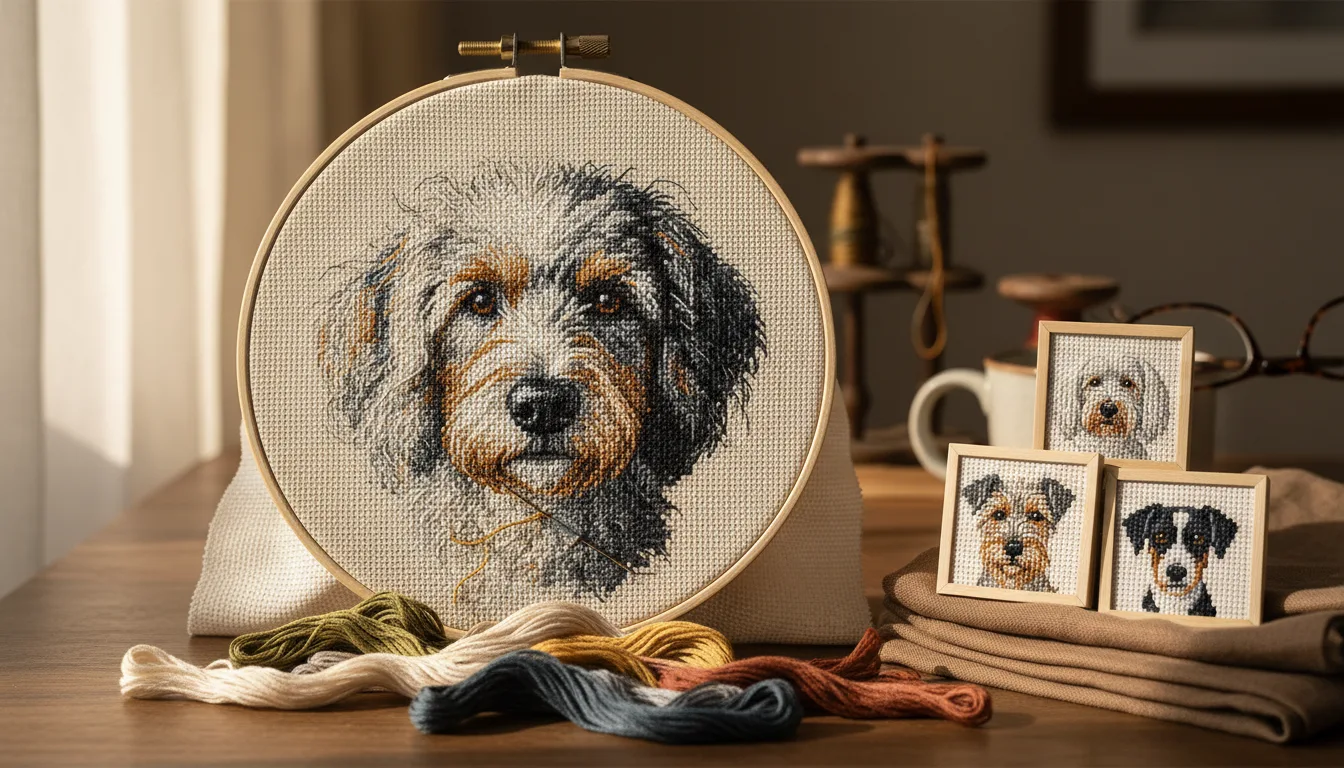 Guides
Dog Cross Stitch Pattern From a Photo: Coat by Coat
Make a custom dog cross stitch pattern from your photo: what smooth, long, curly, wiry, merle, black and white coats each need in colors, size and light.
Read · 12 min