Guides
Quick Cross Stitch Gifts You Can Finish in a Weekend
Small cross stitch gifts that fit a weekend: a card, an ornament, a bookmark, a tote. The stitch budget for your pace and the chart size that fits it.

By Antoine Duno
Updated November 9, 20268 min read
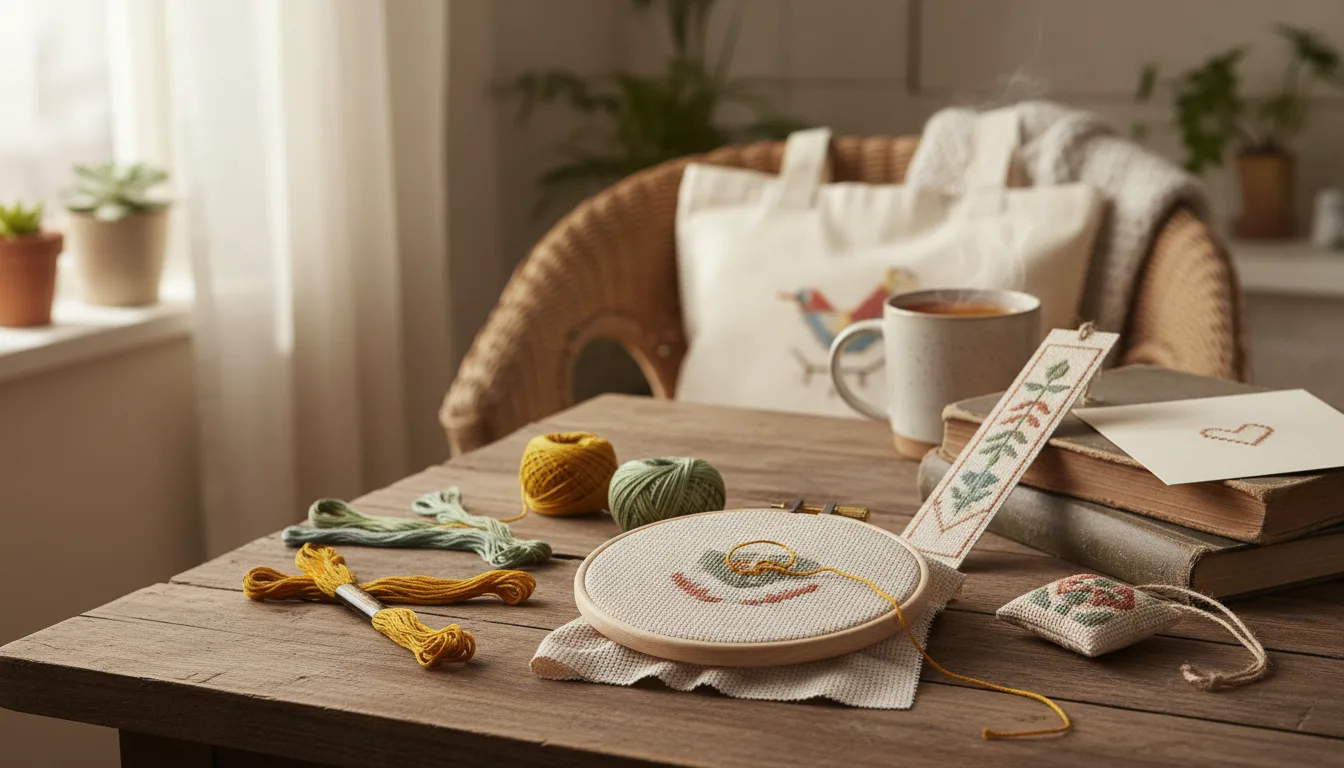
You missed the date for the big piece. Or you just found out about the birthday. Either way, there's a weekend, and the question is what you can honestly stitch and finish in it.
The answer comes from one sum, not a list of ideas: the hours you'll really stitch times your own pace. That gives a stitch budget, and the budget tells you which gifts fit.
Your weekend stitch budget
Nobody can tell you how fast you stitch, so measure it. Stitch one 10 × 10 block, 100 stitches, from a chart like the one you're planning, with a timer running. If it takes 20 minutes, you stitch 300 an hour; if 40 minutes, 150. How long cross stitch takes covers the method in more detail.
Then count hours honestly. A weekend is not 48 hours of stitching; it has meals, sleep, errands, and the finishing still to do.
| Stitching hours | Budget at 150/hr | Largest square | Budget at 300/hr | Largest square |
|---|---|---|---|---|
| 6 | 900 | 30 × 30 | 1,800 | 42 × 42 |
| 10 | 1,500 | 38 × 38 | 3,000 | 54 × 54 |
| 16 | 2,400 | 48 × 48 | 4,800 | 69 × 69 |
These rates are examples for the arithmetic, not claims about how fast people stitch. Put your own in. The largest square is the square root of the budget, rounded down; a rectangle works as long as width × height stays inside it.
Two things change the budget more than pace. Unstitched squares are free: a chart where a third of the area is bare fabric costs only the other two thirds. And color changes are slow: a chart with many colors and scattered single stitches runs slower than the block you timed if your block was simple.
Five gifts that fit
Sizes below are finished size on 14-count Aida, which is stitches ÷ 14, because DMC defines count as the number of stitches you can make in an inch.
| Gift | Example chart | Stitches if fully stitched | Finished on 14-count | Finishing |
|---|---|---|---|---|
| Aperture card | 30 × 40 | 1,200 | 2.1 × 2.9 in | Card, wadding, tape |
| Small hoop or ornament | 40 × 40 | 1,600 | 2.9 × 2.9 in | Hoop, or an ornament finish |
| Bookmark motif on Aida band | 20 × 70 | 1,400 | Depends on the band | Finish the two ends |
| Initial or motif on a tote | 30 × 30 | 900 | 2.1 × 2.1 in | Waste canvas pulled out |
| Tight photo crop of one face | 40 × 50 | 2,000 | 2.9 × 3.6 in | Hoop or card |
1. A card
A stitched card needs no frame and no framer. The Cross Stitch Guild's card method uses a three-fold card with an aperture: trim the fabric to the size of the card, put thin polyester wadding the size of the aperture behind the stitching, and hold it in place with a thin coat of adhesive or double-sided tape inside the aperture, then fold the flap over. The Guild suggests pressing under books if the card buckles as it dries.
Be honest with yourself about what a card is. Adhesive touching the fabric isn't a conservation finish; the framing guide explains why glue and tape are kept away from anything meant to last. For a thank-you or a birthday, that's fine.
2. A small hoop or ornament
A hoop is a frame you finish at home. Stitch, trim the fabric behind, back it, and it's ready to hang. Cross stitch hoop finishing covers backing it neatly. For the tree, a photo Christmas ornament goes through which photos survive at ornament size.
3. A bookmark on Aida band
Aida band is stitching fabric sold as a narrow strip, so the width is decided for you and there's no large piece to mount. Zweigart's bands come in several widths; for example, its 7107 band is 50 mm wide with 26 stitches and its 7008 band is 80 mm wide with 42 stitches. Chart a few stitches narrower than the band so the design doesn't touch the edge. The width is tiny, so the design must be simple. A photo cross stitch bookmark works through sizing a narrow chart.
4. An initial on a tote or a shirt, with waste canvas
Waste canvas lets you cross stitch on fabric with no countable grid. Zweigart's instructions: cut the canvas 8 to 10 cm larger than the design, baste it onto the bag or garment, stitch through both layers, then moisten the work with lukewarm water and pull the canvas threads out one by one, with tweezers for example. Waste canvas cross stitch on clothes and totes covers it in detail. Leave time for the thread-pulling, which is part of the job, not an afterthought. A letter is quickest charted by hand on graph paper, one square per stitch; our generator charts photos and doesn't add lettering.
5. A tight crop from a photo
A detailed portrait doesn't fit a weekend. A tight crop of one face sometimes does. Crop until the head fills the frame, use a photo with a plain background and good light, and keep the chart small. The honest limit: at around 40 stitches across, a face is a few stitches per feature. Simple, high-contrast subjects survive; a group photo or a dim picture won't. Check the eyes in the preview, and if they're a smudge, choose a card or an initial instead.
Keep the weekend clear
Buy supplies before Saturday. Every color in the key needs at least one skein, and a small chart with twelve colors is still twelve skeins to find. On a short deadline, fewer colors is also less shopping. In the generator, turn the color count down and check the preview still reads.
Cut the fabric generously. DMC recommends at least 8 cm / 3 inches of clear fabric around the design if you plan to frame it. For a hoop or a card you'll trim it anyway, but you need enough to hold in a hoop while you stitch.
Decide whether to wash. DMC says many needlework projects never need to be washed. If yours does, its method is cold water with a little non-biological detergent, rolling between towels, air drying until damp, then pressing face down between towels with a warm iron. That's a Saturday-evening job, not a Sunday-at-five one.
If it's traveling, work back from the send-by date, not the occasion. Carriers publish holiday send-by dates each season; use the one for the service you'll actually use.
If the weekend isn't enough
Sometimes the honest answer is that the gift you want doesn't fit. Two alternatives work well:
- Give the chart and the started piece, with a note about when it will be finished. The Christmas gift timeline suggests exactly this for a late start.
- Give a small piece now and the big one later. A card or ornament of the same pet or place, with the full portrait for a birthday. Cross stitch gifts from photos shows how to work out a start date for the larger piece.
What rarely works is planning to stitch faster on Sunday night. Rushed tension shows, and finishing takes longer than it looks.
Frequently asked questions
What cross stitch gift can I finish in a weekend?
Something whose stitch count fits the hours you really have. As arithmetic, 10 hours at 150 stitches an hour is 1,500 stitches, about a 38 by 38 chart. That suits a card, a small hoop or ornament, a bookmark motif or an initial on a tote, not a detailed portrait.
How many stitches can I do in a weekend?
Multiply the hours you'll actually stitch by your own stitches per hour. Find that rate by timing one 10 by 10 block from a similar chart. As arithmetic, 6 hours at 300 stitches an hour is 1,800 stitches; 16 hours at 150 an hour is 2,400. Plan to the lower figure.
Can a photo cross stitch be a quick gift?
Yes, if the chart is small and the photo is simple. A tight crop of one face in good light, against a plain background, can still read at around 40 stitches across. A group, a busy scene or a low-contrast photo won't. Check the eyes in the preview before committing.
What is the fastest way to finish a small cross stitch?
Leave it in a hoop or mount it in a card. Neither needs a framer. The Cross Stitch Guild's card method uses a three-fold aperture card, thin wadding and adhesive or double-sided tape. Glue isn't a conservation finish, so choose a frame for a piece meant to last generations.
Do I need to wash a quick cross stitch gift?
Not always. DMC says many needlework projects never need to be washed. If you do wash it, DMC's method ends with air drying until damp and pressing face down between towels, so leave time for drying rather than planning it for the last hour.
Sources
- The Cross Stitch Guild — Making your own cards (three-fold aperture card, thin polyester wadding, adhesive or double-sided tape)
- Zweigart — Das 1x1 des Stickens (waste canvas: cut 8–10 cm larger, baste, stitch through, moisten and pull threads out)
- Zweigart — Aida-Kreuzstichband 7107 (50 mm, 26 stitches)
- Zweigart — Aida-Kreuzstichband 7008 (80 mm, 42 stitches)
- DMC — How to clean and wash finished needlework (many projects never need washing; cold wash, dry until damp, press face down)
- DMC — What fabric should I use? (count is the number of stitches you can make in an inch)
- DMC — How to prepare your fabric (at least 8 cm / 3 inches of border for framing)
Keep stitching
 Guides
Cross Stitch Gifts From Photos: Ideas and Start Dates
Photo cross stitch gift ideas by occasion, with the arithmetic to work out when to start: chart size, your stitching pace, hours a week and finishing time.
Read · 15 min Guides
Christmas Cross Stitch Gift: When to Start by Size
When to start a Christmas cross stitch gift, by chart size: start-by dates worked back from December 25, 2026, and the largest chart you can still finish.
Read · 7 min Guides
Baby Birth Sampler Cross Stitch: Name, Date, Photo
Plan a birth sampler around a photo: what to include, how many rows lettering takes, charting the name by hand, and what to stitch before the birth.
Read · 11 min Guides
Personalized Christmas Stocking Cross Stitch: Names
Cross stitch a name and a small photo motif onto a Christmas stocking: Aida band sizes, waste canvas on a ready-made cuff, letter sizing, start-by plan.
Read · 10 min Guides
Photo Christmas Ornament Cross Stitch: Small Charts
Turn a pet or baby photo into a cross stitch Christmas ornament: chart sizes that still read, finished size by fabric count, lettering, sparkle and timing.
Read · 11 min Guides
Wedding Cross Stitch From a Photo: Names and Date
Plan a wedding cross stitch from a photo: choosing and sizing the couple photo, a white dress on white fabric, names and date lettering, and when to start.
Read · 11 min